 HYGO News
 KJP opposite: 'People Are Seeing Their Wages Go Up' As Real Wages Fall At Fastest In 40 Years
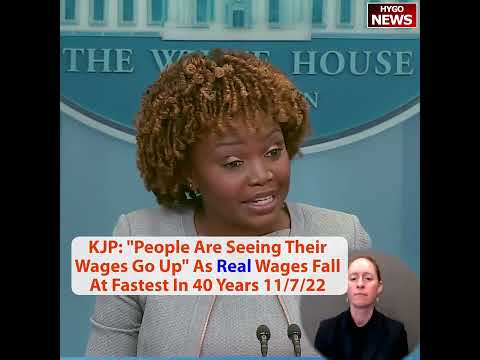
KJP Claims “People Are Seeing Their Wages Go Up” — While Real Wages Were Falling at the Fastest Rate in 40 Years
On 11/7/2022, the day before the midterm elections, White House Press Secretary Karine Jean-Pierre claimed “it’s good that people are seeing their wages go up” while Bureau of Labor Statistics data showed real wages — wages adjusted for inflation — had been declining for 18 consecutive months, the longest sustained drop in purchasing power in four decades. A reporter had asked whether Biden’s statement about not accepting “that the problem is that too many Americans are finding good jobs” was directed at the Federal Reserve, which was raising interest rates specifically to cool the labor market. KJP denied the Fed connection and praised the 261,000 jobs created — conflating nominal wage growth with actual purchasing power.
”Not Directed at the Federal Reserve”
The reporter’s question identified a tension between Biden’s rhetoric and the Fed’s policy. “On Friday, the president in his statement on the jobs report said, ‘We’re going to do what it takes to bring inflation down, but as long as I’m president, I’m not going to accept an argument that the problem is that too many Americans are finding good jobs,’” the reporter said. “Was that statement directed at the Federal Reserve, which anticipates unemployment will go up as they raise interest rates?”
The question was important because the Federal Reserve’s inflation-fighting strategy explicitly required the labor market to weaken. Fed Chair Jerome Powell had stated that bringing inflation down would require “below-trend growth” and “some softening of labor market conditions.” The Fed was deliberately trying to reduce the number of job openings, slow hiring, and ultimately increase unemployment — because the tight labor market was contributing to wage-price spirals that fueled inflation.
Biden’s statement — that he wouldn’t accept criticism of strong job growth — appeared to push back against the very medicine the Fed was prescribing. If the problem included “too many Americans finding good jobs” driving wages up and fueling inflation, Biden was rejecting the economic consensus behind the Fed’s approach.
”Absolutely Not”
KJP denied the Fed connection categorically. “Absolutely not. That was not targeted at the Federal Reserve,” KJP said. “He was, you know, I think, speaking to the critics about the number of jobs that were created.”
The denial was politically necessary — the White House couldn’t publicly oppose the Fed’s rate-hiking strategy while claiming to “respect their independence” — but it left Biden’s statement without a clear target. If he wasn’t pushing back against the Fed, who was arguing that “the problem is too many Americans finding good jobs”? Republicans weren’t making that argument. Economists who supported the Fed’s approach were making a version of it. Biden appeared to be arguing against a position that only the Fed held while his press secretary denied the Fed was the target.
”People Are Seeing Their Wages Go Up”
KJP then delivered the claim that defined the clip. “He wanted to say that, hey, look, 261,000 jobs is something that we should be praising. And we should be saying it’s good that people are seeing their wages go up,” KJP said.
The statement was accurate about nominal wages — the dollar amount on workers’ paychecks had indeed increased. Average hourly earnings were rising at approximately 4.7% year-over-year in October 2022.
But it was profoundly misleading about what those wages could buy. Inflation was running at 8.2% year-over-year — nearly double the rate of wage growth. The gap meant workers’ paychecks were growing but their purchasing power was shrinking. Every dollar of wage increase was worth less than a dollar of price increase.
The Bureau of Labor Statistics’ real earnings data told the true story. Real average hourly earnings — wages adjusted for inflation — had declined year-over-year for 18 consecutive months by October 2022. Workers were earning more nominal dollars but could buy fewer goods and services with them. It was the longest sustained decline in real wages since the early 1980s — the last time the U.S. experienced comparable inflation.
Nominal vs. Real: The Critical Distinction
The difference between nominal wages and real wages is fundamental to economic analysis, and KJP’s conflation of the two — whether deliberate or inadvertent — misled the public about workers’ actual economic condition.
Nominal wages: The dollar amount workers receive. In October 2022, average hourly earnings were approximately $32.58, up from approximately $31.13 a year earlier — a 4.7% increase.
Real wages: The purchasing power of those dollars after accounting for inflation. With inflation at 8.2% and wage growth at 4.7%, real wages declined approximately 3.5% — meaning workers could buy 3.5% fewer goods and services despite receiving higher paychecks.
To put it concretely: a worker earning $32.58 per hour in October 2022 had less buying power than a worker earning $31.13 per hour in October 2021, because prices had risen faster than pay. The nominal raise was an illusion — workers were falling behind despite getting raises.
KJP’s claim that “people are seeing their wages go up” told the nominal story while ignoring the real story. It was the equivalent of telling someone their salary increased by $2,000 while omitting that their rent increased by $4,000 — technically true about income, fundamentally misleading about economic wellbeing.
The Jobs Report Paradox
The October 2022 jobs report showed 261,000 jobs created — a number KJP presented as unambiguously positive. “261,000 jobs is something that we should be praising,” KJP said.
But the jobs report created a paradox for the White House. Strong job growth was simultaneously:
Good news for Biden’s “the economy is working” narrative — more jobs meant more employed Americans, lower unemployment, and a growing economy.
Bad news for inflation — strong hiring indicated the labor market remained tight, which meant the Fed’s rate hikes weren’t yet cooling demand enough. More rate hikes would likely follow, bringing higher mortgage rates, more expensive borrowing, and increased recession risk.
The Fed had been explicit: inflation would not come down until the labor market softened. By celebrating the labor market’s continued strength, Biden was inadvertently celebrating the condition that required continued aggressive monetary tightening — the same tightening that was pushing mortgage rates above 7% and threatening recession.
The 18-Month Decline
The 18 consecutive months of declining real wages represented a sustained erosion of American living standards without precedent in the modern economy. Month after month through 2021 and 2022, workers’ paychecks bought less. The decline was not limited to a single sector or demographic — it was broad-based, affecting workers across industries, education levels, and income brackets.
Lower-income workers were hit hardest because they spent the largest share of their income on the categories experiencing the highest inflation — food (up 11.2%), energy (volatile but elevated), and shelter (rising at the fastest rate in decades). A minimum-wage worker who received a raise from $12 to $12.50 per hour gained $20 per week — while spending $30 more per week on groceries alone.
The 18-month real wage decline was the human cost of the inflation crisis that the White House consistently minimized, reframed, or ignored. KJP’s claim that wages were “going up” was the most direct example: she stated the opposite of what BLS data showed about workers’ actual economic condition.
Key Takeaways
- KJP claimed “people are seeing their wages go up” while BLS data showed real wages had declined for 18 consecutive months — the longest drop in 40 years.
- She conflated nominal wage growth (4.7%) with real purchasing power, ignoring that 8.2% inflation wiped out the gains and then some.
- Biden’s statement about not accepting that “the problem is too many Americans finding good jobs” appeared directed at the Fed’s labor market strategy; KJP denied the connection.
- The 261,000 jobs created were simultaneously good news for Biden’s narrative and bad news for inflation — the tight labor market required more Fed tightening.
- Workers earning higher dollar amounts could buy fewer goods and services — a 3.5% decline in real purchasing power despite nominal raises.
Transcript Highlights
The following is transcribed from the video audio (unverified — AI-generated from audio).
- The president said he’s not going to accept an argument that the problem is that too many Americans are finding good jobs. Was that directed at the Federal Reserve?
- Absolutely not. That was not targeted at the Federal Reserve.
- He was speaking to the critics about the number of jobs that were created.
- 261,000 jobs is something that we should be praising.
- It’s good that people are seeing their wages go up.
- We’re going to do what it takes to bring inflation down.
Full transcript: 145 words transcribed via Whisper AI.