 HYGO News
 KJP Once Again Refuses To Comment On Biden's Lack Of Transparency On Classified Docs
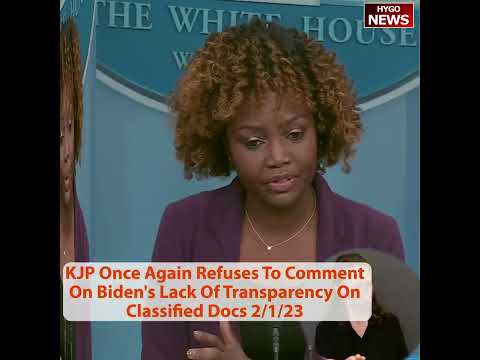
Reporter: How Can White House Claim Transparency When FBI Penn Biden Search “Not Proactively Disclosed”?
In February 2023, a reporter challenged White House Press Secretary Karine Jean-Pierre on transparency claims given belated disclosure of FBI search. “On documents, Ian addressed the version of this at the sticks a little bit ago, but I’m wondering how the White House can claim that they are being transparent when the FBI search of the Penn Center, Penn Biden Center, that happened months ago, was not proactively disclosed to the public, and what should the public take away from the fact that you are keeping information like this from the public?” the reporter asked. KJP deflected: “Look, I’m going to be very prudent from here. Anything that is specific to this particular process, I would refer you to the Department of Justice, and also, again, my colleagues at the White House Counsel’s Office.”
The Transparency Challenge
Challenge:
Transparency claimed — By WH.
Non-disclosure — Fact.
Contradiction — Highlighted.
Accountability — Demanded.
Credibility — At stake.
The reporter’s challenge was substantive. Administration claimed transparency while withholding information. The contradiction required explanation. Credibility was at stake.
The Penn Biden Center Search
Penn Biden search:
FBI search — Occurred.
Months earlier — Timeline.
Not publicly disclosed — Initially.
Eventually revealed — Yes.
Timing — Controversial.
The FBI search of Penn Biden Center had occurred months before public disclosure. Only came to light through reporting. Administration hadn’t proactively disclosed. This was documented timeline issue.
”That Happened Months Ago”
Months ago framing:
Specific timing — Back in time.
Public unaware — Throughout.
Accumulating — Days.
Opportunity — To disclose.
Not taken — Critique.
The “months ago” framing emphasized how long administration had withheld information about search. Opportunity to disclose existed throughout. Not taken was significant critique.
”Not Proactively Disclosed”
Disclosure characterization:
Not proactive — Passive.
Reactive only — When forced.
Transparency claim — Undermined.
Political motivation — Implied.
Administration failure — Alleged.
The “not proactively disclosed” framing was important. Eventual disclosure had been reactive, not proactive. This undermined transparency claims substantively.
”Keeping Information Like This From the Public”
Direct charge:
Information keeping — Alleged.
Public target — Of withholding.
Administrative action — Characterized.
Transparency failure — Direct.
Accountability — Demanded.
The direct charge that administration was “keeping information from the public” was serious. Whether framed as withholding or simply not proactively disclosing, the effect was the same.
”What Should the Public Take Away”
Public interest framing:
Public — Audience.
Takeaway — Lesson.
Administration actions — Subject.
Reasonable question — Posed.
Engagement required — If possible.
The “what should public take away” framing was appropriate journalistic inquiry. Administrative actions had consequences for public understanding. Reasonable question deserving engagement.
”I’m Going to Be Very Prudent From Here”
Prudence framing:
“Prudent” — Virtue claim.
Framing choice — Deflection.
Self-characterization — Favorable.
Pattern — Maintained.
Template — Deployed.
Characterizing deflection as “prudence” was virtue framing for administrative choice. Self-characterization was favorable to administration even while refusing to engage with substance.
”Anything Specific to This Particular Process”
Scope framing:
Specific — To process.
Broad application — In practice.
DOJ deflection — Coming.
Counsel deflection — Also.
Dual referral — Standard.
The “specific to this particular process” framing was broad in application. Almost any question could be called “specific to the process” and thus deflected.
”I Would Refer You to the Department of Justice”
DOJ referral:
Standard deflection — Pattern.
DOJ not briefing — Press.
Dead end — Effectively.
Routine response — Template.
No engagement — With substance.
The DOJ referral was standard template. DOJ didn’t brief press on specific matters. This was essentially dead-end referral that prevented substantive engagement.
”Also, Again, My Colleagues at the White House Counsel’s Office”
Dual deflection:
Counsel also — Named.
“Again” — Pattern acknowledgment.
Double referral — Comprehensive.
Engagement prevented — Through.
Standard framework — Deployed.
The dual referral to both DOJ and Counsel was comprehensive deflection. Between them, any classified documents question could be directed elsewhere. No engagement from podium.
The Transparency vs. Deflection Paradox
Paradox:
Claim transparency — While deflecting.
Logical tension — Clear.
Contradiction apparent — Obviously.
Reporter highlighted — Effectively.
No resolution — Offered.
The contradiction between claiming transparency and deflecting substantive questions was apparent. Reporter highlighted it effectively. No resolution was offered. Tension remained unresolved.
The Ian Sams Reference
Sams reference:
Earlier briefing — Outside.
At “sticks” — Informal.
Same topic — Addressed.
Satisfaction — Limited.
KJP asked — For more.
The reference to Sams having addressed topic at “sticks” (informal briefing) indicated reporter had tried that channel. Unsatisfied, asked KJP. Neither venue providing substance.
The Strategic Disclosure Calculation
Calculation:
Benefits — Of withholding.
Costs — Of disclosing.
Political timing — Factor.
Legal constraints — Claimed.
Strategic choice — Made.
Administration had made strategic calculations about timing of disclosures. Benefits of withholding (political timing) weighed against costs of disclosing. Strategic choices had been made with political dimensions.
The Administrative Strategy
Strategy:
Control narrative — Through timing.
Disclose minimum — Required.
Legal framework — Claimed.
Political interest — Served.
Credibility cost — Accepted.
The administrative strategy controlled narrative through selective disclosure timing. Minimum disclosure required. Legal framework claimed as justification. Political interests served. Credibility cost accepted.
The Political vs. Legal Distinction
Distinction:
Legal requirements — Some real.
Political strategy — Also factor.
Timing decisions — Mixed motives.
Accountability — For both.
Framing confuses — Often.
The distinction between legal requirements and political strategy was often blurred. Timing decisions had mixed motives. Both deserved accountability. Framing confusion often protected political strategy as legal requirement.
The Pattern Documentation
Pattern:
Weeks of deflection — Continuing.
Multiple exchanges — Similar.
Media documentation — Ongoing.
Cumulative effect — Building.
Administrative discipline — Evident.
The deflection pattern had continued for weeks. Multiple similar exchanges. Media was documenting the pattern. Cumulative effect was building. Administrative message discipline was evident throughout.
The Reporter’s Framing Effectiveness
Effectiveness:
Specific facts — Cited.
Logical challenge — Made.
Professional tone — Maintained.
Substantive question — Posed.
Accountability pressure — Applied.
The reporter’s framing was effective journalism. Specific facts cited. Logical challenge. Professional tone. Substantive question. Appropriate accountability pressure applied.
The Administrative Response Weakness
Weakness:
Generic template — Used.
Specific question — Not addressed.
Contradiction — Not resolved.
Public question — Unanswered.
Pattern protecting — Continues.
The administrative response was weak in substantive terms. Generic template used. Specific question not addressed. Central contradiction not resolved. Public interest question unanswered. Pattern protection continued.
The Disclosure Standards
Standards:
Proactive disclosure — Norm.
Reactive disclosure — Lower standard.
Transparency culture — Expected.
Administrative defensiveness — Counter.
Norm erosion — Possible.
The standards around proactive versus reactive disclosure mattered. Proactive disclosure was norm for democratic governance. Reactive disclosure represented lower standard. Norm erosion was possible if pattern continued.
The Historical Context
History:
Previous administrations — Vary.
Scandals handling — Instructive.
Trump documents — Recent parallel.
Transparency practices — Evolving.
Norms — Contested.
Historical context showed varying administration approaches to scandal disclosure. Previous scandals offered instructive parallels. Trump documents case had contemporary relevance. Transparency practices had been evolving. Norms were contested.
The Media’s Role
Media role:
Documenting pattern — Essential.
Accountability pressure — Through coverage.
Public service — Mission.
Administrative response — Influenced.
Eventually matters — Political.
The media’s role in documenting deflection pattern was essential for accountability. Coverage pressure influenced administrative response over time. Eventual political consequences could reflect accumulated coverage.
The Democratic Norm Implications
Norms:
Transparency — Democratic value.
Accountability — Expected.
Information flow — Essential.
Deflection patterns — Problematic.
Long-term damage — Possible.
The democratic norm implications of administrative pattern were concerning. Transparency was core democratic value. Accountability was expected function. Information flow was essential. Deflection patterns could cause long-term damage.
The Penn Biden Center Context
Penn Biden Center:
Biden’s post-VP office — At university.
Some documents found — Initially.
FBI search occurred — Eventually.
Timeline details — Important.
Context matters — For understanding.
The Penn Biden Center had been Biden’s post-Vice Presidency office at University of Pennsylvania. Initial document discovery had occurred there. FBI search followed. Specific timeline mattered for understanding.
The Discovery Timeline Importance
Timeline importance:
Events sequence — Key.
Disclosure choices — Political.
Investigation decisions — Legal.
Public information — Delayed.
Accountability — Through timeline.
The specific discovery timeline was key to understanding administrative choices. Sequence of events showed when decisions were made. Disclosure choices had political dimensions. Investigation decisions had legal ones. Public information was delayed.
The Comparison Question
Comparison:
Trump search — Public immediately.
Biden search — Delayed.
Different treatment — Noted.
Standards varied — Apparently.
Political implications — Clear.
The comparison between Trump documents search (publicly known quickly) and Biden documents search (delayed disclosure) highlighted different treatment. Whatever the legal reasons, optics mattered politically.
The Democratic Coalition Strain
Coalition strain:
Transparency advocates — Uncomfortable.
Defense of administration — Difficult.
Norm violations — Problematic.
2024 implications — Real.
Various discomfort — Within coalition.
Democratic coalition included transparency advocates who had defended such values against Trump. Defending current administration’s non-transparency was difficult. Norm violations were problematic. 2024 implications real.
The 2024 Implications
2024:
Campaign vulnerability — Growing.
Transparency narrative — Available.
GOP material — Accumulating.
Voter impression — Shaping.
Electoral cost — Possible.
The 2024 implications of administrative deflection pattern were real. Transparency narrative was available for opponents. GOP campaign material accumulating. Voter impressions shaping. Electoral costs possible.
The Hur Investigation Anticipation
Hur:
Investigation ongoing — By Special Counsel.
Report eventual — Expected.
Findings unknown — Then.
Timeline addressed — Likely.
Political consequences — Possible.
Special Counsel Hur’s investigation was ongoing. Eventual report would likely address timeline and disclosure issues. Political consequences of findings unknown but possible.
The Hur Report Impact
Report impact:
February 2024 — Eventually released.
Memory issues — Central.
Timeline details — Included.
Controversy — Generated.
Political effects — Major.
The eventual Hur report in February 2024 had major impact. Memory characterization of Biden generated controversy. Timeline details documented. Political effects were substantial.
The Administrative Response to Hur
Response:
Strong pushback — On memory characterization.
Acceptance — Of no charges.
Mixed outcome — Essentially.
Political damage — Real.
Campaign effect — Significant.
When Hur report came out, administrative response was strong pushback on memory characterization while accepting no-charges conclusion. Mixed outcome with real political damage affecting 2024 campaign.
The Accountability Delay
Delay:
Questions asked — Weekly.
Answers delayed — Or refused.
Eventually — Some information.
Timeline — Long.
Patience required — Of press.
The accountability was delayed through administrative pattern. Questions were asked weekly. Answers delayed or refused. Eventually some information emerged. Timeline was long. Patience required of press corps.
The Institutional Implications
Institutional:
Press briefings — Function reduced.
Accountability mechanism — Weakened.
Future precedent — Set.
Democratic erosion — Possible.
Long-term concern — Real.
The institutional implications of administrative pattern were concerning. Press briefing function reduced. Accountability mechanism weakened. Future precedent set. Democratic erosion possible over time.
The Biden Campaign Strategy
Campaign:
Minimize exposure — Strategic.
Control message — Through timing.
Avoid difficult topics — In public.
2024 positioning — Built around.
Risk managed — Carefully.
The Biden campaign strategy was to minimize direct exposure on difficult topics. Control message through timing. Avoid difficult questions in public. 2024 positioning built around careful risk management.
The Limits of Strategy
Strategy limits:
Time pressure — Real.
Events force — Eventually.
Media pressure — Building.
Electoral — Requires engagement.
Inevitable — Eventual exposure.
The strategy of minimizing exposure had real limits. Time pressure real as election approached. Events would force engagement eventually. Media pressure building. Electoral demands would require more engagement. Inevitable eventual exposure.
The Reactive Pattern
Pattern:
Reactive communications — Generally.
Control attempts — Ongoing.
Crisis management — Mode.
Proactive rare — In contrast.
Character — Of administration.
The administration’s communications pattern was largely reactive. Control attempts ongoing. Crisis management mode. Proactive engagement was rare. This seemed to be character trait of administration.
The Biden Personal Style
Personal style:
Limited press — Engagement.
Low interview count — Historically.
Formal speeches — More.
Q&A sessions — Fewer.
Pattern — Deliberate.
Biden’s personal style had involved limited press engagement historically. Lower interview counts than predecessors. More formal speeches than Q&A sessions. Pattern was deliberate administrative choice.
The Administrative Discipline
Discipline:
Message control — Tight.
Deflection uniform — Across topics.
Staff coordination — Professional.
Adjustment limited — Even to criticism.
Maintained — Despite cost.
The administrative discipline was tight. Uniform deflection across topics. Professional staff coordination. Limited adjustment even to criticism. Pattern maintained despite political costs.
The Transparency Irony
Irony:
Biden ran — On transparency.
Trump criticism — Of opacity.
Current practice — Similar.
Hypocrisy charges — Valid.
Narrative damage — Real.
The transparency irony was real. Biden had run on transparency contrasting with Trump’s opacity. Current administrative practice looked similar. Hypocrisy charges had validity. Narrative damage real.
The Media Coverage Arc
Coverage:
Initially — Sympathetic.
Increasingly — Critical.
Patterns documented — Repeatedly.
Coverage tone — Shifting.
Pressure building — Through coverage.
Media coverage arc had been shifting. Initially sympathetic. Increasingly critical. Patterns documented repeatedly. Coverage tone shifting from reporting to criticism of administrative approach.
The Substantive Democracy Costs
Costs:
Information gap — Growing.
Voter knowledge — Limited.
Democratic participation — Affected.
Informed electorate — Challenged.
Serious cost — Real.
The substantive democracy costs of administrative pattern were real. Information gap growing. Voter knowledge about administrative practices limited. Democratic participation affected by limited information flow. Informed electorate was challenged.
The Press Secretary Challenge
Challenge:
Defend administration — Job.
Engage press — Also.
Balance difficult — Often.
Strategy constrained — Choices.
Individual agency — Limited.
The press secretary role had fundamental challenges. Defending administration was job. Engaging press was also. Balance was difficult. Strategic constraints limited choices. Individual agency was limited within administration’s approach.
Key Takeaways
- A reporter challenged KJP on transparency claims given belated disclosure of FBI Penn Biden Center search.
- Challenge framed directly: “How the White House can claim that they are being transparent when the FBI search of the Penn Center, Penn Biden Center, that happened months ago, was not proactively disclosed to the public.”
- Public interest framing: “What should the public take away from the fact that you are keeping information like this from the public?”
- KJP deflected: “Look, I’m going to be very prudent from here.”
- Dual referral pattern maintained: “I would refer you to the Department of Justice, and also, again, my colleagues at the White House Counsel’s Office.”
- The fundamental contradiction between claiming transparency while deflecting substantive questions went unresolved.
Transcript Highlights
The following is transcribed from the video audio (unverified — AI-generated from audio).
- On documents, Ian addressed the version of this at the sticks a little bit ago.
- How the White House can claim that they are being transparent when the FBI search of the Penn Center, Penn Biden Center, that happened months ago, was not proactively disclosed to the public?
- What should the public take away from the fact that you are keeping information like this from the public?
- Look, I’m going to be very prudent from here.
- Anything that is specific to this particular process, I would refer you to the Department of Justice.
- And also, again, my colleagues at the White House Counsel’s Office.
Full transcript: 109 words transcribed via Whisper AI.