 HYGO News
 KJP Attacks 'Irresponsible Reporting' on White House Cocaine, Falsely Claims Bidens Were Not There Friday
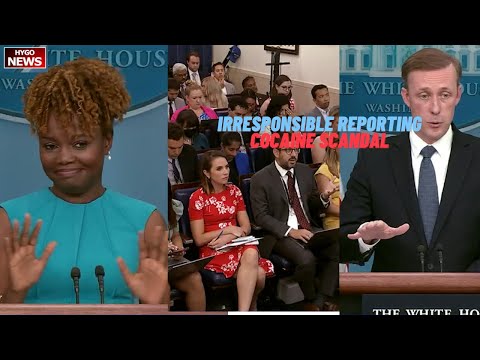
KJP Attacks “Irresponsible Reporting” on White House Cocaine, Falsely Claims Bidens Were Not There Friday
On July 7, 2023, White House Press Secretary Karine Jean-Pierre lashed out at reporters asking about cocaine found inside the White House, calling the questions “incredibly irresponsible” and insisting the Biden family was not present at the residence when the substance was discovered. A pool report, however, placed Hunter Biden at the White House on the Friday in question. In the same briefing, National Security Adviser Jake Sullivan deflected cocaine questions to the Secret Service, and KJP gave a muddled answer on affirmative action and legacy admissions.
KJP Explodes at New York Post Reporter
The White House had spent the previous two days refusing to deny that the cocaine discovered inside the building belonged to a member of the Biden family. This prompted the New York Post’s Caitlin Doornbos to ask the obvious follow-up question: “Can you just say once and for all whether or not the cocaine belonged to the Biden family?”
Jean-Pierre’s response was combative: “So… we’ve answered this… for the last 2 days… There has been some irresponsible reporting… To ask that question is actually incredibly irresponsible.”
Rather than answering the question, KJP attacked the reporter for asking it. The characterization of a straightforward question as “irresponsible” was notable given that the White House had, in fact, not answered the question — it had spent two days declining to deny a connection between the cocaine and the Biden family.
The False Timeline Claim
Jean-Pierre then attempted to establish an alibi for the Biden family by listing the days they were allegedly absent from the White House.
“The Biden family was not here! They were not here! They were at Camp David. They were not here Friday. They were not here Saturday. They were not here Sunday. They were not even here Monday!” KJP said, her voice rising with each repetition.
The emphatic denial was contradicted by the White House’s own press pool reports. According to a pool report from that Friday, “Poolers saw Jill Biden, Baby Beau, and Hunter Biden climb into presidential SUV. President Biden followed a few minutes later. Motorcade rolling to Fort McNair as of 6:34 pm.”
The pool report placed not only President Biden but also Jill Biden and Hunter Biden at the White House on the Friday that KJP insisted the family “was not here.” The presence of Hunter Biden was particularly relevant given his well-documented history of substance abuse, which he had written about in his own memoir. KJP’s false claim that the family was not at the White House on Friday was directly disprovable by the White House press pool’s own contemporaneous records.
Jake Sullivan Deflects on Cocaine and the Situation Room
National Security Adviser Jake Sullivan was also pressed on the cocaine discovery during the same briefing, particularly regarding national security implications of an illegal substance being found near the White House Situation Room.
A reporter asked: “Five days after cocaine was found here in the White House, congressional Republicans seem like they’re very close to launching some sort of formal investigation. I’m curious, from a national security perspective: A, what was your reaction when the drugs were found? And, B, was there any risk to security either to the President, to your staff, anybody that would work out of the Sit Room for this stuff to be so close to where you work?”
Sullivan’s response was a study in bureaucratic deflection. “First, I would refer to the Secret Service when it comes to questions of the security of the President. I won’t speak to that,” he said.
Sullivan then attempted to distance the cocaine from the Situation Room: “The Situation Room is not in use and has not been in use for months because it is currently under construction. We are using an alternate Situation Room in the Eisenhower Executive Office Building. So the only people coming in and going out of the Sit Room in this period have been workers who are getting it ready to go.”
When the reporter tried to follow up, Sullivan cut them off: “But no, there was no issue with the Situation Room relative to this. And then, finally, look, we have rigorous drug testing policies at the White House. We have rigorous drug use policies here at the White House.”
The invocation of “rigorous drug testing policies” raised more questions than it answered. If the White House had rigorous drug testing, how did cocaine end up inside the building? And if the testing was effective, it should have been straightforward to identify whose cocaine it was — unless the administration did not want to find out.
KJP’s Muddled Affirmative Action Response
In a separate exchange during the same briefing, a reporter asked whether Biden supported banning legacy admissions preferences in light of the Supreme Court’s recent decision striking down affirmative action in Students for Fair Admissions v. Harvard.
“Given the U.S. Supreme Court’s decision last week on affirmative action, I’m interested if the President has a stance on whether Congress should take action to ban legacy preferences in higher education admissions,” the reporter asked.
KJP’s response wandered far from the question: “I don’t have anything further to add on the President’s position on what you just laid out… when you think about affirmative action, it had been a constitutional kind — kind of constitutional right for decades and had been held up by Republicans and Democrats. And so it was another kind of — another act by the Supreme Court that was unprecedented.”
The characterization of affirmative action as a “constitutional right” was legally inaccurate. Affirmative action had been permitted under certain circumstances by Supreme Court precedent, but it was never established as a constitutional right. The distinction mattered: a constitutional right is something the government must protect, while a permitted practice is something the government may allow. KJP’s framing misrepresented the legal status of the policy the administration was defending.
She then pivoted to judicial nominations: “One of the things that the President has taken very seriously is to make sure that we have federal judges that are diverse, that represent the country. We have been able to not just nominate but get through about 136 judges, again, who are diverse.”
The pivot from the reporter’s specific question about legacy admissions to a talking point about judicial diversity illustrated KJP’s approach throughout the briefing: avoid the substance of difficult questions by redirecting to pre-prepared messages on adjacent topics.
Key Takeaways
- KJP called it “incredibly irresponsible” for reporters to ask whether the cocaine found at the White House belonged to the Biden family, after two days of refusing to deny the connection.
- KJP falsely claimed the Biden family was “not here” on Friday, directly contradicted by a pool report placing Jill Biden, Hunter Biden, and President Biden at the White House that same day.
- Jake Sullivan deflected cocaine questions to the Secret Service and claimed the Situation Room was under construction, while citing “rigorous drug testing policies” that apparently failed to prevent cocaine from entering the building.
- KJP incorrectly described affirmative action as a “constitutional right” when asked about legacy admissions, then pivoted to an unrelated talking point about judicial diversity nominations.