 HYGO News
 KJP Invents Another New Word: 'I'm Not Gonna Get Into Hypo-Theoreticals...'
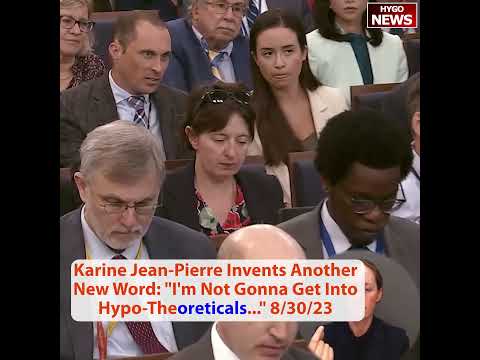
KJP Invents Another New Word: “I’m Not Gonna Get Into Hypo-Theoreticals”
On August 30, 2023, White House Press Secretary Karine Jean-Pierre added another entry to her growing collection of invented words when she told a reporter she was “not going to get into hypo-theoreticals” while dodging a question about government spending negotiations. The reporter had asked whether President Biden would accept a short-term continuing resolution to fund the government through December, a straightforward question about an active legislative debate. Jean-Pierre’s response, which mangled the word “hypotheticals” into the non-word “hypo-theoreticals,” became yet another viral example of the press secretary’s persistent verbal difficulties.
The mispronunciation was minor in isolation, but it added to a pattern that had raised persistent questions about Jean-Pierre’s command of the English language and her ability to serve effectively as the primary public spokesperson for the President of the United States.
The Exchange
A reporter raised a timely question about the approaching government funding deadline: “A couple of follow-ups on the spending questions that you got. Lawmakers are already, sort of, talking about a proposal that perhaps would be a CR in the December, kind of a shorter-term deal. Is that acceptable to the President? Would he be okay with that?”
The question was specific and grounded in real-time legislative developments. Congress was facing an approaching deadline to pass appropriations bills or face a government shutdown, and discussions about a continuing resolution, a temporary funding measure that maintains government spending at existing levels, were already underway on Capitol Hill.
Jean-Pierre’s response was a brush-off: “That is something — I’m not going to get into hypo-theoreticals. That is something that Congress, Congress should, should kind of decide on.”
The answer accomplished little beyond demonstrating Jean-Pierre’s difficulty with the word “hypotheticals” and her default strategy of declining to engage with substantive questions about legislative negotiations.
The Word “Hypo-Theoreticals”
The word Jean-Pierre was attempting to say was “hypotheticals,” a common English word meaning situations or scenarios that have not yet occurred. It is a word that press secretaries across multiple administrations had used routinely, often deploying the phrase “I’m not going to get into hypotheticals” as a standard way to decline speculative questions.
Instead, Jean-Pierre produced “hypo-theoreticals,” which appeared to be a blend of “hypotheticals” and “theoretical.” Neither the prefix “hypo-” (meaning under or below) combined with “theoreticals” nor any other interpretation of the word produced a meaningful English term. It was simply a mispronunciation that revealed the speaker was not fully processing the word she was attempting to say.
What made the moment noteworthy was that it was not an unfamiliar or technical term. “Hypotheticals” is one of the most common words in the press secretary’s vocabulary, used in virtually every briefing to avoid answering speculative questions. The fact that Jean-Pierre could not pronounce a word she presumably used multiple times per week suggested either a fundamental difficulty with the term or, more likely, a broader pattern of verbal imprecision that manifested across many different words and contexts.
Jean-Pierre’s Growing Collection of Verbal Stumbles
The “hypo-theoreticals” moment was part of an extensive and growing catalog of verbal errors that had come to define Jean-Pierre’s tenure at the podium.
Other notable entries included her pronunciation of “warlord” as “warload” while discussing Prigozhin’s death, her struggles with the names of world leaders and administration officials, her frequent loss of place in briefing materials leading to awkward pauses, and her tendency to repeat phrases and filler words (“look,” “so,” “again”) as verbal placeholders while she searched for her next thought.
The pattern went beyond simple mispronunciation. Jean-Pierre frequently produced grammatically incomplete sentences, started thoughts she could not finish, and delivered answers that, when transcribed, were virtually incomprehensible. Her August 30 answer about “hypo-theoreticals” was a relatively clean example; many of her other responses contained far more tangled syntax and unfinished thoughts.
The issue was particularly striking when compared to her predecessors. Previous White House press secretaries, regardless of party, were generally selected for their verbal facility and ability to handle rapid-fire questioning with precision. Dana Perino, Jay Carney, Josh Earnest, Sarah Sanders, and Jen Psaki all demonstrated a command of language that allowed them to deliver the administration’s message clearly, even when they were being evasive. Jean-Pierre’s verbal struggles represented a noticeable departure from this standard.
The “Hypotheticals” Dodge
Beyond the mispronunciation, Jean-Pierre’s use of the “hypotheticals” dodge in this context was itself questionable. The reporter was not asking about a far-fetched scenario; a continuing resolution through December was an option actively being discussed by congressional leaders. The question was whether Biden would accept such a deal, a matter of presidential policy preference that Jean-Pierre could reasonably have addressed.
Press secretaries commonly use the “hypotheticals” framing to avoid answering questions about scenarios that are genuinely speculative, such as “What would the president do if Country X launched a nuclear weapon?” Using it to avoid addressing a legislative proposal that was already being negotiated in Congress stretched the dodge well beyond its normal application.
The approach reflected the Biden White House’s broader strategy of declining to take positions on legislative specifics whenever possible, a strategy that frustrated reporters seeking to pin down the administration’s stance on evolving policy debates. By calling the question a “hypothetical” when it was actually about an active proposal, Jean-Pierre was able to avoid providing any information about the administration’s negotiating position.
The Government Spending Context
The spending question Jean-Pierre was dodging related to one of the most significant fiscal policy debates of 2023. Congress needed to pass appropriations legislation before the start of the new fiscal year on October 1, 2023, or face a government shutdown.
House Republicans, who had won the majority in the 2022 midterm elections, were pushing for spending cuts and policy riders that the Biden White House and Senate Democrats opposed. The prospect of a continuing resolution, a temporary measure to maintain current spending levels while negotiations continued, was a standard legislative tool used to avoid shutdowns.
The question of whether Biden would accept a CR through December was directly relevant because it would determine the administration’s leverage in the negotiations. If Biden signaled acceptance of a short-term CR, it could reduce urgency for a comprehensive deal. If he rejected it, it could increase the risk of a shutdown but also increase pressure on Congress to reach a broader agreement.
Additional Context
Jean-Pierre’s “hypo-theoreticals” moment occurred during the same August 30 briefing that produced several other notable clips, including her claim that Biden was “stopping the flow at the border” and her refusal to confirm whether Biden would cancel his beach vacation during Hurricane Idalia. The accumulation of multiple embarrassing moments from a single briefing illustrated the daily challenges facing the Biden communications operation.
The government spending debate Jean-Pierre was dodging would indeed result in a series of continuing resolutions and near-shutdowns throughout the fall of 2023, with Congress ultimately passing a short-term CR in September 2023 to avert a shutdown, followed by additional stopgap measures as negotiations continued. The scenario the reporter asked about was not hypothetical at all; it was precisely what happened.
Key Takeaways
- Karine Jean-Pierre mispronounced “hypotheticals” as “hypo-theoreticals” while dodging a question about government spending negotiations on August 30, 2023.
- The reporter asked a specific question about whether Biden would accept a continuing resolution through December, a proposal actively being discussed in Congress, not a hypothetical scenario.
- The mispronunciation added to Jean-Pierre’s growing catalog of verbal errors that included “warload” for “warlord” and numerous other stumbles during her tenure.
- Jean-Pierre used the “hypotheticals” dodge to avoid stating the administration’s position on a live legislative debate, a strategy that frustrated reporters seeking clarity on the White House’s negotiating stance.
- The moment occurred during the same briefing that produced multiple other viral clips, illustrating the persistent communications challenges facing the Biden White House.