 HYGO News
 KJP has no idea now, nor when as Principal Deputy: If Biden Supports/Opposes 9/11-Style Commission?
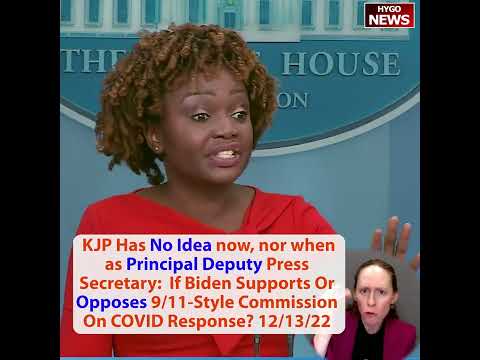
KJP Can’t Say Whether Biden Supports or Opposes 9/11-Style COVID Commission — “I Don’t Know If We’ve Changed Our Position”
On 12/14/2022, a reporter asked White House Press Secretary Karine Jean-Pierre a straightforward question: did President Biden support or oppose legislation to create a 9/11-style commission to investigate the U.S. COVID pandemic response? “Does President Biden support or oppose legislation that is stolen Congress to create a 9-11 style commission to investigate the US response to the COVID pandemic? What is the White House position on this?” the reporter asked. KJP couldn’t answer and deferred to when prior Press Secretary Jen Psaki had addressed the issue: “This has been asked before. I think during Jen’s tenure, I don’t have anything more to add.” When the reporter pressed for the basic support/oppose position, KJP admitted she didn’t know: “I don’t know if we’ve changed our position. I have to go back to see exactly where we are on that particular question.”
The COVID Commission Legislation
The reporter’s question referenced legislation that had been proposed in Congress to create a 9/11-style commission to investigate the COVID-19 pandemic. The concept had several dimensions:
9/11 Commission Analogy — The bipartisan commission that had investigated the 9/11 terrorist attacks.
Comprehensive scope — Examining all aspects of the U.S. COVID response.
Independent investigation — Rather than partisan congressional oversight.
Accountability focus — Who made what decisions and with what effects.
Policy recommendations — For future pandemic response.
The proposed commission would have investigated:
Federal agency decisions — CDC, NIH, FDA actions during the pandemic.
Pandemic preparedness — What plans existed before COVID.
Public health messaging — Including accuracy and effectiveness.
Medical response — Including vaccine development and distribution.
Economic response — Including lockdowns and stimulus.
School closures — Effects on children and educational outcomes.
Mental health impacts — And other secondary effects.
Various proposals for such a commission had been introduced. Some had bipartisan support; others had been more partisan. The specific legislation the reporter referenced wasn’t identified, but any such proposal would require administration engagement if it were to advance.
The Administration’s Interest
The COVID commission had significant political dimensions. The COVID response had been:
Initially Trump’s responsibility — As the pandemic began in his term.
Transitioned to Biden — Who inherited ongoing response.
Contested on many issues — Including school closures, vaccine mandates, masking.
Politically divisive — With partisan interpretations of most decisions.
Subject to ongoing review — As data emerged about various decisions.
A commission’s findings could affect:
Trump’s reputation — If Trump-era decisions were criticized.
Biden’s reputation — If Biden-era decisions were criticized.
Public health infrastructure — If systemic issues were identified.
Scientific institutions — If agencies faced criticism.
Political narratives — As each side interpreted findings.
The Biden administration had political reasons for and against supporting such a commission. Support could:
- Create accountability for Trump-era decisions
- Demonstrate commitment to transparency
- Produce useful recommendations for future preparedness
Opposition could:
- Protect Biden-era decisions from criticism
- Avoid political challenges to public health establishment
- Prevent narratives that could be used by opponents
The Reporter’s Simple Question
The reporter’s question was as simple as possible. “Does President Biden support or oppose legislation that is stolen Congress to create a 9-11 style commission to investigate the US response to the COVID pandemic? What is the White House position on this?” the reporter asked.
“Is stolen Congress” was a transcription error — probably “has been introduced in Congress” or similar. The core question was clear:
Does Biden support the commission legislation? Does Biden oppose the commission legislation? What is the White House position?
This was a yes-or-no question with a clear format. Administration positions on legislation were routine matters that press secretaries should be prepared to address. The question wasn’t obscure, unusual, or unanticipated.
”Asked Before, During Jen’s Tenure”
KJP’s first response deflected to history. “So I think this has been asked before. I think during Jen’s tenure, I don’t have anything more to add or more to look into on this. I would have to go back to the team and see if our position has changed, but nothing new for you,” KJP said.
The “during Jen’s tenure” reference was to Jen Psaki, KJP’s predecessor as Press Secretary. Psaki had held the role from January 2021 to May 2022. KJP had served under Psaki as Principal Deputy before becoming Press Secretary in May 2022.
KJP’s framing had several features:
Claimed prior engagement — The question had been asked before.
Attributed to Psaki era — When KJP was Deputy.
Didn’t remember the answer — Despite presumably hearing it.
Would need to check — Couldn’t address now.
Nothing new — Didn’t update current position.
The framing was problematic. If the question had been asked during Psaki’s tenure, KJP should have known the answer — she had been Principal Deputy at the time. Being in senior White House communications for a question that was asked but having no memory of the answer was notable.
The Principal Deputy Context
KJP’s deflection to “during Jen’s tenure” was particularly awkward because she had been Principal Deputy during that entire period. The Principal Deputy Press Secretary role included:
Senior communications — Full access to administration positions.
Briefing preparation — Working on press briefing topics.
Policy tracking — Following administration positions on legislation.
Internal coordination — With various agencies and offices.
Public engagement — Including giving some briefings.
If the COVID commission question had been asked during Psaki’s tenure, KJP would have been aware of:
The question being asked — As Principal Deputy.
The answer given — As part of briefing preparation.
The administration’s position — On the underlying issue.
Any subsequent developments — As the issue evolved.
For KJP to now not know whether Biden supported or opposed the legislation suggested either:
Memory failure — Not recalling prior discussions.
Information management — Not tracking this topic.
Positional confusion — Unclear what position the administration held.
Deflection technique — Claiming ignorance to avoid engagement.
The Reporter’s Follow-Up
The reporter pressed for the prior position. “What was the position?” the reporter asked.
This was a simple follow-up. If KJP remembered the question had been asked, she might remember the answer. The reporter was testing whether KJP’s claimed historical knowledge included the substance or just the fact of the question.
KJP’s response was more uncertainty. “No, I’m just saying I know that this has come up. I just don’t have anything new to add or to go back and ask and to see where we are on that,” KJP said.
This was a significant escalation of uncertainty. KJP now admitted she didn’t know:
The prior position — From Psaki’s tenure.
The current position — As of the current briefing.
Whether the position had changed — Either direction.
How to find the information — Needing to “go back and ask.”
The cumulative uncertainty was substantial. The administration apparently didn’t have a clear, communicable position on a straightforward legislative question, and the Press Secretary couldn’t even remember what prior administration communications had said.
”Do You Support It or Oppose It?”
The reporter tried again with the simplest possible version. “So whether you… but does the administration support it or oppose it?” the reporter asked.
This was the minimum version of the question. Not asking for reasoning, justification, or detail — just the binary position. Yes or no. Support or oppose.
KJP couldn’t answer. “I just answered your question. I said I know this has come up in the past, but I don’t know if we’ve changed our position. I have to go back to see exactly where we are on that particular question,” KJP said.
The response was notable for the acknowledgment that KJP didn’t know the position. “I have to go back to see exactly where we are” was an admission that current administration positioning on a COVID commission question wasn’t clearly established or communicated.
”I Just Answered Your Question”
KJP’s claim that she had “just answered your question” was notably not true. The reporter’s question had been whether Biden supported or opposed the legislation. KJP’s response had not answered that. She had only said she didn’t know.
The “I just answered your question” framing was a defensive move. It attempted to close discussion by claiming the question had been handled. But the actual exchange showed it hadn’t been. This kind of framing — claiming an answer when no answer had been given — was characteristic of briefing dynamics where press secretaries and reporters disagreed about whether responses were responsive.
The Policy Engagement Gap
The exchange revealed a significant gap in administration policy engagement. A 9/11-style COVID commission was:
A major proposal — With significant implications.
Congressionally active — Requiring administration engagement.
Publicly discussed — Not an obscure matter.
Politically relevant — With partisan dimensions.
Operationally complex — If enacted, requiring administration cooperation.
For the Press Secretary to not know the administration’s position on such a matter suggested:
The issue hadn’t been prioritized — Despite its importance.
Administration coordination was weak — On some policy issues.
Legislative tracking was incomplete — For some proposals.
Press preparation was inadequate — For predictable questions.
Any of these interpretations was troubling. The administration should have had a clear position on a major pandemic-related commission proposal. The Press Secretary should have known that position.
The COVID Investigation Pattern
The broader context was the administration’s general approach to COVID investigations. Several patterns were visible:
Limited enthusiasm for broad investigations — Especially those that might examine Biden-era decisions.
Focus on specific questions — Rather than comprehensive review.
Preference for internal assessments — Over independent commissions.
Sensitivity to criticism of public health institutions — Which had been allied with the administration.
Emphasis on moving forward — Rather than investigating past decisions.
These patterns meant that the administration was likely to have been skeptical of a 9/11-style commission. Such a commission would have been too broad and too independent for administration preferences. But stating this opposition publicly had costs — it would look like hiding from accountability.
The deflection and uncertainty KJP displayed might have been politically motivated rather than truly unknown. Keeping the position opaque avoided both the cost of supporting a broad commission and the cost of publicly opposing one.
The Eventual Position
The administration’s eventual position on various COVID commission proposals generally ranged from:
Public silence — Not taking positions on specific proposals.
Procedural engagement — Working with Congress on what might be feasible.
Support for limited investigations — That focused on specific questions.
Opposition to broad independent commissions — That might examine Biden-era decisions.
Preference for existing processes — Agency assessments and congressional oversight.
No 9/11-style comprehensive commission was ever created for COVID. Various more limited investigations proceeded, with mixed conclusions. The administration’s preference for limited investigation over comprehensive commission substantially affected the process that emerged.
Key Takeaways
- A reporter asked KJP whether Biden supported or opposed legislation to create a 9/11-style commission to investigate the U.S. COVID response.
- KJP deflected to when the question had been asked during Jen Psaki’s tenure, but claimed not to remember the answer.
- Asked what the prior position was, KJP admitted she didn’t know.
- Asked the simpler question of whether the administration supported or opposed, KJP said: “I don’t know if we’ve changed our position.”
- The exchange revealed that the Press Secretary couldn’t identify the administration’s position on a major COVID-related commission proposal — despite having served as Principal Deputy when the question had previously been raised.
Transcript Highlights
The following is transcribed from the video audio (unverified — AI-generated from audio).
- Does President Biden’s support or oppose legislation that is stolen Congress to create a 9-11 style commission to investigate the US response to the COVID pandemic?
- This has been asked before. I think during Jen’s tenure, I don’t have anything more to add.
- I would have to go back to the team and see if our position has changed, but nothing new for you.
- What was the position? — No, I’m just saying I know that this has come up.
- So whether you… but does the administration support it or oppose it?
- I don’t know if we’ve changed our position. I have to go back to see exactly where we are on that particular question.
Full transcript: 173 words transcribed via Whisper AI.