 HYGO News
 KJP Gives Rambling Answer On Banks Getting Bailed Out As 'Average Americans' Get Nothing
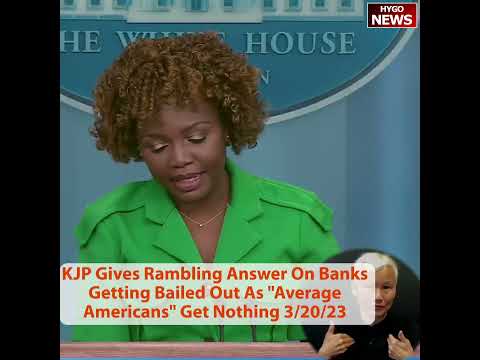
KJP Gives Rambling Answer On Banks Getting Bailed Out As “Average Americans” Get Nothing
White House Press Secretary Karine Jean-Pierre offered a circular, hard-to-parse answer during a March 2023 briefing when asked whether the Biden administration was worried about the political optics of bank bailouts while ordinary Americans received no equivalent support. Jean-Pierre pivoted to Treasury Secretary Janet Yellen’s prior remarks on “not put on the hook” messaging, emphasizing “decisive actions” to restore confidence — but struggled to cleanly rebut the “banks bailout, Americans nothing” framing that had taken hold across the political spectrum.
The Political Optics Question
- Reporter’s framing: The journalist asked directly about the political risk of perceived banks-versus-Americans disparity.
- Public perception: Polls showed broad skepticism about the SVB and Signature interventions.
- Cross-partisan critique: Both progressive Democrats and conservative Republicans criticized the interventions.
- Historical echo: The 2008 TARP bailout memory colored current public reception of banking interventions.
- Messaging stakes: The White House needed to manage perception without reopening institutional confidence concerns.
Jean-Pierre’s Rambling Response
- Yellen reference: The press secretary pointed to Yellen’s prior comments as providing substantive answer.
- “Not on the hook”: She repeatedly used the framing that taxpayers would not be “put on the hook.”
- Decisive actions: Jean-Pierre emphasized the administration’s “decisive actions” multiple times.
- Confidence focus: She framed the goal as maintaining “confidence” in the banking system.
- Incomplete sentences: The transcript captured incomplete phrasing suggesting difficulty with clear messaging.
The “Not on the Hook” Messaging
- Administration position: Officials repeatedly insisted taxpayers would not bear costs of the bank interventions.
- DIF funding: The FDIC’s Deposit Insurance Fund would fund SVB and Signature coverage.
- Bank assessment replenishment: Losses to the DIF would be recovered through special assessments on other banks.
- Technical accuracy: The “not on the hook” framing was technically accurate but missed the systemic point.
- Moral hazard concern: Critics argued the interventions created moral hazard regardless of funding source.
The Systemic Risk Determination
- FDIC authority: The systemic risk exception allowed the FDIC to guarantee all deposits at SVB and Signature.
- Regulatory approvals: Treasury, Federal Reserve, and presidential approval activated the exception.
- Precedent concern: Critics argued invoking the exception established an implicit guarantee for large depositors.
- Cost allocation: Technical funding mechanism shifted costs from failed banks to the broader banking system.
- Deposit flight: The intervention aimed to prevent deposit flight but acknowledged the initial failures had occurred.
The “Average Americans” Complaint
- Direct benefit absence: Average Americans with standard deposits saw no direct benefit from the interventions.
- Mortgage delinquency: Struggling homeowners had not received comparable government backstops during housing stress.
- Student loan contrast: Student loan forgiveness was stalled in court while bank depositors received immediate relief.
- Small business perspective: Small business owners without SVB accounts got no comparable support.
- Rural banking: Community bank customers saw their institutions facing stress without comparable interventions.
The 2008 TARP Echoes
- Financial crisis memory: The 2008 Troubled Asset Relief Program remained politically radioactive.
- Populist resentment: TARP fueled both Tea Party and Occupy movements.
- Institutional scars: The memory of 2008 influenced both policy design and political messaging.
- New framework: Post-2008 Dodd-Frank reforms aimed to prevent need for taxpayer-funded bailouts.
- Credibility testing: The SVB response tested whether new frameworks could prevent institutional panic.
Media Reception
- Mainstream skepticism: Even friendly outlets questioned the administration’s messaging.
- Talk show criticism: Both progressive and conservative talk shows criticized the interventions.
- Expert commentary: Academic economists split on whether interventions were necessary or excessive.
- Political strategist warnings: Democratic strategists privately expressed concern about messaging.
- Correspondent frustration: Press corps frustration with administration non-answers visible in briefing exchanges.
The Broader Banking Stress
- First Republic pressure: First Republic Bank faced severe deposit flight at the time of the briefing.
- Regional bank stress: Regional banks broadly experienced deposit outflows and stock pressure.
- Credit Suisse parallel: The Swiss bank’s emergency UBS takeover added to global banking concerns.
- Fed pivot questions: Markets pressured the Federal Reserve to reconsider planned interest rate increases.
- Contagion concerns: Analysts debated whether broader banking system contagion was contained.
Political Strategy Implications
- Messaging challenge: The administration struggled to articulate a coherent “won’t be on the hook” narrative.
- Economic team visibility: Yellen and Fed Chair Jerome Powell became central public faces of the response.
- Congressional pressure: Both House and Senate committees held hearings on the banking response.
- Regulatory reform: Calls for banking regulatory reform intensified in the aftermath.
- 2024 implications: Banking stress could affect economic narrative heading into the presidential election.
Key Takeaways
- Jean-Pierre struggled to provide a clear rebuttal to the “banks bailout, Americans nothing” framing at the briefing.
- The press secretary repeatedly emphasized the administration’s “decisive actions” and the “not on the hook” framing.
- She pointed to Treasury Secretary Yellen’s prior remarks as the administration’s substantive answer.
- The messaging challenge reflected broader political anxiety about TARP-style comparisons.
- Technical accuracy about DIF funding did not fully address populist concerns about the intervention.
- The administration prioritized systemic confidence restoration over clean political messaging.
Transcript Highlights
The following quotations are drawn from an AI-generated Whisper transcript of the briefing and should be considered unverified pending official transcript release.
- “The President made a commitment to make sure, and you heard also Secretary Yellen speak to this last week, and making sure that they’re not put on the hook for this, right?” — Karine Jean-Pierre
- “We want to make sure, and we’re doing this to make sure that the Americans are confident, American people are confident in the work that this administration is trying to do.” — Karine Jean-Pierre
- “Making sure that we make these decisive actions.” — Karine Jean-Pierre
- “Again, we just saw some decisive action this weekend.” — Karine Jean-Pierre
- “Is the President worried or is the White House worried about the politics of this in terms of banks getting bailouts and average Americans sort of saying not?” — Reporter question
- “We meet the demands of resources for depositors or men.” — Karine Jean-Pierre
Full transcript: 125 words transcribed via Whisper AI.