 HYGO News
 KJP: 'Don't Have Anything More To Share' On Where Cocaine Was Found In The West Wing
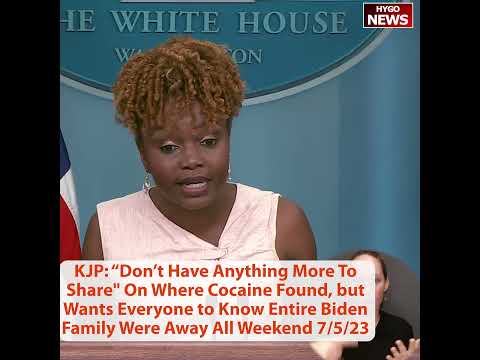
KJP Refuses to Say Where in the West Wing Cocaine Was Found — “Don’t Have Anything More to Share”
On July 5, 2023, reporters pressed White House Press Secretary Karine Jean-Pierre repeatedly to identify the specific location within the West Wing where cocaine had been discovered. Jean-Pierre refused to provide any details, citing the Secret Service investigation, even as she simultaneously used the vague descriptor “heavily traveled area” to imply that anonymous tourists were the most likely culprits. The exchange became a masterclass in stonewalling, with reporters methodically narrowing their questions and Jean-Pierre deflecting each one.
”I’m Not Going to Get Into Specifics”
The location of the cocaine within the West Wing was a critical detail. Different areas of the building have different levels of access, and knowing where the substance was found would significantly narrow the universe of people who could have left it there.
A reporter asked directly: “Can you just clarify for us where exactly inside the West Wing the substance was discovered?”
Jean-Pierre shut the question down immediately: “I’m not going to get into specifics. All I can say is: When people visit the West Wing, there is an area of the West Wing where it is highly traveled.”
The answer gave no new information. The phrase “highly traveled area” had already been used multiple times during the briefing. By repeating it without adding specifics, Jean-Pierre maintained the narrative that the cocaine was found in a place accessible to a large number of people — reinforcing the implication that any of hundreds of visitors could have been responsible.
Reporter Tries to Narrow Down the Entrance
Recognizing that Jean-Pierre would not volunteer the location, a reporter attempted to narrow the possibilities by identifying the two primary entrances to the West Wing and asking which one was involved.
The reporter said: “There are a couple of primary entrances into the West Wing. There’s the one with which we’re all familiar, right outside of the driveway where the Marine stands when the President is in the West Wing. And there’s another entrance off West Executive Avenue. Can you explain which entrance we’re talking about?”
This was a significant question. The main entrance off the driveway — the one near the Marine sentry — is the entrance most commonly seen on television and is used by senior officials and high-profile visitors. The entrance off West Executive Avenue is used for a different set of visitors and staff. Knowing which entrance was involved would have provided an important clue about the type of access the person who left the cocaine had.
Jean-Pierre deferred entirely: “I’m going to let the Secret Service speak to that."
"Can You Explain Why You Can’t Explain It?”
The reporter followed up with the most incisive question of the exchange, challenging Jean-Pierre on the logic of her stonewalling.
“Can you explain why you can’t explain it? I mean, you’ve described it as a heavily traveled area,” the reporter said.
The question highlighted a contradiction in Jean-Pierre’s approach. She was willing to characterize the area as “heavily traveled” — a descriptor that served the White House’s narrative by implying that many people had access — but unwilling to provide the specific information that would allow reporters and the public to evaluate that claim.
Jean-Pierre responded: “That’s what the Secret — I’m just saying what the Secret Service said. We got this from the Secret Service, so I’m sharing a little bit more with you from here.”
The answer implied that the Secret Service had provided only general information and that Jean-Pierre was sharing everything she had been given. But it also raised a question: if the White House wanted to get to the bottom of the situation, as they claimed, why had they not asked the Secret Service for more specific information that they could share with the press?
The Tour Timing Question
A reporter then asked about the timing of staff-led tours, trying to establish whether the cocaine could have been left by a visitor or whether it was more likely left by someone with access outside of tour hours.
“The substance was discovered late on Sunday. What’s the latest staff-led tours that happen in the West Wing on a Sunday?” the reporter asked.
Jean-Pierre said: “You know, I don’t have the specific on how late the staff tours — staff-led tours go. But I can tell you that there was one on Friday, there was one on Saturday, there was one on Sunday.”
The response confirmed that tours had occurred on all three days but conspicuously avoided addressing the timing question. If the cocaine was discovered “late on Sunday” and the last tour ended hours earlier, that would narrow the suspect pool to people with after-hours access — a much smaller group than the hundreds of visitors who pass through during tour hours.
By failing to address the timing, Jean-Pierre avoided providing information that could have undermined the tour-visitor narrative the White House was promoting.
The Stonewalling Pattern
The exchange over the cocaine’s location followed a consistent pattern throughout the briefing. Reporters would ask specific, fact-based questions. Jean-Pierre would provide a general, narrative-serving response. When pressed for details, she would defer to the Secret Service. When asked why she could not provide details, she would claim she was sharing everything she had.
This pattern effectively made it impossible for reporters to learn anything concrete about the incident while allowing Jean-Pierre to maintain the posture of transparency. She was “sharing” information — just not any information that would be useful for understanding what actually happened.
The stonewalling was particularly notable because the information reporters were requesting — the general location within a building and the timing of events — was not the kind of sensitive investigative detail that would typically be withheld. In most security incidents at government buildings, basic facts about where and when something occurred are shared promptly. The West Wing cocaine incident was handled with the opacity usually reserved for matters of national security.
The Broader Context
The cocaine was discovered during the Fourth of July weekend while the Biden family was at Camp David. Jean-Pierre had made it a priority to establish the family’s absence before addressing any other aspect of the situation. The combination of emphasizing the Biden family’s alibi, attributing the cocaine to a vague “heavily traveled area,” pointing to staff-led tours, and refusing to provide any specific details created a comprehensive deflection strategy.
The West Wing is one of the most heavily secured buildings in the world. It has surveillance cameras, visitor logs, access control systems, and the constant presence of Secret Service personnel. The idea that a substance could be left there without the possibility of identifying who was responsible strained credulity. The White House’s refusal to share even basic location information only deepened skepticism about the seriousness of the investigation.
Key Takeaways
- KJP refused to identify the specific location within the West Wing where cocaine was found, saying only that it was a “highly traveled” area and deferring all details to the Secret Service.
- When a reporter described the two primary West Wing entrances and asked which one was involved, Jean-Pierre would not say, denying information that would have narrowed the suspect pool.
- A reporter challenged KJP on why she could describe the area as “heavily traveled” but could not provide the actual location, exposing the selective nature of the information sharing.
- KJP confirmed staff-led tours occurred on Friday, Saturday, and Sunday but would not say when they ended, avoiding the timing question that could have undermined the visitor narrative.
- The refusal to share basic facts about the location and timing of the discovery was unusual for a building with extensive surveillance and access controls, deepening skepticism about the investigation.