 HYGO News
 KJP 'Disagree' Biden not successful on lowering costs before midterm, release emergency oil reserves
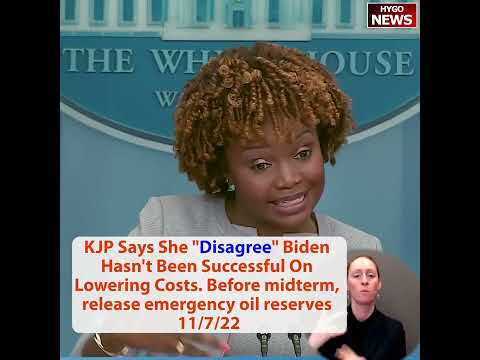
Reporter: Biden’s Cost-Lowering Message Has Been “Basically Without Much Success” for Over a Year — KJP: “I Disagree,” Cites SPR Drawdown
On 11/7/2022, the day before the midterm elections, a reporter delivered a blunt assessment of Biden’s economic messaging to White House Press Secretary Karine Jean-Pierre: “The President has been giving us that message for more than a year, basically without much success. So is it time for a pivot?” KJP said “I disagree with that not having much success” and cited Biden’s “historic action” of tapping the Strategic Petroleum Reserve as proof of results. She then acknowledged “Americans are feeling a little bit of a squeeze right now” — her standard minimization of an inflation crisis that had eroded household purchasing power by 13% since Biden took office.
”Basically Without Much Success”
The reporter’s question was a midterm-eve summary of Biden’s economic record. “You said here the president’s plans are going to lower costs, they’re going to get inflation down,” the reporter noted. “But the president has been giving us that message for more than a year, basically without much success. So is it time for a pivot?”
The characterization “basically without much success” was supported by the data. Biden had been promising to reduce costs since at least mid-2021, when inflation first began accelerating. Over the subsequent 16 months, the White House had used the same talking points — “the president is laser-focused,” “we understand,” “we’re working on it” — while inflation rose from 5% to 9.1% before declining slightly to 8.2%.
By November 2022, the cumulative result of Biden’s cost-lowering efforts was that costs had increased approximately 13% since his inauguration. Food was up 11.2%. Energy was up dramatically despite recent declines from peak. Shelter costs were rising at the fastest rate in decades. Real wages had fallen for 18 consecutive months. Not one of Biden’s stated economic goals — reducing inflation to pre-2021 levels, lowering gas prices to pre-Biden levels, or reducing grocery costs — had been achieved.
The reporter’s phrase “basically without much success” was, if anything, generous. A more precise characterization would have been “without any success” as measured by the metrics Biden himself had identified.
”I Disagree”
KJP’s response began with her reflexive disagreement. “I disagree with that not having much success,” KJP said — maintaining the White House position that Biden’s economic policies were producing results even as consumer prices remained at 40-year highs.
“Because if you look at the president’s policies as it relates to, for example, the gas prices, the president took bold actions, as you’ve heard us say,” KJP continued. “He tapped into the Strategic Petroleum Reserve, which was a historic action. And because of that — and it has been proven by data — and that’s because he took action.”
The SPR drawdown was KJP’s only specific example of successful cost-lowering action — and it was a double-edged sword. Yes, releasing 180 million barrels of emergency oil had contributed to lower gas prices from their June peak. But gas remained $1.37 higher than on Inauguration Day. The SPR was depleted to its lowest level since the 1980s. And the releases were widely viewed as politically timed rather than emergency-driven.
More fundamentally, the SPR releases addressed one consumer cost — gasoline — while leaving all other inflation categories untouched. Grocery prices, rent, healthcare costs, electricity bills, and every other household expense had continued rising regardless of what Biden did with oil reserves. Citing gas prices as proof that the broader cost-lowering agenda was “successful” was like pointing to one room in a burning building that hadn’t caught fire yet.
The Inflation Reduction Act — Again
KJP then pivoted to the Inflation Reduction Act. “Inflation Reduction Act — again, only Democrats, congressional Democrats voted for that. It’s going to lower the cost of energy. It’s going to…” KJP said, trailing off before completing the thought.
The IRA defense had appeared in virtually every KJP briefing on the economy for months. But by November 7, the act’s limitations as an inflation-fighting tool were well-established. The CBO found its impact on inflation was “negligible.” Its major consumer-facing provisions — Medicare drug pricing negotiations — wouldn’t take effect until 2026. Clean energy tax credits required substantial upfront investment. The legislation was primarily a climate bill, not an inflation bill, and its name was a political marketing decision rather than a description of its effects.
The “only Democrats voted for it” addendum served the campaign narrative — Democrats acted, Republicans obstructed — but didn’t address the reporter’s point about results. Whether the vote was partisan or bipartisan, the question was whether inflation had come down. It hadn’t.
”A Little Bit of a Squeeze”
KJP concluded with the administration’s standard empathy language. “We understand that Americans are feeling a little bit of a squeeze right now. And we get that. The president gets that,” KJP said.
“A little bit of a squeeze” had become KJP’s go-to minimization of the inflation crisis. She had used similar language throughout the fall — “a bit of a crunch,” “a difficult time,” “a tough time” — all formulations that downplayed the severity of what families were experiencing.
The “squeeze” families faced was not “a little bit.” It was the worst erosion of purchasing power in 40 years. Families were paying roughly $8,000 more per year for the same goods and services compared to January 2021. Many families were choosing between groceries and gas, between rent and healthcare, between heating their homes and feeding their children. Calling this “a little bit of a squeeze” on the eve of an election where the economy was voters’ top concern demonstrated the disconnect between White House messaging and voter reality.
”Is It Time for a Pivot?”
The reporter’s question about pivoting — changing the economic message or strategy — was itself revealing. By asking whether it was “time for a pivot,” the reporter was implicitly acknowledging that the current approach wasn’t working and suggesting the White House should try something different.
KJP’s response — “I disagree” followed by the same SPR and IRA talking points she had delivered hundreds of times — was the answer: no pivot was coming. The White House would ride the same message through Election Day and beyond, regardless of whether voters found it persuasive.
The midterm results the following day would validate this concern. Voters who cited the economy as their top issue broke heavily Republican, suggesting that “I disagree with not having much success” was not a message that resonated with the Americans experiencing 8.2% inflation at the grocery checkout.
The Midterm Eve Assessment
The exchange captured the state of the Biden White House’s economic communications on the eve of the most consequential election of his presidency. After more than a year of promising to lower costs, the administration could point to one partially successful initiative (SPR releases for gas prices) and one future-tense promise (IRA provisions that hadn’t taken effect). Everything else — food, shelter, energy, healthcare, real wages — was worse than when Biden took office.
KJP’s “I disagree” was the White House’s final economic word before voters rendered their own verdict. The next day, those voters would deliver a split decision: Democrats held the Senate but lost the House, with economy-focused voters breaking heavily Republican. The message that had been delivered “for more than a year, basically without much success” remained unsuccessful on Election Day.
Key Takeaways
- A reporter told KJP that Biden’s cost-lowering message had been delivered “for more than a year, basically without much success” and asked if it was time to pivot.
- KJP said “I disagree” and cited the SPR drawdown as proof of success — while gas remained $1.37 higher than on Inauguration Day and all other costs continued rising.
- She described Americans’ experience with 8.2% inflation as “a little bit of a squeeze” — her standard minimization of the worst inflation in 40 years.
- The only specific cost-reduction KJP could cite was gas prices, achieved by draining the SPR to its lowest level since the 1980s.
- Midterm exit polls the next day showed economy-focused voters broke heavily Republican, confirming the economic message had failed.
Transcript Highlights
The following is transcribed from the video audio (unverified — AI-generated from audio).
- The president has been giving us that message for more than a year, basically without much success. Is it time for a pivot?
- I disagree with that not having much success. If you look at the president’s policies on gas prices, he took bold actions.
- He tapped into the Strategic Petroleum Reserve, which was a historic action. It has been proven by data.
- The Inflation Reduction Act — only Democrats, congressional Democrats voted for that. It’s going to lower the cost of energy.
- We understand that Americans are feeling a little bit of a squeeze right now. We get that. The president gets that.
- That’s an action that he took.
Full transcript: 153 words transcribed via Whisper AI.