 HYGO News
 KJP Didn't Speak To Biden Today Despite Holding Press Briefing
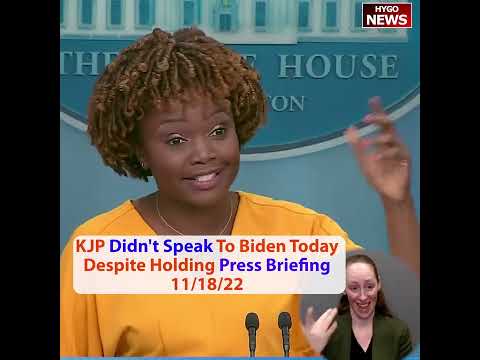
KJP Admits She Hadn’t Spoken to Biden Before Holding White House Press Briefing — “I’ve Not Spoken to Him Before Coming Out Here”
On 11/21/2022, White House Press Secretary Karine Jean-Pierre made a remarkable admission during her press briefing: she had not spoken to President Biden before coming to the podium that day. When a reporter asked who informed Biden of certain news and how Biden learned about it, KJP responded: “Again, I’m just not going to go beyond. I know you’re asking me about the president specifically. I’ve not spoken to him before coming out here, so can’t give you details on that. I was not able to have an opportunity — it’s just been a busy day.” The press secretary — whose entire job was to speak for the president — acknowledged she hadn’t spoken with him before the briefing where she was supposed to represent his views.
”I’ve Not Spoken to Him Before Coming Out Here”
The admission came in response to a reporter’s question about how Biden had learned of a particular development. “Who informed him today when he learned of the news? How did he learn of the news today?” the reporter asked.
KJP’s response was candid but undermined her credibility as the president’s spokesperson. “Again, I’m just not going to go beyond. I know you’re asking me about the president specifically. I’ve not spoken to him before coming out here, so can’t give you details on that.”
The statement raised an obvious question: if the press secretary hadn’t spoken to the president before her briefing, how was she supposed to accurately represent his current thinking, reactions, or positions to the press and the American people? The press secretary’s core function is to convey the president’s views and actions to the public through the press corps. That function requires, at minimum, current knowledge of the president’s views and activities.
A press secretary who hadn’t spoken to the president that day was operating from stale information. She could repeat previously prepared talking points, cite published statements, and reference past communications — but she couldn’t speak with authority about the president’s current state of mind, recent reactions, or immediate concerns.
”I Was Not Able to Have an Opportunity”
KJP offered an explanation for the missed contact. “I was not able to have an opportunity. It’s just been a busy day to check in on when he was last tested,” KJP added.
The phrase “check in on when he was last tested” suggested the topic of conversation would have been COVID-19 testing — likely related to whether Biden had been tested recently following contact with someone who had tested positive. This was not a minor topic. COVID-19 testing protocols for the president are a matter of significant public interest, and reporters routinely ask about them when relevant news arises.
The admission was doubly damaging: KJP not only hadn’t spoken to Biden that day but had specifically failed to gather basic information about his recent COVID testing status — information she should have had before briefing the press on a topic that was publicly relevant.
“It’s just been a busy day” was the excuse. But the press secretary’s primary job on a busy day is to ensure she has the information she needs to do her job when she reaches the podium. If there wasn’t time to speak with the president, the briefing could have been delayed. If the information was critical, the briefing should have been delayed until the information was available. Conducting the briefing without the necessary information was the worst of all options.
”Why the Briefing Was Delayed”
The reporter asked a follow-up question that revealed more context. “Can you help us understand why the briefing was delayed?” the reporter asked.
KJP’s answer was vague. “Absolutely. It’s just been a long week. There’s a lot to cover. As I know, you all have a lot of topics, and it just took a little bit of time to get us out here tonight. It’s almost tonight this afternoon, as the sun is probably setting at this time. But no big reason, just there’s a lot.”
The response revealed two things. First, the briefing had been delayed — to the point that it was nearly “tonight this afternoon,” suggesting it had been pushed from the typical midday timing to late afternoon or early evening. Second, despite the delay, KJP had still not used the extra time to speak with the president.
A delayed briefing was an opportunity to gather additional information. If the briefing was pushed back, the communications team had more time to prepare talking points, consult with policy officials, and — if possible — check in with the president. KJP’s admission that she hadn’t spoken to Biden despite the delay suggested either that Biden was unavailable for consultation, or that KJP’s team hadn’t prioritized obtaining current information from him.
The Press Secretary Function
The exchange raised fundamental questions about the role of the press secretary in the Biden administration. Historically, White House press secretaries maintained close, continuous contact with the president — often speaking multiple times per day to ensure they could accurately represent his views on any topic that might arise.
Jen Psaki, KJP’s predecessor, had been known for her daily briefings with Biden to ensure she was current on his thinking. Earlier press secretaries had similar practices. The press secretary’s ability to speak for the president depended on actually knowing what the president was thinking at that moment.
KJP’s admission suggested a different model. She was operating from prepared talking points, previously approved messaging, and coordination with other staff — but not from direct communication with the president. This model worked for briefings that covered expected topics with predetermined answers. It broke down when reporters asked unexpected questions or sought real-time reactions to developing events.
The “Busy Day” Defense
KJP’s “busy day” explanation raised additional concerns. If Biden was too busy to speak with his press secretary before her briefing, what was he doing that was more important than ensuring his spokesperson could accurately represent him? Meeting with foreign dignitaries? Reviewing intelligence briefings? Making policy decisions?
Or was it the opposite — that Biden’s schedule was light enough that the staff hadn’t prioritized getting KJP in front of him? The “busy day” framing didn’t specify whose day was busy or why.
Either interpretation was damaging. If Biden was genuinely too busy, it suggested the president and press secretary didn’t have regular scheduled communication — a structural problem. If Biden wasn’t that busy and the lack of contact was a scheduling oversight, it suggested the White House didn’t consider press secretary briefings with the president a priority.
Key Takeaways
- KJP admitted she had not spoken to President Biden before her White House press briefing on 11/21/2022.
- The admission came in response to a question about how Biden had learned of specific news that day.
- KJP said “it’s just been a busy day” and she “was not able to have an opportunity” to speak with the president.
- The briefing had been delayed to late afternoon, but KJP still hadn’t used the extra time to consult with Biden.
- The admission undermined the core function of a press secretary — to accurately represent current presidential views to the press and public.
Transcript Highlights
The following is transcribed from the video audio (unverified — AI-generated from audio).
- Who informed him today when he learned of the news? How he learned of the news today?
- I’ve not spoken to him before coming out here, so can’t give you details on that.
- I was not able to have an opportunity. It’s just been a busy day to check in on when he was last tested.
- Can you help us understand why the briefing was delayed?
- It’s just been a long week. There’s a lot to cover.
- But no big reason. Just there’s a lot.
Full transcript: 144 words transcribed via Whisper AI.