 HYGO News
 KJP Denies Biden Admin Was Involved In Twitter's Effort To Censor Conservative Voices
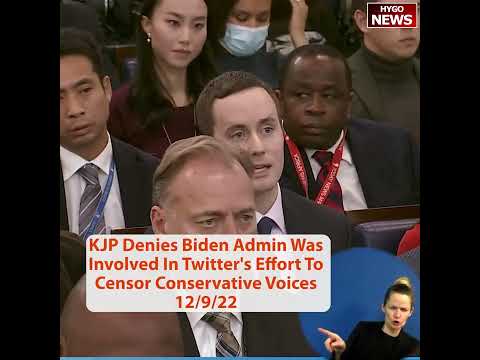
Reporter to KJP on Jim Baker Firing: Was Biden Admin in Touch With Twitter’s Former FBI Lawyer? KJP Flatly: “We Were Not Involved”
On 12/9/2022, a reporter asked White House Press Secretary Karine Jean-Pierre about Elon Musk’s firing of Jim Baker — the former FBI general counsel who had been serving as a top Twitter lawyer — and whether the Biden administration had been in contact with Baker about content moderation or transparency efforts. “Musk alleges that he may have been involved with countermanding his attempts at transparency and I was wondering if anyone in the Biden administration was in touch with Baker either regarding moderation decisions that critics call political censorship or regarding his transparency efforts recently,” the reporter asked. KJP denied administration involvement multiple times: “It’s up to private companies to make these types of decisions. We were not involved. I can say that. We were not involved. We were not involved in speaking with Baker about this transparency effort by Musk.” The repetitive denial was notable for its specificity but left open questions about earlier Baker-era communications with Twitter.
The Jim Baker Context
Jim Baker had been a high-profile figure in U.S. intelligence and law enforcement:
Former FBI General Counsel — Served under Director James Comey during 2014-2018.
Key figure in Russia investigation — Involved in early stages of the Trump-Russia probe.
Controversial departure from FBI — Left amid questions about his role in various matters.
Subsequent private sector career — Including roles at Brookings and then Twitter.
Twitter Deputy General Counsel — Senior legal role at the social media company.
His presence at Twitter had been controversial even before the Musk acquisition. Critics had noted that his FBI background and involvement in politically sensitive investigations made him an unusual choice for a content moderation role. His ability to influence Twitter’s decisions about politically sensitive content was seen by some as problematic.
The Musk Firing and Allegations
Musk had fired Baker earlier that week. Musk’s public statements about the firing had suggested that Baker had been involved in:
Countermanding transparency efforts — Allegedly reviewing Twitter Files documents before release.
Withholding information — From Matt Taibbi and other Twitter Files journalists.
Influencing content moderation — During his tenure at Twitter.
Protecting internal decisions — From disclosure after Musk’s takeover.
Musk’s allegations suggested that Baker had been essentially a pro-establishment force within Twitter who had used his legal role to preserve the status quo that Musk was trying to disrupt through the Twitter Files project.
The Reporter’s Direct Question
The reporter’s question was specific and pointed. “I was wondering if anyone in the Biden administration was in touch with Baker either regarding moderation decisions that critics call political censorship or regarding his transparency efforts recently,” the reporter asked.
The question covered two distinct concerns:
Current transparency efforts — Had the administration been in contact with Baker about the Twitter Files disclosures?
Historical moderation decisions — Had the administration been in contact with Baker about content moderation?
The two concerns addressed different potential misconduct:
Transparency interference — Baker possibly coordinating with administration to limit Twitter Files disclosures.
Content moderation coordination — Baker possibly coordinating with administration on decisions about what to suppress.
Either would be significant. The first would suggest ongoing coordination about managing damaging disclosures. The second would confirm the kind of government-platform coordination that raised constitutional concerns.
The Initial Denial
KJP’s first response asserted private company autonomy. “So it’s up to private companies to make these types of decisions,” KJP said.
The “private company decisions” framing had a specific purpose. It positioned content moderation as exclusively private decisions rather than as matters involving government coordination. This framing was consistent with the administration’s preferred position on Twitter Files matters — characterizing them as private decisions not warranting government scrutiny.
But the framing wasn’t directly responsive to the question. The reporter hadn’t asked who was making content moderation decisions. The reporter had asked whether the administration had been in touch with a specific Twitter employee about specific matters. These were different questions with different answers.
”We Were Not Involved”
KJP then moved to direct denial. “We were not involved. I can say that. We were not involved,” KJP said.
The repetitive denial had several features:
Definitive character — Not hedged or qualified.
Direct rejection — Of administration involvement.
Repeated for emphasis — Saying it twice made the denial stronger.
Comprehensive scope — “Not involved” suggested across all relevant matters.
This kind of flat denial was unusual for KJP. On many other topics, she offered qualified or deflected responses. The direct “not involved” language was notably categorical.
The Specific Transparency Version
KJP clarified the scope. “We were not involved in speaking with Baker about this transparency effort by Musk,” KJP said.
This was a narrower version of the denial. It specifically addressed:
Baker communications — Not just any Twitter employees.
Transparency effort — Not broader content moderation questions.
Musk’s effort — The current Twitter Files disclosures.
The narrowing was significant. The broader “we were not involved” could mean many things. The narrower “not involved in speaking with Baker about this transparency effort by Musk” was a specific denial about a specific matter.
What it didn’t deny was equally important. It didn’t deny that:
The administration had communicated with Twitter generally — Before or after the Twitter Files.
The administration had communicated with Baker about other matters — During his tenure.
The administration had coordinated on moderation decisions — Before the Twitter Files revealed them.
Administration-Twitter communications had occurred during earlier periods — Before Musk’s transparency effort.
The narrowness of the denial left these possibilities open, even as the specific claim about Baker communications regarding the current transparency effort was categorically denied.
The Reporter’s Verification
The reporter sought confirmation. “Is that what you’re saying? That the Biden administration wasn’t involved?” the reporter asked.
This verification question was standard journalism. When someone makes a significant claim, reporters often seek to confirm understanding before publishing the claim. The reporter was ensuring that KJP’s denial was being properly understood.
The Repeated Denial
KJP confirmed. “We were just not involved. Just answering your question. We were not involved,” KJP said.
The repetition of “we were not involved” emphasized the denial. The “just answering your question” framing suggested that the denial was the full answer — no complications, qualifications, or additional context.
The Verification Pattern
The pattern — reporter asking, KJP denying, reporter confirming, KJP confirming — was notable. It produced a clear record of administration denial. If subsequent investigation showed that the administration had been in touch with Baker about the transparency effort, the denial would be explicitly refutable.
This clarity was unusual in KJP briefings. On most topics, evasive or qualified language was standard. The direct “we were not involved” language on this question suggested:
The administration was confident about the denial — Either because it was true or because evidence of falsity wasn’t available.
The topic required clear positioning — The accusation was serious enough to warrant direct denial.
Hedging would have looked worse — Qualified denials would have suggested possible involvement.
Political calculation favored denial — Even if there was some truth, denial was safer.
The Historical Context
While KJP denied current involvement, the historical context was more complicated. Various Twitter Files disclosures had documented:
FBI-Twitter communications — Throughout Baker’s tenure and beyond.
Government-platform contacts — On various content moderation issues.
DHS coordination — With various social media platforms.
Academic-government partnerships — Organizations tracking “disinformation” that coordinated with platforms.
These historical communications raised questions that extended beyond the specific “Baker transparency effort” question KJP denied. The broader pattern of government-platform communications — whether or not they specifically involved Baker — was the substantive concern the Twitter Files had highlighted.
The Specific vs. General
KJP’s denial was specific to one matter while the broader concerns were general. This was a common pattern in administration responses to politically sensitive questions:
Deny specific allegation — Which was what KJP did.
Don’t address broader pattern — Avoiding general positioning.
Leave general questions open — For future deflection.
Create defensibility — On narrow factual ground.
The approach was politically effective. The specific denial could withstand factual scrutiny (if true). The broader pattern remained available for criticism but couldn’t be directly attributed to specific denied communications.
The Institutional Questions
The broader institutional questions the Twitter Files raised weren’t addressed by KJP’s specific denial. These included:
What communications patterns existed between administration and platforms?
How did government officials influence content moderation decisions?
Were there formal or informal coordination mechanisms?
What constitutional and legal limits applied to such coordination?
Should future coordination be subject to disclosure requirements?
These questions required broader engagement than KJP’s narrow denial provided. The administration’s posture throughout the Twitter Files period had been to avoid such broader engagement, preferring narrow denials and characterizations of the disclosures as distractions.
Baker’s Post-Firing Role
Baker’s subsequent career trajectory was relevant context. After his Twitter firing, Baker returned to the Brookings Institution and continued public commentary. His statements about Musk and the Twitter Files were generally defensive of the positions he had taken at Twitter.
Various investigations subsequently examined Baker’s role in Twitter decisions. Congressional testimony, legal discovery in various cases, and journalistic investigations produced additional information about the period when Baker had served at Twitter.
None of this subsequent information directly contradicted KJP’s specific denial about the Musk transparency effort. But the broader context revealed more complex relationships between government officials, platform employees, and content moderation decisions than KJP’s brief denial suggested.
Key Takeaways
- A reporter asked KJP whether the Biden administration had been in touch with Jim Baker — fired Twitter lawyer and former FBI general counsel — about content moderation or Twitter Files transparency efforts.
- KJP flatly denied administration involvement: “We were not involved. I can say that. We were not involved.”
- She specifically denied involvement “in speaking with Baker about this transparency effort by Musk.”
- The reporter sought verification, and KJP repeated: “We were just not involved. Just answering your question. We were not involved.”
- The narrow denial was notable for its directness — unlike many KJP responses — but left open questions about broader government-platform communications that the Twitter Files had documented.
Transcript Highlights
The following is transcribed from the video audio (unverified — AI-generated from audio).
- Elon Musk this week fired former FBI general counsel Jim Baker who was serving as a top Twitter lawyer.
- Musk alleges that he may have been involved with countermanding his attempts at transparency.
- I was wondering if anyone in the Biden administration was in touch with Baker either regarding moderation decisions that critics call political censorship or regarding his transparency efforts recently.
- It’s up to private companies to make these types of decisions. We were not involved.
- We were not involved in speaking with Baker about this transparency effort by Musk.
- Is that what you’re saying? That the Biden administration wasn’t involved? — We were just not involved. Just answering your question. We were not involved.
Full transcript: 125 words transcribed via Whisper AI.