 HYGO News
 KJP Claims Biden Made Her Press Secretary Because She's 'Beyond Capable'; KJP Gaffe Examples
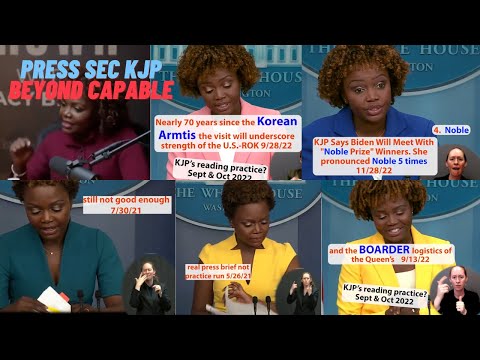
KJP Claims Biden Made Her Press Secretary Because She’s “Beyond Capable”; KJP Gaffe Examples
In a podcast appearance with Stacy Brown, White House Press Secretary Karine Jean-Pierre explained why she was chosen for the job: because she was “beyond capable.” Jean-Pierre described how President Biden and the First Lady selected her, stating, “They decided that they wanted Karine Jean-Pierre, with all of the things, all of the communities that I represent, clearly being a black person, right, being a black woman. They said, we want you to represent us, we want you to represent the White House. We want to meet this moment that we’re in, and we know that you are beyond capable of doing that, right. You are — you are, uh, you are experienced, and you are the voice that we want to have.”
The claim of being “beyond capable” stood in sharp contrast to Jean-Pierre’s ongoing and well-documented struggles at the briefing room podium, where she had accumulated a substantial collection of mispronunciations, invented words, factual errors, and grammatical stumbles that raised persistent questions about her fitness for the role.
The “Beyond Capable” Claim
During the podcast, Jean-Pierre framed her selection as press secretary as a deliberate choice by the Bidens to put her in a historic position. She told Brown that “they decided to put me in this position,” referring to the president and first lady. She emphasized her identity as a factor in the selection, describing herself as representing multiple communities.
Jean-Pierre then added: “Knowing that I am representing the voice of the president, then I have to do that, right? That’s the job.”
The irony was that Jean-Pierre’s day-to-day performance at the podium frequently failed to project the competence she described. She often lacked answers to straightforward questions, regularly referred reporters to other departments, and repeatedly blamed the Trump administration for issues well into Biden’s third year in office. Her verbal performance at the podium had become a source of regular viral clips, not for effective communication but for the opposite.
Gaffe 1: “Hypo-Theoreticals”
On August 30, 2023, a reporter asked Jean-Pierre whether President Biden would be willing to accept a short-term continuing resolution to fund the government. Her response: “That is something — I’m not going to get into Hypo-Theoreticals. That is something that Congress — Congress should — should kind of decide.”
The word she was attempting to say was “hypotheticals,” one of the most commonly used words in the press secretary’s vocabulary. Instead, she produced “hypo-theoreticals,” an invented word that appeared to blend “hypotheticals” with “theoretical.” The mispronunciation of a word that press secretaries use in virtually every briefing suggested she was not fully processing the language she was speaking.
Gaffe 2: “Russian Warload”
While discussing the chaos surrounding the Wagner Group’s Yevgeny Prigozhin, Jean-Pierre attempted to describe him as a “warlord” but instead called him a “warload”: “If we take a step back, if you look back for a second, all of this happened because of dysfunction inside Russia. A Russian warload himself.”
The mispronunciation turned a serious discussion about Russian military dynamics into another viral clip. “Warlord” is not an obscure or technical term, and Jean-Pierre’s inability to pronounce it correctly during a prepared statement about a major international development further undermined her credibility as a spokesperson on foreign affairs.
Gaffe 3: “Noble Prize” — Five Times
On November 28, 2022, Jean-Pierre announced that President Biden had met with three U.S. winners of the 2022 Nobel Prize. She pronounced “Nobel” as “Noble” not once but five times in a single statement:
“Now, finally, today, President Biden met with three U.S. winners of the 2022 Noble Prize: Dr. Carolyn Bertozzi, who won the Noble Prize in Chemistry; Dr. John Clauser, who won the Noble Prize in Physics; and Dr. Douglas Diamond, who won the Noble Prize in Economic Sciences. The President is restarting an important tradition that just like — just like he does for winning sports teams, as you have seen him do in the past 20 months or so, the President meets with U.S. winners of the Noble Prize.”
The Nobel Prize, named after Alfred Nobel, is one of the most prestigious awards in the world and a term that appears routinely in news coverage. Mispronouncing it once could be excused as a slip of the tongue. Mispronouncing it five consecutive times suggested Jean-Pierre genuinely did not know the correct pronunciation.
In the same appearance, she used the phrase “I’m going to go out of school for a second” instead of the common expression “go off script,” compounding the impression of someone struggling with basic English idioms.
Gaffe 4: “Korean Armtice”
While previewing Vice President Harris’s visit to the Demilitarized Zone, Jean-Pierre attempted to reference the Korean Armistice but stumbled over the word, producing “armtice” instead: “The Vice President will visit the DMZ. Nearly 70 years since the Korean Armtis, the visit will underscore the strength of the U.S.-ROK alliance.”
“Armistice” is a standard term in American history and foreign policy, taught in schools and used regularly in discussions of the Korean War. The mispronunciation during a prepared statement about a diplomatic visit raised questions about Jean-Pierre’s familiarity with the basic historical and diplomatic vocabulary her role required.
Gaffe 5: Oil at “$70 Per Gallon”
On October 19, 2022, Jean-Pierre announced that the Biden administration intended to repurchase oil for the Strategic Petroleum Reserve “when prices are around $70 per gallon.” The correct unit was “$70 per barrel.” Since a standard U.S. barrel contains 42 gallons of crude oil, the figure Jean-Pierre stated would have meant Biden was proposing to buy oil at $2,940 per barrel, a price that would have been catastrophic for taxpayers.
The error was not merely verbal; it revealed a lack of understanding of the basic units used in energy policy, a subject Jean-Pierre was briefing on regularly as the Biden administration drew down the Strategic Petroleum Reserve amid high gas prices.
During the same briefing, a reporter noted that in 2020, when Congress debated funding to replenish the SPR at a low price, Democrats blocked it, calling it a bailout for big oil. When asked about the apparent contradiction with Biden now proposing to refill it at a higher price, Jean-Pierre’s response was simply: “It was a different time.”
Gaffe 6: “Bi-Carmel”
On December 13, 2022, while discussing the Respect for Marriage Act, Jean-Pierre invented the word “Bi-Carmel” as a substitute for “bicameral,” using it three times in a single briefing:
“This is an important civil rights accomplishment that achieved — that was achieved in a Bi-Carmel and bipartisan way.”
“I think that matters, right? Bi-Carmel, bipartisan support was had for this piece of legislation.”
“This — this piece of legislation was done in a bipartisan, Bi-Carmel way, and it will make a difference for millions of Americans across the country.”
“Bicameral” refers to the two chambers of Congress, the House and Senate, and is a word used routinely in political discourse. Jean-Pierre’s consistent mispronunciation across multiple uses in the same briefing indicated it was not a one-time slip but rather that she did not know the correct word.
The Pattern
Taken individually, any single mispronunciation could be attributed to nerves, fatigue, or a momentary lapse. Taken together, Jean-Pierre’s catalog of errors painted a picture of a press secretary who struggled with vocabulary, pronunciation, and factual precision at a level that was unusual for the position.
Previous White House press secretaries had occasionally misspoken, but the frequency and nature of Jean-Pierre’s errors set her apart. Her difficulties extended beyond pronunciation to include regularly incomplete sentences, frequent losses of place in her briefing materials, and a reliance on phrases like “look,” “so,” and “again” as verbal placeholders.
The contrast between Jean-Pierre’s self-assessment as “beyond capable” and her documented performance at the podium became one of the defining tensions of the Biden White House communications operation.
Key Takeaways
- Karine Jean-Pierre claimed in a podcast interview that the Bidens chose her as press secretary because she was “beyond capable” and they wanted her to represent the White House.
- Her documented gaffes included “hypo-theoreticals” for hypotheticals, “warload” for warlord, “Noble Prize” five times for Nobel Prize, “armtice” for armistice, “$70 per gallon” instead of per barrel, and “Bi-Carmel” three times for bicameral.
- The “Noble Prize” error was particularly notable because she mispronounced it five consecutive times in a single prepared statement, suggesting she did not know the correct pronunciation.
- The oil pricing error of “$70 per gallon” instead of “$70 per barrel” would have represented a cost of $2,940 per barrel to taxpayers.
- The gap between Jean-Pierre’s “beyond capable” self-assessment and her documented verbal performance became a defining feature of the Biden White House communications operation.