 HYGO News
 KJP Claims Biden 'Has Done The Work' On Securing The Border 'Since Day One'
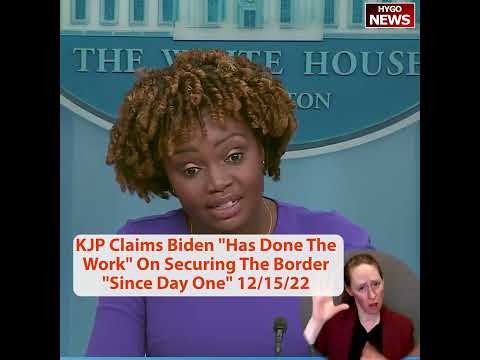
KJP on Title 42 End: Biden “Has Done the Work” Since “Day One” — Blames Trump for “Gutted” Immigration System
On 12/15/2022, a reporter asked White House Press Secretary Karine Jean-Pierre whether Americans should be supportive or concerned about the impending end of Title 42 — the policy that had allowed rapid expulsion of migrants without asylum processing. “Should Americans be supportive or concerned with the end of Title 42, which obviously stops most migrants from being able to apply for asylum?” the reporter asked. KJP’s response didn’t directly address whether Americans should be concerned. Instead, she pivoted to claims that Biden had “done the work” on immigration since “day one” and blamed Trump for “gutting” the immigration system. “The president has done the work to deal with what we’re seeing at the border since day one… to fix the gutted system that was that has been around for some time, but certainly was gutted by the last administration.”
The Reporter’s Specific Question
The reporter asked a substantive question about public response. “Americans clearly divided about immigration. From the White House perspective, though, should Americans be supportive or concerned with the end of Title 42, which obviously stops most migrants from being able to apply for asylum?” the reporter asked.
The question had several important features:
Acknowledged public division — Americans were divided on immigration.
Asked for administration framing — “From the White House perspective.”
Gave a binary choice — Supportive or concerned.
Noted specific policy effect — Title 42 blocked asylum applications.
Sought genuine guidance — About how to think about the change.
The question essentially asked: what should Americans think about Title 42 ending? Should they welcome it as restoring normal asylum processing? Should they worry about it because of anticipated increases in border crossings?
The “Day One” Framing
KJP’s response pivoted to familiar framing. “What Americans should know is that the president has done the work to deal with what we’re seeing at the border since day one,” KJP said.
The “since day one” framing was a standard administration pattern:
Emphasized sustained effort — Not just recent action.
Claimed long-term engagement — Two years of work.
Portrayed ongoing process — Rather than reactive response.
Suggested competence — Deliberate work over time.
But the “since day one” framing was substantively contested. Biden had taken various actions on immigration on his first day:
Rescinded Trump’s border policies — Various executive orders.
Sent comprehensive reform bill to Congress — Which didn’t pass.
Ended “Remain in Mexico” program — Later forced to reinstate.
Halted border wall construction — And later restarted some construction.
Changed ICE enforcement priorities — Reducing interior enforcement.
These day-one actions were interpreted differently by different observers:
Biden supporters — Saw humane policy corrections.
Biden critics — Saw disincentives to border enforcement.
Analysts — Saw mixed effects on border flows.
Border communities — Experienced increased crossings.
The “done the work” framing assumed the day-one actions were positive. Whether they had “dealt with” the border situation was debatable — border encounters had been at record levels throughout Biden’s presidency.
The Comprehensive Reform Reference
KJP returned to the immigration reform bill. “The president put forth an immigration reform policy to make sure that we’re dealing with a broken system, to make sure that we’re able to protect dreamers, to make sure that we deal with the backlog that we’re seeing with asylum seekers,” KJP said.
This was another recycled talking point. The U.S. Citizenship Act Biden had sent to Congress on January 20, 2021 had elements:
Path to citizenship — For undocumented immigrants.
DACA protection — For Dreamers.
Asylum backlog reduction — Processing improvements.
Border security — Technology-focused.
Root cause focus — Central America investment.
The bill had gone nowhere in Congress. By late 2022, it was effectively dormant. Referencing it repeatedly as evidence of administration engagement showed commitment but not results.
”Fix the Gutted System”
KJP’s framing blamed Trump. “To fix the gutted system that was that has been around for some time, but certainly was gutted by the last administration,” KJP said.
The “gutted by the last administration” framing was partisan interpretation. Trump had made substantial changes to immigration policy:
Muslim travel ban — Initially blocked then upheld in modified form.
Remain in Mexico — Forcing asylum seekers to wait in Mexico.
Wall construction — Physical barriers.
Reduced refugee admissions — Historic lows.
Zero tolerance policy — Family separations.
Public charge rule — Affecting green card processing.
Asylum restrictions — Various procedural changes.
Whether these changes constituted “gutting” the system was a matter of perspective:
Biden administration perspective — Trump had damaged humanitarian protections.
Trump administration perspective — Trump had restored immigration law enforcement.
Historical perspective — Both administrations had pursued different priorities within existing frameworks.
The “gutted” framing favored the Biden administration’s narrative that Trump had damaged the system that Biden was now repairing. This framing shifted responsibility for current problems to the prior administration.
The Blame Displacement
The Trump blame framing served a specific purpose. It displaced responsibility for current border challenges:
Current problems — Attributed to Trump-era policies.
Current administration — Trying to fix inherited situation.
Future outcomes — If positive, credit to Biden; if negative, blame to Trump’s legacy.
Political accountability — Deflected from specific Biden decisions.
This was a standard political technique. Every administration blamed predecessors for difficult situations they inherited. Biden’s blame of Trump was more pronounced than some transitions because of:
Trump’s controversial tenure — Various immigration controversies.
Policy reversals — Biden reversed many Trump policies.
Ongoing Trump political presence — Trump remained a political figure.
Media receptivity — Trump critics sympathetic to Biden blame.
The “gutted” framing was probably more extreme than required. Trump had made major changes, but the system had still functioned (for better or worse depending on perspective). “Gutted” implied complete destruction, which overstated the actual changes.
What KJP Didn’t Address
The reporter’s specific question — whether Americans should be supportive or concerned — was never answered.
If Americans should be supportive:
Title 42 was a problematic emergency policy — Its end was appropriate. Regular asylum processing — Would restore normalcy. Humanitarian considerations — Supported by ending rapid expulsions.
If Americans should be concerned:
Title 42 had reduced flows — Ending it could increase crossings. Asylum system was strained — Would be further stressed. Border communities would bear costs — Of increased migration.
KJP’s response addressed neither framing specifically. Her pivot to “done the work” and “gutted system” bypassed the direct question entirely.
The Administration’s Narrative Strategy
The administration’s messaging strategy on immigration had multiple goals:
Claim effective policy — “Done the work since day one.”
Acknowledge ongoing problems — Without specifics.
Blame Trump — For systemic issues.
Blame Republicans — For legislative obstruction.
Promise continued effort — Without specific commitments.
Avoid political damage — From specific policies.
These goals produced messaging that was consistent across briefings but limited in actual informational value. Each component served political purposes without providing operational detail.
The Asylum System Reality
The asylum system reality KJP referenced had specific problems:
Massive backlogs — Over 1 million pending cases.
Processing times — Years for resolution.
Limited capacity — Courts and administrative systems.
High approval rates for some groups — Creating incentives.
Low deportation rates — For rejected asylum claims.
Catch-and-release practices — Due to detention limits.
These problems predated Biden but had continued during his administration. The system’s strain was real. But attributing it primarily to Trump “gutting” overlooked decades of limitations that had developed under multiple administrations.
The Political Context
By late 2022, immigration had become increasingly politically sensitive:
Midterm election aftermath — Republicans had made immigration a major issue.
Border state concerns — Governor complaints about federal handling.
Media coverage intensity — Increasing focus on border situations.
Public polling — Showing immigration as top concern.
2024 positioning — Both parties preparing for election messaging.
The administration’s messaging had to navigate this political context. Too much honesty about border challenges would damage Biden politically. Too much defensive denial would appear out of touch. The administration’s “done the work” framing tried to balance these tensions.
The “What Americans Should Know” Framing
KJP’s repeated “what Americans should know” framing was paternalistic. The Press Secretary was essentially telling Americans what they should think:
“Should know” — Implied correct understanding. Administration perspective — As the correct perspective. Alternatives as wrong — Other views as misinformed.
This framing appeared frequently in administration messaging on contested issues. It substituted administration assertions for engagement with alternative perspectives. Americans with different views weren’t being addressed — they were being corrected.
The Substantive Policy Gap
The exchange exemplified a gap in administration policy engagement. On a specific question about how to think about Title 42’s end, the administration couldn’t offer a clear framing:
Because supporting — Might alienate concerned border communities.
Because concerned — Would contradict claims about administration competence.
Because ambiguous — Would suggest lack of confidence.
The result was a response that didn’t engage with the question. This was politically safe but substantively inadequate. Americans actually dealing with the immigration issue didn’t get useful guidance from administration messaging.
Key Takeaways
- A reporter asked whether Americans should be supportive or concerned about Title 42 ending the next week.
- KJP didn’t directly answer whether Americans should be supportive or concerned.
- She pivoted to claiming Biden had “done the work” on immigration “since day one.”
- KJP referenced Biden’s day-one comprehensive immigration reform bill (which had gone nowhere in Congress).
- She blamed Trump for “gutting” the immigration system.
- The response exemplified the administration’s pattern of deflecting specific policy questions with Trump-blame framing and generic action claims.
Transcript Highlights
The following is transcribed from the video audio (unverified — AI-generated from audio).
- Americans clearly divided about immigration. From the White House perspective, though, should Americans be supportive or concerned with the end of Title 42?
- Which obviously stops most migrants from being able to apply for asylum?
- What Americans should know is that the president has done the work to deal with what we’re seeing at the border since day one.
- The president put forth an immigration reform policy to make sure that we’re dealing with a broken system.
- To make sure that we’re able to protect dreamers, to make sure that we deal with the backlog that we’re seeing with asylum seekers.
- To fix the gutted system… certainly was gutted by the last administration.
Full transcript: 130 words transcribed via Whisper AI.