 HYGO News
 KJP: 'CDC -- They're The Experts! They Use Science.'
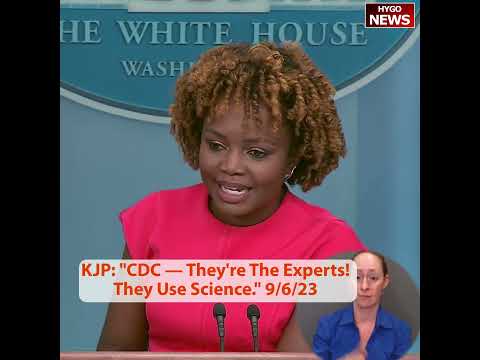
KJP: “CDC — They’re The Experts! They Use Science.”
On September 6, 2023, Fox News correspondent Jacqui Heinrich pressed White House Press Secretary Karine Jean-Pierre on whether the CDC’s school masking recommendations were based on actual evidence. When Heinrich pointed out that the CDC “does not seem to be responding to the data,” Jean-Pierre’s defense was a pure appeal to authority: “CDC — they’re the experts. They use science to come forward with their guidelines.” When Heinrich asked about the data directly, Jean-Pierre delivered a line that captured the administration’s approach to the question in a single sentence: “I know you’re asking me about data, but all you got to do is look at where we are as a country.”
The Exchange
The clip captured the most heated portion of a longer back-and-forth between Heinrich and Jean-Pierre about CDC guidance on masking in schools. Children were returning to classrooms for the fall 2023 semester, and the CDC was still recommending universal indoor masking for students and staff — a recommendation that had been in place for over two years.
Heinrich had already established in an earlier portion of the briefing that independent analysis, including a review published in The Atlantic, had found the CDC’s own cited studies did not support the school masking guidance. She was now pressing on the fundamental question: if the data did not support the guidance, why was the guidance still in place?
“Do we know what works though?” Heinrich asked. When Jean-Pierre tried to interject, Heinrich completed her point: “I mean, the CDC does not seem to be responding to the data.”
Jean-Pierre first clarified the topic: “I’ll say this — and you’re talking about schools?” When Heinrich confirmed she was, Jean-Pierre offered what became the clip’s defining moment.
”They Use Science”
“CDC — they’re the experts. They’re — they use science to come to — to come forward with their guidelines. And it is important that we allow them to do their work,” Jean-Pierre said.
The statement was a textbook appeal to authority. Rather than addressing whether the CDC’s school masking guidance was supported by evidence, Jean-Pierre asserted that the CDC uses science — as though invoking the concept of science was equivalent to demonstrating that a specific policy was scientifically supported.
Heinrich had not questioned whether the CDC employed scientists or whether the agency was capable of conducting research. She had pointed to specific evidence — analysis of the CDC’s own cited studies — showing that the data did not support the school masking recommendation. Jean-Pierre’s response did not engage with this evidence at any level. She simply restated that the CDC is an expert body that uses science, treating the institution’s credentials as a substitute for addressing the substance of the question.
The stammering nature of the response — “they’re — they use science to come to — to come forward with their guidelines” — suggested Jean-Pierre did not have a prepared answer for the specific evidentiary challenge Heinrich was presenting. The talking point was designed for a general “do you trust the CDC?” question, not for a reporter who had done the homework on what the CDC’s own studies actually showed.
”I Know You’re Asking Me About Data”
Jean-Pierre then made what may have been the most revealing statement of the exchange: “I know you’re asking me about data, but all you got to do is look at where we are as a country.”
The sentence acknowledged Heinrich’s question and then explicitly declined to answer it. “I know you’re asking me about data” was a confession that the spokesperson understood what was being asked. “But all you got to do is look at where we are as a country” was a redirect to a vague, unfalsifiable claim about the nation’s overall COVID status.
What did “where we are as a country” mean? Lower hospitalization rates? Higher vaccination rates? Schools being open? Any of those things could be true regardless of whether the CDC’s school masking guidance was evidence-based. The improvement in COVID outcomes was not evidence that masking in schools had caused the improvement. Jean-Pierre was conflating correlation with causation — or more precisely, she was gesturing at a positive trend without establishing any causal connection to the policy being questioned.
Heinrich’s Counter: The Patchwork
Heinrich responded by presenting empirical evidence that the CDC’s school masking guidance was already being widely disregarded: “I am looking around. And, you know, 16 states don’t have any mask mandates — or, sorry, 16 states follow CDC guidance closely for schools. Nine states have banned school mask mandates. There’s a patchwork, basically, of protocols.”
The statistics were significant. Only 16 states closely followed the CDC’s school masking recommendations. Nine states had explicitly prohibited them. The remaining states fell somewhere in between. This meant the majority of the country was not following the guidance Jean-Pierre was defending as expert and science-based.
Heinrich was making an implicit point: if the country was indeed in a good place, as Jean-Pierre had just claimed, and most states were not following the CDC’s school masking guidance, then perhaps the guidance was not the reason for the improvement. The logical conclusion was that the guidance was either unnecessary or disconnected from outcomes — neither of which was a conclusion Jean-Pierre could accept.
The “Guidelines, Not Mandates” Retreat
As Heinrich pressed on the patchwork of state approaches, Jean-Pierre pivoted to a new defensive position: “Here’s the thing, these are guidelines by CDC. These are not mandates. Hold on. These are not mandates. These are guidelines by CDC — what they recommend, what they believe would work. These are guidelines. And it is up to local officials and local leaders to decide how they want to move forward.”
The shift from defending the CDC’s scientific credibility to emphasizing that its recommendations were merely non-binding guidelines was a significant rhetorical retreat. For over two years, the Biden administration had treated CDC guidance as authoritative. States that deviated from CDC recommendations were publicly criticized. Governors who lifted masking requirements were accused of endangering public health.
Now, when confronted with evidence that the guidance lacked scientific support, Jean-Pierre recharacterized the same recommendations as optional suggestions that local leaders could adopt or reject as they saw fit. The transition from “follow the science” to “it’s just a guideline” happened in the space of minutes, driven entirely by the inconvenience of the evidence being presented.
When Heinrich asked the direct question — “Should they be revised?” — Jean-Pierre cut her off: “Hold on.” She never answered.
The Abrupt Exit
The briefing ended with Jean-Pierre terminating the exchange: “Oh, we — oh, okay. All right. We’ve got to go. We’ve got to go. Sorry, guys.”
“Catch you next time,” a reporter called out.
“Next time,” Jean-Pierre replied.
The abrupt ending was consistent with Jean-Pierre’s pattern of cutting briefings short when questions became too pointed to deflect with prepared talking points. Rather than continue an exchange where each follow-up exposed a new contradiction, she ended the briefing entirely.
Key Takeaways
- On September 6, 2023, Jacqui Heinrich pressed KJP on whether CDC school masking guidance was supported by data. Jean-Pierre responded that the CDC “use science” without citing any evidence.
- Jean-Pierre acknowledged “I know you’re asking me about data” and then redirected to the vague claim that one need only “look at where we are as a country.”
- Heinrich cited that only 16 states closely followed CDC school masking guidance while 9 had banned school mask mandates, undermining the relevance of the guidance.
- When pressed, Jean-Pierre retreated from defending the guidance’s scientific basis to characterizing it as non-binding “guidelines, not mandates” — a reversal of the administration’s prior stance.
- Jean-Pierre ended the briefing abruptly without answering whether the CDC’s school masking guidance should be revised.