 HYGO News
 KJP Can't Give Any Information On If Biden Will Further Drain Strategic Oil Reserve
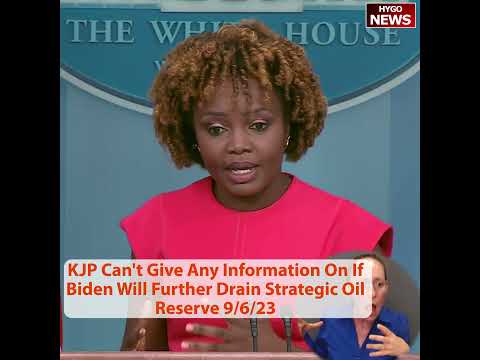
KJP Can’t Give Any Information on Whether Biden Will Further Drain the Strategic Oil Reserve
On September 5, 2023, a reporter asked White House Press Secretary Karine Jean-Pierre whether the Biden administration would consider further tapping the Strategic Petroleum Reserve if oil prices continued to rise. The question was timely — gas prices were climbing again, and the administration had already drawn the SPR down to its lowest level since 1983. Jean-Pierre’s response was to refuse to engage with the question at all, calling it a “hypothetical” and deferring to the Energy Department. The exchange highlighted the administration’s inability to offer any coherent strategy on energy prices beyond the short-term political fix of draining the nation’s emergency oil stockpile.
The Exchange
The reporter framed the question with awareness of the administration’s contradictory position: “I know the administration is currently trying to refill the Strategic Petroleum Reserve, but if prices continue to spiral out of control, would you consider tapping it and selling more on the market to lower prices?”
Jean-Pierre deflected immediately: “So, I don’t want to get too much into hypotheticals of what may or may not happen. Just want to be very careful. Clearly, that’s something that the Energy Department focuses on, as it relates to that piece of refilling — refilling. So, I’m just not going to get ahead of what the Energy Department might do. And so, I’m just going to leave it — kind of leave it there.”
The answer was remarkable for how little information it conveyed. In roughly 60 words, Jean-Pierre managed to say nothing about the administration’s plans, strategy, or even general direction on oil reserves. She used the word “hypothetical” to avoid a question about a scenario that was already unfolding — gas prices were rising at the time of the briefing — and deferred to the Energy Department, effectively telling the White House press corps to ask someone else.
The Strategic Petroleum Reserve Crisis
The reporter’s question came at a particularly fraught moment for the SPR. The Biden administration had conducted the largest drawdown in the reserve’s history, releasing approximately 180 million barrels of crude oil between March and October 2022 in an effort to lower gasoline prices ahead of the 2022 midterm elections.
The massive release brought the SPR’s inventory from approximately 568 million barrels when Biden took office in January 2021 to roughly 347 million barrels by September 2023, the lowest level since September 1983. The reserve, which has a maximum capacity of 714 million barrels, had been created in 1975 in response to the Arab oil embargo specifically to provide a strategic cushion against supply disruptions that could threaten national security.
Critics argued that the Biden administration had transformed the SPR from a national security asset into a political tool, draining it to temporarily suppress gas prices and improve poll numbers rather than reserving it for genuine emergencies. The drawdown coincided with the run-up to the 2022 midterm elections, and the timing reinforced the perception that the release was politically rather than strategically motivated.
The Refilling Problem
The reporter’s question exposed a fundamental contradiction in the administration’s energy policy. The White House had simultaneously claimed credit for drawing down the SPR to lower gas prices and promised to refill the reserve when prices dropped. However, the administration had struggled to execute the refilling plan.
The Department of Energy had announced plans to begin repurchasing oil for the SPR when crude prices fell to around $70 per barrel or below. However, oil prices had remained stubbornly above that threshold through much of 2023, and the administration had purchased only a small fraction of what it had released. By September 2023, the refilling effort was far behind schedule.
The difficulty of refilling the SPR at affordable prices illustrated the problem with using the reserve as a price management tool. Selling when prices were high and buying when prices were low sounded logical in theory, but in practice, the government was selling at lower prices than it would need to pay to refill, creating a net loss for taxpayers. Moreover, the announcement that the government was buying oil for the SPR put upward pressure on prices, working against the very goal of lowering costs for consumers.
Saudi Production Cuts Complicate the Picture
The SPR question came in the context of Saudi Arabia’s decision to extend voluntary oil production cuts. Saudi Arabia had been reducing output by one million barrels per day since July 2023 in coordination with other OPEC+ members, a move that kept oil prices elevated and put additional upward pressure on American gas prices.
The Saudi cuts directly undermined the Biden administration’s energy strategy. The administration had sold SPR oil to bring prices down, but the Saudi production cuts pushed prices back up. The net effect was that the United States had less oil in reserve and prices were rising again anyway, leaving the country in a worse position than before the drawdown began.
A follow-up question during the same briefing asked Jean-Pierre about the Saudi production cuts. She claimed the cuts did not “complicate” the administration’s efforts to lower gas prices, a statement that strained credulity given the direct relationship between global oil supply and domestic gas prices.
Gas Prices Under Biden
Jean-Pierre used the SPR exchange as an opportunity to claim credit for lowering gas prices, saying: “If you look at what we’ve been able to do from last summer to this summer — lowering gas prices by a dollar twenty cents — that is because of the work that this administration has done.”
This claim required significant context. Gas prices had spiked dramatically under Biden, reaching a national average of over $5.00 per gallon in June 2022, the highest level in American history. The subsequent decline from that peak to approximately $3.80 per gallon by September 2023 was largely driven by the massive SPR drawdown, declining global demand, and market corrections rather than any permanent policy change.
Moreover, the baseline comparison Jean-Pierre chose was deliberately flattering. Gas prices when Biden took office in January 2021 averaged approximately $2.39 per gallon. By September 2023, they were approximately $3.80 per gallon, a 59 percent increase. Comparing to the crisis peak rather than to Biden’s starting point allowed the administration to claim credit for a decline when prices remained substantially higher than when Biden entered office.
The “Hypothetical” That Was Not Hypothetical
Jean-Pierre’s characterization of the question as a “hypothetical” was itself a deflection. The reporter was not asking about an implausible scenario. Gas prices were rising at the time of the briefing. The administration had already demonstrated its willingness to tap the SPR for price relief. The question was whether it would do so again.
This was not a hypothetical; it was a question about the administration’s contingency plans for an actively developing situation. By labeling it a hypothetical, Jean-Pierre avoided having to discuss the uncomfortable reality that the administration’s primary tool for managing gas prices — the SPR — was severely depleted, and there was no clear plan for what to do if prices continued climbing.
The deferral to the Energy Department was equally evasive. Energy policy at this scale was not a technical matter for the department to decide independently; it was a political decision made at the highest levels of the White House. The president himself had ordered the previous SPR releases, and any future release would similarly require presidential authorization. Jean-Pierre’s suggestion that this was an Energy Department question was an attempt to create distance between the White House and an issue it was directly responsible for.
Key Takeaways
- On September 5, 2023, KJP refused to say whether Biden would further tap the Strategic Petroleum Reserve as gas prices rose, calling the question a “hypothetical” and deferring to the Energy Department.
- The SPR had been drawn down from approximately 568 million barrels when Biden took office to roughly 347 million barrels by September 2023, the lowest level since 1983, following the largest release in the reserve’s history.
- The administration’s plan to refill the SPR when prices fell to $70 per barrel was far behind schedule, as oil prices remained stubbornly above that threshold throughout 2023.
- KJP claimed gas prices had been lowered by $1.20 from the previous summer, but this compared to a crisis peak; prices remained approximately 59 percent higher than when Biden took office.
- Saudi Arabia’s production cuts were simultaneously pushing prices higher, undermining the effect of the SPR releases and leaving the reserve depleted without a lasting benefit to consumers.