 HYGO News
 KJP Brags About 'Lowering Gas Prices,' Even As Prices Have Soared Since Biden Took Office
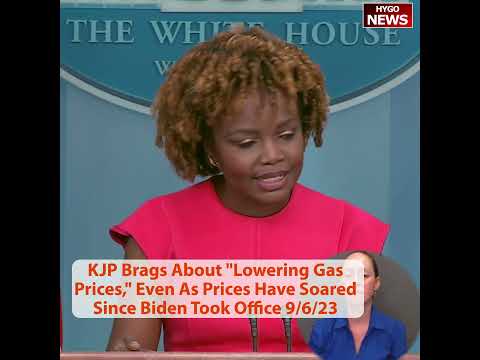
KJP Brags About “Lowering Gas Prices” Even as Prices Have Soared Since Biden Took Office
On September 5, 2023, a reporter asked White House Press Secretary Karine Jean-Pierre about Saudi Arabia’s decision to extend oil production cuts and how that complicated the administration’s efforts to lower gas prices. Jean-Pierre’s response was to flatly deny that the Saudi cuts complicated anything, then pivot to bragging that the administration had lowered gas prices “by a dollar twenty cents” from the previous summer. The claim relied on a carefully chosen baseline that measured from the crisis peak of summer 2022 rather than from when Biden took office, obscuring the fact that gas prices remained dramatically higher than they were before Biden’s presidency began.
The Exchange
The reporter asked a direct, policy-relevant question: “And the Saudi decision to extend their oil production cuts — what’s your reaction to that? How does that complicate your effort to lower gas prices?”
Jean-Pierre’s answer denied the premise entirely: “So, look, it — it doesn’t complicate our efforts. We’ve been very clear. The President has said at the — at the — at the top, or the center, of his economic policy is lowering costs for Americans, right? And — and so, our focus is going to be about American consumers, how we can continue to do that.”
She then delivered the talking point: “If you look at what we’ve been able to do from last summer to this summer — lowering gas prices by a — by a dollar twenty cents — that is — that is because of the work that this administration has done. And so, we’re always going to be focused on how — what — you know, what — what steps we can take to continue to lower prices for Americans.”
The claim that Saudi production cuts did not “complicate” the administration’s gas price efforts defied basic economics. Saudi Arabia was the world’s largest oil exporter and a dominant force in OPEC+. When Saudi Arabia cut production, global oil supply contracted, pushing crude prices higher, which directly translated to higher gasoline prices at American pumps. Denying this relationship was the equivalent of claiming that removing a major supplier from a market had no effect on prices.
The $1.20 Talking Point and Its Deception
The centerpiece of Jean-Pierre’s response was the claim that gas prices had fallen by $1.20 “from last summer to this summer.” This figure was accurate as a mathematical comparison between June 2022 and September 2023 average prices. However, it was profoundly misleading as a measure of the administration’s economic performance.
Gas prices had spiked to an all-time national average of $5.01 per gallon in June 2022, a level that reflected a convergence of factors including Russia’s invasion of Ukraine, post-pandemic demand recovery, constrained refinery capacity, and the inflationary effects of the administration’s massive spending programs. By September 2023, the national average had come down to approximately $3.80 per gallon.
The $1.20 decline from the crisis peak was real, but presenting it as an achievement was like a firefighter claiming credit for reducing a fire from five alarms to three. The fire was still burning, and the house was still engulfed compared to its pre-fire condition.
The more honest comparison was to the starting point of Biden’s presidency. When Biden was inaugurated on January 20, 2021, the national average gas price was approximately $2.39 per gallon. By September 2023, it was approximately $3.80 — a 59 percent increase, or roughly $1.41 per gallon more than when Biden took office. Americans filling a typical 15-gallon tank were paying approximately $21 more per fill-up compared to January 2021.
The Saudi Production Cuts
Saudi Arabia’s decision to extend its voluntary production cut of one million barrels per day through the end of 2023 was a direct challenge to the Biden administration’s energy strategy. The cuts, implemented in coordination with other OPEC+ members including Russia, were designed to support oil prices at levels favorable to producer nations.
The Biden administration had tried multiple approaches to influence Saudi oil production. President Biden had traveled to Saudi Arabia in July 2022 for a meeting with Crown Prince Mohammed bin Salman, a trip that was widely seen as an effort to persuade the Saudis to increase production. The trip produced a controversial fist bump between Biden and MBS but no meaningful change in Saudi production policy. In fact, OPEC+ announced production cuts just weeks later, a move that the White House privately viewed as a deliberate snub.
The Saudi cuts were particularly problematic because they coincided with the administration’s effort to refill the Strategic Petroleum Reserve. The administration needed low oil prices to refill the SPR cost-effectively, but the Saudi cuts pushed prices higher, making refilling more expensive and putting the administration in the uncomfortable position of either paying more to refill the reserve or leaving it at historically low levels.
The Baseline Game
The administration’s gas price messaging relied on what economists call “baseline manipulation” — choosing a comparison point that produced the most favorable narrative. By measuring from the June 2022 peak rather than from January 2021, the White House could claim a decline when the overall trajectory under Biden was sharply upward.
This technique was used across multiple economic metrics during the Biden presidency. Inflation was described as “falling” because the rate of price increases was slowing, even though prices themselves remained elevated. Job creation was described as “historic” by counting pandemic recovery jobs as new employment. And gas prices were described as “lowered” by measuring from a crisis peak that occurred on the administration’s own watch.
The approach had a fatal flaw: Americans did not experience gas prices as a comparison between two cherry-picked dates. They experienced them every time they filled their tanks, and their reference point was what they had been paying before Biden took office. By that measure, the news was unambiguously bad.
The SPR Factor
A significant portion of the gas price decline Jean-Pierre was claiming credit for was attributable to the administration’s massive drawdown of the Strategic Petroleum Reserve. The release of approximately 180 million barrels between March and October 2022 had temporarily increased domestic oil supply and put downward pressure on prices.
However, this was not a sustainable strategy. The SPR was a finite resource, and the administration had already drawn it down to its lowest level since 1983. The temporary price relief purchased by depleting the reserve came at the cost of reduced national security preparedness. If a genuine supply disruption occurred — a major hurricane damaging Gulf Coast refineries, an escalation in Middle East tensions disrupting tanker traffic, or a broader conflict affecting oil production — the United States would have significantly less cushion than it had before Biden began the drawdowns.
The irony of the administration bragging about lowering gas prices through SPR releases was that this approach was essentially a one-time trick. The reserve could not be drawn down indefinitely, and when the releases stopped, prices rose again, which is exactly what was happening in September 2023 as gas prices crept higher.
The Broader Energy Policy Failure
Jean-Pierre’s gas price boast came against the backdrop of an administration whose broader energy policy was oriented toward restricting domestic fossil fuel production. Biden had canceled the Keystone XL pipeline on his first day in office, paused new oil and gas leasing on federal lands, and pursued regulatory changes that discouraged investment in domestic energy production.
These policies reduced domestic supply potential at a time when global demand was recovering and geopolitical instability was threatening international supply chains. The predictable result was higher energy prices, which the administration then attempted to address through SPR releases rather than by encouraging domestic production.
The disconnect between the administration’s climate-oriented energy policy and its desire for low gas prices was a fundamental tension that Jean-Pierre’s talking points could not resolve. You could not simultaneously restrict domestic energy production, deplete the strategic reserve, face OPEC+ production cuts, and claim to be lowering gas prices for Americans with a straight face. Yet that is precisely what the White House attempted every time the subject came up.
Key Takeaways
- KJP claimed Saudi Arabia’s oil production cuts did not “complicate” the administration’s efforts to lower gas prices, denying the basic economic relationship between supply reductions and price increases.
- Jean-Pierre boasted that gas prices had fallen “$1.20” from the previous summer, a figure measured from the June 2022 crisis peak of $5.01 per gallon rather than from the $2.39 average when Biden took office.
- By the honest baseline of Biden’s inauguration, gas prices were approximately 59 percent higher in September 2023, costing a typical driver about $21 more per fill-up.
- The gas price decline Jean-Pierre cited was largely attributable to the administration’s historically massive drawdown of the Strategic Petroleum Reserve, which depleted the emergency stockpile to its lowest level since 1983.
- The administration’s energy policy simultaneously restricted domestic production, depleted the strategic reserve, and faced OPEC+ production cuts, creating contradictions that talking points about “$1.20 savings” could not resolve.