 HYGO News
 KJP assures us 6-point plan; blame GOPs political stunt
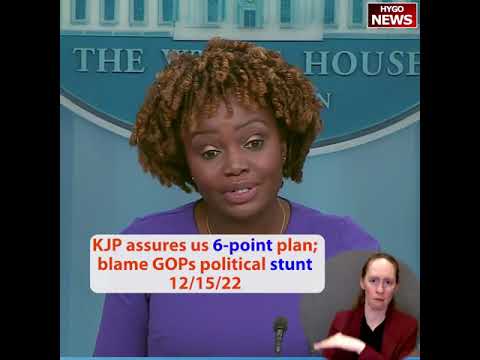
KJP: Republicans Doing “Political Stunts” as Border Response — Points to DHS “Six-Point Plan” From Mayorkas’s Border Visit
On 12/15/2022, White House Press Secretary Karine Jean-Pierre characterized Republican border visits as “political stunts” while pointing to the Biden administration’s preparation for the anticipated end of Title 42 the following week. “What we’re seeing is Republicans continue to move forward with political stunts. Many of them are doing this, and we continue to see this over the last several months. So the president has done the work. He’s secured record funding,” KJP said. She cited a DHS “six-point plan” from Secretary Alejandro Mayorkas’s border visit as evidence of preparation: “Secretary Mayakis was very clear about that. He laid out their six-point plan when he was at the border just a couple of days ago.” The framing combined Republican-blame deflection with generic preparation claims to address concerns about the impending Title 42 end.
The Political Stunts Framing
KJP opened with a Republican attack. “What we’re seeing is Republicans continue to move forward with political stunts. Many of them are doing this, and we continue to see this over the last several months,” KJP said.
The “political stunts” framing was the administration’s standard characterization of Republican border engagement. Republican border visits, media events, and legislative proposals were consistently characterized as political theater rather than substantive engagement.
The framing served several purposes:
Delegitimized Republican criticism — If stunts, not substantive.
Excused administration inaction — If Republicans weren’t serious, no cooperation needed.
Shifted narrative — From border problems to Republican performance.
Protected administration messaging — From Republican counter-messaging.
But the framing was selective. While some Republican actions were admittedly performative, others were substantive:
Governor border visits — Often included operational discussions. Senator oversight hearings — Asked detailed policy questions. House investigations — Produced specific findings. State legal challenges — Argued substantive legal positions. Specific policy proposals — Contained concrete provisions.
Characterizing all of this as “stunts” ignored the substantive elements. The framing was rhetoric more than analysis.
”The President Has Done the Work”
KJP claimed administration action. “So the president has done the work. He’s secured record funding,” KJP said.
The “done the work” framing was vague. “The work” wasn’t specified. “Record funding” was cited but without explanation of what the funding had accomplished.
This pattern was common in administration border messaging:
Generic action claims — Without operational specifics.
Funding emphasis — Over actual outcomes.
Temporal vagueness — About when actions occurred.
Subject deflection — From problems to administration efforts.
The framing told the public that Biden was doing something without telling them what. This protected the administration from scrutiny of specific actions while claiming generic credit for engagement.
”Taking Steps to Prepare”
KJP addressed the Title 42 deadline. “What the American people should know is that we have taken the steps. We’re taking the step to prepare for what is, for when Title 42 is lifted next week,” KJP said.
The “taking steps” framing was similarly vague:
What steps — Not specified.
How many steps — Unclear.
What progress — Not detailed.
What outcomes expected — Not projected.
Listening to KJP’s response, listeners would know that preparation was happening but not what specifically was being prepared. This was preparation-as-concept rather than preparation-as-operational-detail.
The Six-Point Plan Reference
KJP pointed to specific administration action. “You saw that from the Department of Homeland Security. Secretary Mayakis was very clear about that. He laid out their six-point plan when he was at the border just a couple of days ago,” KJP said.
“Mayakis” was a mispronunciation of Mayorkas — the DHS Secretary. The reference to a six-point plan was interesting because:
Specific number — Six points suggested concrete plan.
DHS authorship — Agency-level planning.
Recent announcement — Within days of this briefing.
Secretary-level presentation — At senior administration level.
Border location — Operational context.
The six-point plan Mayorkas had announced on December 13, 2022 included:
1. Surge resources — Personnel, facilities, transportation.
2. Increase efficiency — Processing capacity.
3. Deploy regional processing centers — In Western Hemisphere.
4. Impose consequences — For unlawful entry.
5. Bolster non-governmental capacity — NGO partnerships.
6. Target smugglers — Law enforcement against criminal networks.
These were substantive policy elements. The administration did have a plan with specific components. KJP’s reference gave the plan existence even if she didn’t detail it herself.
The Six-Point Plan’s Limitations
Despite its substantive content, the six-point plan had limitations that KJP didn’t address:
Not a magic solution — The anticipated surge would still be challenging.
Dependent on regional cooperation — Which was variable.
Required Congressional funding — Still being requested.
Subject to legal challenges — On various provisions.
Uncertain timing — For full implementation.
The six-point plan was a framework, not a guaranteed outcome. Its effectiveness would depend on execution, cooperation from various parties, and specific circumstances as Title 42 ended.
”This Is an Administration That Has Taken This Very…”
KJP’s response trailed off. “And this is an administration that has taken this very…,” she continued, with the transcript cutting off at “very.”
Whatever follows “very” was probably “seriously” or “carefully” — a standard administration framing for any issue. The incomplete sentence was another example of KJP’s verbal patterns.
The trailing off might have been:
Clip cutoff — The video ended before the sentence completed.
Mental trailing — KJP started a sentence without a clear ending.
Interruption — Being asked a different question.
Topic shift — Moving to next reporter.
Regardless of cause, the incomplete sentence left the promised administration characterization unfinished. Listeners would have to assume what KJP was going to say.
The Pattern of Messaging
The exchange exemplified several patterns in administration border messaging:
Republican blame framing — Blaming the other party for political behavior.
Preparation claims — Without specific operational detail.
Cabinet reference — Pointing to Mayorkas and other officials.
Resource emphasis — Citing funding rather than outcomes.
Defensive posture — Responding rather than proactively addressing.
These patterns combined to produce messaging that sounded substantive but provided limited actual information. Reporters could quote administration officials saying preparation was occurring, but readers couldn’t learn what specific preparations existed or how they would work.
The Context: Title 42 Ending Soon
The briefing occurred in a context of imminent change. Title 42 was set to end on December 21, 2022 — less than a week after this briefing. The Supreme Court had not yet intervened, and the legal deadline was approaching rapidly.
The administration needed to:
Show preparation — To avoid appearing unready.
Manage expectations — About anticipated surge.
Communicate with border communities — About what to expect.
Coordinate with international partners — For regional implementation.
Prepare for political fallout — If preparations were inadequate.
KJP’s messaging was part of this broader effort. By pointing to the six-point plan and administration funding, the administration was establishing that preparation had occurred. If subsequent events were chaotic, the administration could claim it had done what it could with available resources.
The “Record Funding” Claim
KJP cited “record funding” for border operations. This claim deserved examination:
DHS funding had grown — During Biden’s presidency.
Border-related appropriations — Had increased.
CBP operational resources — Had expanded.
But some cuts had occurred — In specific areas.
Administration requests exceeded appropriations — In various cycles.
“Record funding” was technically accurate for overall DHS budget, but operational reality was more complex. Various specific needs were unmet. Staffing shortages existed. Infrastructure was strained. Congressional negotiations continued about specific funding levels.
The “record funding” claim, like many administration claims, was true in aggregate but misleading in specifics. It conveyed adequate resourcing without acknowledging operational constraints.
The Eventual Title 42 End
The anticipated December 21, 2022 end of Title 42 didn’t occur due to Supreme Court intervention. Chief Justice Roberts stayed the lower court ruling, preserving Title 42 while the Court considered whether to take the case.
Title 42 eventually ended in May 2023 under different circumstances. The administration’s preparation in late 2022 wasn’t tested against the anticipated surge. The six-point plan continued to be elaborated but wasn’t immediately challenged by mass migration.
When Title 42 did end in May 2023, the administration had additional months of preparation. Various new policies were in place. The actual post-Title-42 experience was less chaotic than had been feared, though it wasn’t without challenges.
Whether the December 2022 six-point plan would have been adequate for the December 21 end was never tested. The plan evolved over the intervening months into more elaborate policies. The counterfactual — how the plan would have performed in December 2022 — remained unknown.
The Effectiveness Question
The administration’s effectiveness on border issues throughout Biden’s term was contested. Different metrics showed different things:
Border encounters — At record levels throughout 2021-2023.
Deportations — At lower rates than some previous administrations.
Asylum processing — Continued backlogs.
Catch-and-release — Substantial percentages of encounters.
Migration from specific countries — Venezuela, Haiti, etc.
Regional cooperation — Variable results.
Biden’s defenders argued the administration was managing a difficult situation as effectively as possible given various constraints. Critics argued the administration’s policies had contributed to the surge by reducing enforcement disincentives. These interpretations reflected different assessments of what the data meant and what policies were appropriate.
KJP’s briefing messaging consistently favored the administration’s framing. Republican criticism was stunts; administration action was substantive work; specific plans existed to address challenges. This messaging may or may not have matched operational reality, but it was the consistent public positioning.
Key Takeaways
- KJP characterized Republican border engagement as “political stunts” while claiming the administration had “done the work.”
- She cited DHS Secretary Mayorkas’s “six-point plan” for handling the anticipated end of Title 42 — announced days earlier at the border.
- The six-point plan included surging resources, increasing efficiency, deploying regional processing centers, imposing consequences, bolstering NGO capacity, and targeting smugglers.
- KJP’s response combined specific plan reference with generic claims about “record funding” and “taking steps to prepare.”
- The response didn’t detail the six-point plan’s specifics or address concerns about its adequacy for an anticipated unprecedented surge.
- The December 21 end of Title 42 didn’t occur due to Supreme Court intervention, meaning the specific preparations weren’t tested against the anticipated surge.
Transcript Highlights
The following is transcribed from the video audio (unverified — AI-generated from audio).
- What we’re seeing is Republicans continue to move forward with political stunts.
- So the president has done the work. He’s secured record funding.
- What the American people should know is that we have taken the steps.
- We’re taking the step to prepare for what is, for when Title 42 is lifted next week.
- Secretary Mayakis was very clear about that. He laid out their six-point plan when he was at the border just a couple of days ago.
- And this is an administration that has taken this very…
Full transcript: 118 words transcribed via Whisper AI.