 HYGO News
 KJP Appears To Have No Idea What Biden Meant By 'Read Your Press' On Afghanistan
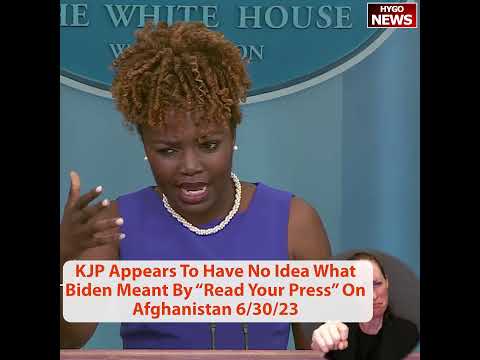
KJP Appears to Have No Idea What Biden Meant by “Read Your Press” on Afghanistan
On June 30, 2023, White House Press Secretary Karine Jean-Pierre was unable to explain what President Biden meant when he told reporters to “read your press” in response to questions about the State Department’s after-action review of the Afghanistan withdrawal. Earlier that day, Biden had been asked whether he admitted failure in Afghanistan, to which he defiantly responded that he “was right” and instructed reporters to read their own coverage. When Jean-Pierre was pressed on what Biden had meant, she acknowledged she had not heard his exact remarks and instead pivoted to general talking points about the “tough decision” Biden had to make early in his administration.
The Reporter’s Question
A reporter brought Biden’s earlier comments directly to Jean-Pierre during the White House briefing: “Can you just on the report, has the President reviewed it or been briefed on it? He was just asked about it in the Roosevelt Room, and he said, ‘Read your press.’ And I wasn’t really clear what he was trying to say there.”
The question was straightforward: what did the President mean? Biden had been asked about the State Department’s newly released review of the Afghanistan withdrawal, a document that detailed failures in planning and execution, and his response had been to tell reporters to read their own press coverage. The reporter, understandably, wanted clarification on what specific press coverage Biden was referencing and what point he was trying to make.
The question also carried an implicit observation: the reporter had been present for Biden’s remarks and could not determine their meaning, which suggested that Biden’s answer had been either incoherent or deliberately evasive.
Jean-Pierre’s Non-Answer
Jean-Pierre’s response confirmed that she could not explain Biden’s remark either. She began with a significant admission: “Well, I didn’t hear — I know that he was asked about this particular review or this action — after-action review that was given.”
The admission that she had not heard Biden’s exact words was notable because it meant the White House press secretary was unable to provide a first-hand interpretation of the President’s statement. Rather than saying she would follow up with the President or his staff to clarify, she immediately pivoted to a prepared talking point.
Jean-Pierre continued: “Look, what I can speak to is more broadly what the President has said. And I think this is what he was referring to: He had to make a tough decision. Right? In the beginning of his administration, he had to make a tough decision.”
The phrase “I think this is what he was referring to” was a telling hedge. Jean-Pierre was not explaining what Biden meant; she was speculating about what he might have meant. And her speculation — that Biden was referring to the general difficulty of the withdrawal decision — did not address the specific “read your press” instruction at all. Biden had not told reporters that withdrawing from Afghanistan was a tough decision. He had told them to read their press, implying that media coverage somehow vindicated his approach. Jean-Pierre’s answer did not bridge the gap between what Biden said and what he apparently meant.
Biden’s Earlier Remarks
The exchange Jean-Pierre was being asked about occurred earlier the same day. Biden had been defiant when asked if he would admit the U.S. made mistakes before and during the withdrawal from Afghanistan. He responded: “Remember what I said about Afghanistan? I said Al-Qaeda would not be there. I said it wouldn’t be there. I said we’d get help from the Taliban. What’s happening now? What’s going on? Read your press. I was right.”
Biden’s claims were factually challenged on multiple fronts. Al-Qaeda’s continued presence in Afghanistan had been documented by U.S. intelligence agencies and UN monitoring teams. The killing of Al-Qaeda leader Ayman al-Zawahiri in Kabul in July 2022, living under apparent Taliban protection, directly contradicted Biden’s assertion that Al-Qaeda “would not be there.” His claim that the U.S. would “get help from the Taliban” was similarly unsupported by the Taliban’s actions following the withdrawal, including their imposition of authoritarian rule and their systematic repression of women and political opponents.
The State Department Review
The after-action review at the center of the exchange was the State Department’s most comprehensive internal assessment of the August 2021 withdrawal. The review found that the State Department failed to do enough planning before the collapse of the U.S.-backed government in Afghanistan. It repeatedly blamed the administrations of both former President Trump and President Biden for their efforts before and after the August 2021 departure of U.S. forces from Kabul.
The review documented specific failures, including the administration’s inability to decide which Afghans should be eligible for evacuation, changing guidance that created confusion among personnel on the ground, and inadequate preparation for the rapid collapse of the Afghan government and military. The U.S. had evacuated an estimated 124,000 Afghans from the country, but the process was marred by chaos, with desperate crowds overwhelming the airport perimeter and resulting in the tragic deaths of 13 U.S. service members in a suicide bombing at Abbey Gate.
The administration released only 24 of the review’s 87 pages, and the release came on a Friday afternoon before a holiday weekend, a timing choice that critics described as a deliberate effort to minimize press coverage and public scrutiny.
A Pattern of Deflection
Jean-Pierre’s inability to explain Biden’s remarks was part of a recurring pattern during the Biden administration’s press briefings. When Biden made statements that were unclear, contradictory, or factually challenged, Jean-Pierre frequently found herself in the position of having to interpret the President’s words while simultaneously distancing herself from them.
In this case, the deflection to “broadly what the President has said” about making “a tough decision” was a retreat to safe ground. It avoided engaging with the specific claim that events had proven Biden right on Afghanistan, a claim that did not withstand scrutiny. It also avoided addressing the State Department review’s actual findings, which documented significant failures that the President had just denied.
Republicans accused the administration of not taking responsibility for intelligence failures and for the chaotic execution of the withdrawal. The exchange between the reporter and Jean-Pierre reinforced that criticism. The White House press secretary could not explain the President’s own words about the most consequential military withdrawal in decades, and her attempt to speculate about his meaning only highlighted the gap between Biden’s claims of vindication and the documented reality of the withdrawal’s failures.
Key Takeaways
- When asked what Biden meant by telling reporters to “read your press” about Afghanistan, Jean-Pierre admitted she had not heard his remarks and could only speculate that he was referring to the general difficulty of the withdrawal decision.
- Jean-Pierre hedged with “I think this is what he was referring to,” confirming she could not definitively explain the President’s statement.
- Biden had earlier declared “I was right” about Afghanistan and claimed Al-Qaeda would not be there and the U.S. would get help from the Taliban — both assertions contradicted by subsequent events.
- The State Department review found that both the Trump and Biden administrations bore responsibility for failures in the Afghanistan withdrawal, but only 24 of 87 pages were released.
- The exchange reinforced Republican criticism that the Biden administration refused to take responsibility for the chaotic withdrawal that killed 13 U.S. service members and evacuated 124,000 Afghans.