 HYGO News
 KJP announces more pardons; sign or veto Laken Riley Act? Facebook eliminated DEI & fact checking
KJP announces more pardons; sign or veto Laken Riley Act? Facebook eliminated DEI & fact checking
In one of the final White House press briefings of the Biden administration in January 2025, Press Secretary Karine Jean-Pierre announced that President Biden would be issuing additional pardons, dodged a direct question about whether Biden would sign or veto the Laken Riley Act, and was pressed on Meta’s decisions to eliminate both its DEI programs and its third-party fact-checking system on Facebook and Instagram.
Biden to Issue More Pardons
Karine Jean-Pierre confirmed that President Biden intended to issue additional pardons before leaving office on January 20. “We will be making some more additional announcements on pardons,” KJP told reporters when asked whether the president was still considering preemptive pardons for government officials.
The announcement came in the context of growing speculation about whether Biden would issue preemptive pardons to allies who might face investigation or prosecution under the incoming Trump administration. Biden had already issued a controversial pardon for his son Hunter Biden in December 2024, reversing his earlier pledge not to do so. The prospect of additional preemptive pardons for government officials raised questions about whether the outgoing president was using his pardon power to shield political allies from accountability.
KJP did not specify who would receive pardons or the scope of the planned clemency actions, leaving reporters and the public to speculate about which officials might be included.
Laken Riley Act: “I’m Not Going to Get Into Hypotheticals”
The most contentious exchange of the briefing came when the Associated Press’s Zeke Miller asked KJP directly whether Biden would sign the Laken Riley Act if it reached his desk before he left office. The bill, named after Laken Riley, a Georgia nursing student who was murdered by an illegal immigrant in February 2024, would require federal detention of illegal immigrants arrested for certain crimes.
“Yesterday, the Senate advanced the Laken Riley Act, which passed the House,” Miller said. “If it’s presented to him before he leaves office on the 20th, would the President sign that bill or veto it?”
KJP’s response was marked by visible discomfort and repeated stammering. “So — um — I’m not going to get ahead of — uh — of what’s happening, the proceed — I know there was a procedural vote that happened in the Senate. I’m gonna let the process play — uh — play out — let the — let the senators do — uh — do their work on that. I don’t want to get ahead of that, so we’re going to let it play out. Uh — I’m not going to get into — uh — a hypothetical on this right now.”
Miller pressed further, noting that the administration typically issues Statements of Administration Policy (SAPs) indicating where the president stands on pending legislation. “The administration also often puts out statements of administration policy — where it stands, so you’re not putting one out here?” he asked.
KJP could only repeat that “the process is still playing out.” The non-answer was widely interpreted as an indication that the administration wanted to avoid the politically toxic optics of either signing a bill that contradicted its immigration stance or vetoing legislation named after a murder victim. The Laken Riley case had become one of the most potent symbols of the consequences of the Biden administration’s border policies.
Meta Eliminates DEI Programs
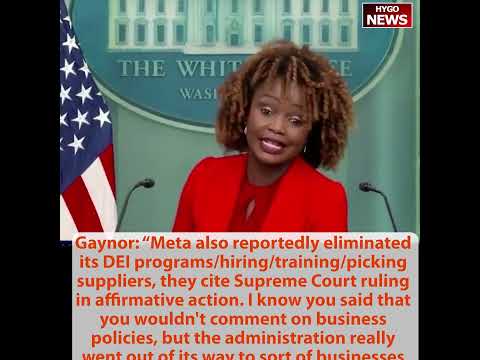
TheGrio’s Gerren Keith Gaynor pressed KJP on Meta’s decision to eliminate its Diversity, Equity, and Inclusion programs across hiring, training, and supplier selection. Meta cited the Supreme Court’s ruling on affirmative action as part of its rationale, joining companies like McDonald’s and Walmart in rolling back DEI initiatives.
KJP fell back on broad talking points. “You’ve heard from this President, you’ve heard from this administration — diversity is our greatest strength,” she said. “You have seen this not just by words, by action that this President has taken, and certainly that is a sentiment you’ve heard echoed by leaders across businesses and government.”
She emphasized the importance of “different voices around the table” and “different voices working on policy to make sure that we are delivering for the American people.” But she stopped short of criticizing Meta or any specific company, maintaining the administration’s position of not commenting on individual corporate policy decisions.
The gap between the administration’s rhetoric about diversity as “our greatest strength” and its unwillingness to criticize companies for abandoning DEI programs illustrated the political bind the White House found itself in during its final days.
Facebook Drops Fact Checking
Reuters’s Jeff Mason brought up Meta’s separate but related decision to eliminate its third-party fact-checking program on Facebook and its other platforms, a move that had been announced by CEO Mark Zuckerberg as part of a broader shift toward “free expression.”
KJP acknowledged the administration’s longstanding position that social media companies have “an important role to play in enforcing their own rules to prevent the spread of misinformation,” but refused to comment specifically on Meta’s announcement. “Speaking specifically to an announcement, we’re just not going to comment on that,” she said.
Mason pushed back, noting: “That is something that you guys have been outspoken about and they’re making a change on it, so I guess it’s something I thought maybe you would want to comment on.”
KJP held firm. “We talk about social media companies having a responsibility. We’ve always said that,” she repeated. “We’ve also been clear that policy decisions that are made by private companies, we’re not going to speak to those specific announcements.” The refusal to engage directly with Meta’s decision was notable given the Biden administration’s history of pressuring social media companies to moderate content, an effort that had drawn significant legal scrutiny and accusations of government censorship.
No Final Press Conference Planned
In a telling exchange near the end of the briefing, Miller asked whether Biden planned to hold a final press conference during his last week in office, noting it was customary for departing presidents. KJP could not confirm any such plans. “I don’t have anything to preview right now at this moment,” she said, adding only that Biden would “certainly continue to engage with all of you by taking your questions.”
The absence of a planned final press conference for a departing president was unusual and contributed to the sense that the Biden administration was winding down without the traditional gestures of transparency that mark presidential transitions.
Key Takeaways
- Karine Jean-Pierre confirmed Biden would issue additional pardons before leaving office, raising concerns about preemptive pardons for political allies.
- KJP refused to say whether Biden would sign or veto the Laken Riley Act if it reached his desk, repeatedly calling it a “hypothetical” despite the bill having already passed the House and advanced in the Senate.
- Meta eliminated its DEI programs across hiring, training, and supplier selection; KJP would only repeat that “diversity is our greatest strength” without criticizing the company.
- Meta also dropped its third-party fact-checking program on Facebook; KJP declined to comment specifically despite the administration’s history of pushing social media companies to combat misinformation.
- No final presidential press conference was planned for Biden’s last week in office, breaking with longstanding tradition.