 HYGO News
 KJP Again Dodges Questions On Biden's Involvement In Hunter's Foreign Business Deals
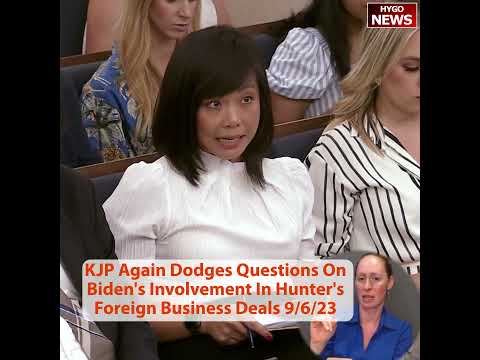
KJP Again Dodges Questions on Biden’s Involvement in Hunter’s Foreign Business Deals
On September 5, 2023, a reporter confronted White House Press Secretary Karine Jean-Pierre with one of the most specific and damaging pieces of evidence to emerge in the House Oversight Committee’s investigation into the Biden family’s business dealings. The reporter cited email traffic between Kate Bedingfield, then-Vice President Biden’s communications director, and Eric Schwerin, a longtime Hunter Biden business associate, in which Bedingfield signed off on quotes to be used in responding to media inquiries about Hunter Biden’s involvement with Burisma Holdings. The reporter asked how the White House responded to criticism that this showed there was “no wall” between Biden’s official work and his family’s business dealings. Jean-Pierre’s response was a masterpiece of deflection: “I understand the question. I appreciate the question. I get the question. I’m just going to let the White House Counsel team answer that question.”
The Bedingfield-Schwerin Email Connection
The evidence the reporter cited was significant because it directly linked the Office of the Vice President’s official communications staff with Hunter Biden’s business network. Kate Bedingfield served as Joe Biden’s communications director during his vice presidency and later returned to serve as White House communications director during the first two years of the Biden presidency, departing in February 2023.
Eric Schwerin was not a casual acquaintance of the Biden family. He was the president of Rosemont Seneca Partners, the investment firm co-founded by Hunter Biden and Devon Archer. Schwerin had extensive access to the Biden family’s financial affairs and had been identified in congressional investigations as a central figure in managing the flow of money through the network of companies associated with Hunter Biden’s business ventures.
The email traffic between Bedingfield and Schwerin involved Bedingfield reviewing and approving specific language — quotes — that would be used to respond to press inquiries about Hunter Biden’s role on the board of Burisma Holdings, the Ukrainian energy company. This meant that the vice president’s official communications team was not merely aware of Hunter Biden’s foreign business entanglements but was actively managing the public messaging around them.
The “No Wall” Question
The reporter’s question about whether the emails demonstrated there was “no wall” between Biden’s official duties and his family’s business activities went to the heart of Joe Biden’s primary defense. Throughout the 2020 campaign and his presidency, Biden had repeatedly insisted that he never discussed business with his son and that there was a complete separation between his government service and his family’s commercial activities.
The Bedingfield-Schwerin correspondence directly undermined this claim. If the vice president’s own communications director was coordinating messaging about Burisma with Hunter Biden’s business partner, it was impossible to maintain that Biden’s office operated independently of his son’s foreign business dealings. The communications staff would not have been managing Burisma-related media inquiries without the knowledge and direction of the vice president himself, as controlling the principal’s message is the communications director’s core function.
The “no wall” characterization also echoed testimony from Devon Archer, who had told the House Oversight Committee in July 2023 that there was no separation between Joe Biden’s official life and his family’s business life. Archer described a pattern in which the Biden name and Biden’s official position were central to the value proposition that he and Hunter Biden offered to foreign business partners.
KJP’s Four-Part Non-Answer
Jean-Pierre’s response to the reporter’s question was notable for its structure. She acknowledged the question four times in four different ways — “I understand the question. I appreciate the question. I get the question” — before delivering a fifth sentence that was the only one with any substance: “I’m just going to let the White House Counsel team answer that question.”
The quadruple acknowledgment served a specific rhetorical purpose. By saying she understood, appreciated, and “got” the question, Jean-Pierre was signaling that she recognized the question was legitimate and important. This was a departure from her handling of some Hunter Biden-related questions, where she had characterized them as “incredibly irresponsible” or dismissed the premises. The softer approach suggested that even the White House recognized the Bedingfield-Schwerin evidence was too concrete to brush off dismissively.
Yet the ultimate response was identical to every other Hunter Biden deflection: a referral to the White House Counsel’s Office. The counsel’s office, which does not hold press conferences or respond to individual reporter inquiries in real time, served as a dead end for accountability. Reporters could send questions to the counsel’s office, but they had no mechanism to press for follow-up or challenge non-responsive answers.
Burisma and the Ukraine Connection
The Burisma Holdings board appointment that the emails referenced had been one of the earliest and most persistent controversies surrounding Hunter Biden’s foreign business dealings. Hunter Biden joined the board of Burisma in April 2014, just weeks after his father, as vice president, was designated as the Obama administration’s point person on Ukraine policy.
Burisma was one of Ukraine’s largest private natural gas companies and was owned by Mykola Zlochevsky, a Ukrainian oligarch who had served in the government of the pro-Russian president Viktor Yanukovych. At the time of Hunter Biden’s appointment, Burisma was under investigation by Ukrainian prosecutors, and the company was seeking to burnish its international reputation and gain protection through high-profile Western board members.
Hunter Biden had no experience in the energy sector, no expertise in Ukrainian affairs, and no apparent qualification for the position beyond his last name. His compensation for the board seat was reported to be approximately $50,000 per month, a sum that congressional investigators argued was explicable only as payment for the access and influence associated with being the son of the vice president overseeing U.S. policy toward Ukraine.
The fact that the vice president’s own communications team was coordinating Burisma messaging with Hunter’s business partner added a new dimension to the controversy. It was no longer just about Hunter trading on his father’s name; it was about the vice president’s office actively participating in the management of the family’s business reputation.
The White House Counsel Strategy
The Biden White House’s reliance on the counsel’s office as a shield against press inquiries about family business dealings had been in place since the earliest days of the administration. The strategy was designed by White House Counsel Stuart Delery and his team and was intended to insulate the press secretary from making statements that could be contradicted by emerging evidence or used in legal proceedings.
However, the strategy’s effectiveness had diminished by September 2023. The sheer volume of deflections to the counsel’s office had become a story in itself, with reporters and commentators noting that the White House was willing to discuss virtually any topic except the president’s family finances. The pattern suggested not careful legal prudence but active concealment.
The counsel’s office strategy also created an asymmetry in the public discourse. Congressional Republicans held press conferences, issued statements, and engaged with media questions about their investigative findings. The White House’s silence on the substance allowed the Republican narrative to go largely unchallenged in the public arena, with Jean-Pierre’s repeated deflections serving as the only visible White House response.
The Broader Pattern of Evidence
The Bedingfield-Schwerin emails were part of a larger body of evidence that congressional investigators were assembling to demonstrate connections between Joe Biden’s official activities and his family’s business dealings. Other elements included visitor logs showing Hunter Biden’s business associates visiting the White House and vice presidential residence, photographs of Joe Biden with Hunter’s foreign business partners, text messages from Hunter Biden referencing his father’s involvement, and bank records tracing payments from foreign entities through a network of Biden family shell companies.
Each new piece of evidence made Jean-Pierre’s blanket deflections more untenable. The specificity of the Bedingfield-Schwerin connection — named individuals, specific documents, a clear chain of communication between the VP’s office and Hunter’s business network — was particularly difficult to dismiss as partisan overreach.
Key Takeaways
- A reporter cited email traffic between Kate Bedingfield, then-VP Biden’s communications director, and Eric Schwerin, Hunter Biden’s business associate, showing Bedingfield approved quotes responding to press inquiries about Hunter’s Burisma involvement.
- Jean-Pierre acknowledged the question four times — “I understand the question. I appreciate the question. I get the question” — before deflecting to the White House Counsel’s Office.
- The emails directly contradicted Biden’s claim that there was “no wall” between his official duties and his family’s business activities, as his own communications staff was coordinating Burisma messaging with Hunter’s business partner.
- Hunter Biden joined Burisma’s board in April 2014 at approximately $50,000 per month, weeks after his father was named the Obama administration’s point person on Ukraine policy, with no relevant experience in energy or Ukraine.
- The deflection to the White House Counsel’s Office was consistent with a strategy that shielded the administration from substance but reinforced the perception of concealment.