 HYGO News
 KJP Admits There's 'Gonna Be A Lot Of Questions' On Biden's Classified Docs Scandal
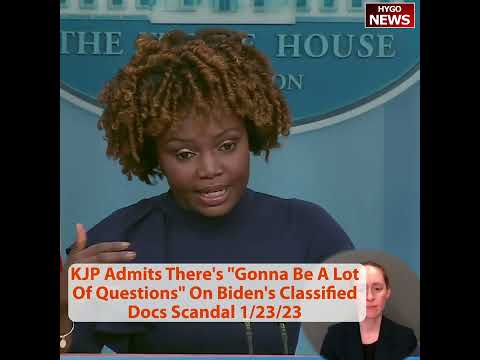
KJP Acknowledges “Lot of Questions” on Biden Classified Documents — But Ian Sams Says Total Document Count “Complicated”
In January 2023, White House Press Secretary Karine Jean-Pierre acknowledged that there would be “a lot of questions” about the Biden classified documents situation while continuing to deflect answers to Counsel’s office. A reporter asked about Biden’s surprise levels: “When the initial batch of documents were reported a couple of weeks ago, said he was surprised that there were classified documents down at the Penn Biden Center. Was he surprised that there was classified material found at his home on Friday, as well as the prior discovery of this house?” KJP responded: “There’s going to be a lot of questions on this. I know my colleagues from the White House Council’s office has been pretty diligent on taking questions these last couple of days. I’m going to continue to be prudent from here. I’m going to continue to be consistent and make sure that those questions go to my colleagues.” Ian Sams, responding to a separate question about total document count, said: “The answer to it is a little bit complicated because of this point that I’m making about the integrity of an ongoing Justice Department investigation.”
The Surprise Escalation Question
The reporter’s question was strategically sophisticated:
Initial surprise — Penn Biden Center documents.
Friday discovery — Home search findings.
Prior discovery — Earlier Wilmington finds.
Pattern question — About ongoing surprise.
Cumulative context — For responses.
The question implicitly challenged the “surprised” framing. If Biden had been surprised three separate times, either the surprises were genuine and suggesting lack of awareness, or the “surprise” characterization was wearing thin. Either interpretation was politically problematic.
The Penn Biden Center Context
The original discovery site had specific context:
Penn Biden Center — University of Pennsylvania.
Think tank — After VP term.
November 2022 — Documents found.
Initial discovery — First public.
Biden offices — Used.
The Penn Biden Center had been Biden’s post-VP think tank. Documents were discovered there in November 2022 during office cleanup. This was the first discovery. Subsequent findings at Wilmington home were separate events.
”Lot of Questions” Acknowledgment
KJP’s acknowledgment was notable. “Look, again, there’s going to be a lot of questions on this,” KJP said.
The acknowledgment:
Questions inevitability — Admitted.
Topic persistence — Recognized.
Administrative burden — Accepted.
Ongoing nature — Confirmed.
Pattern awareness — Displayed.
This was honest acknowledgment that the questions would continue. By admitting this, KJP was recognizing that her deflection strategy would be tested extensively going forward. This was more candid than pure deflection mode.
”My Colleagues From White House Counsel’s Office”
KJP referenced colleagues. “I know my colleagues from the White House Council’s office has been pretty diligent on taking questions these last couple of days,” KJP said.
The framing:
Counsel office diligence — Claimed.
Question taking — By Counsel.
Recent days — Timeframe.
Outside briefing — Activity.
Administration engagement — Framework.
This was interesting claim. Counsel’s office didn’t typically take press questions in briefing format. Whether “diligent on taking questions” meant something specific was unclear. The claim suggested more engagement than had actually occurred publicly.
The Counsel Office’s Actual Engagement
White House Counsel’s office activities:
Press statements — Few public.
Background briefings — Some.
Written statements — Through KJP.
Media interviews — Limited.
Ian Sams deployment — For specific questions.
The “pretty diligent” characterization was generous. Counsel’s office wasn’t providing extensive public engagement. Some background activity had occurred, and Ian Sams had been deployed. But comprehensive public engagement wasn’t happening.
”Prudent From Here”
KJP framed her approach. “I’m going to continue to be prudent from here. I’m going to continue to be consistent,” KJP said.
The framing:
“Prudent” — Virtue framing.
“Consistent” — Pattern maintenance.
Here — Briefing location.
Self-characterization — Favorable.
Pattern continuation — Committed.
This was KJP’s self-characterization of her deflection pattern. “Prudent” and “consistent” framed what was increasingly seen as evasion in virtue terms. The self-description was political messaging about the administration’s approach.
”Make Sure Those Questions Go to My Colleagues”
KJP’s referral. “I’m going to continue to… make sure that those questions go to my colleagues,” KJP said.
The referral:
Question routing — To colleagues.
Administrative function — Managing.
Not answering — Herself.
Colleagues unspecified — General.
Pattern institutionalized — Formally.
By framing referrals as making sure questions “go to colleagues,” KJP was making her deflections sound like administrative function. The framing suggested questions would be answered elsewhere, though this wasn’t consistently happening.
The Sams Response Included
The transcript included Ian Sams’s response to different question:
Document total count — Asked.
“Complicated” — Response framing.
Investigation integrity — Cited.
DOJ role — Emphasized.
Deflection pattern — From Sams too.
Ian Sams’s response pattern matched KJP’s broader pattern. Despite being deployed as classified documents spokesperson, Sams also deflected specific questions. The deflection was administration-wide, not just KJP.
”It’s a Little Bit Complicated”
Sams’s response was notable for “complicated” characterization. “Actually the answer to it is a little bit complicated,” Sams said.
The framing:
Simple question — Document count.
“Complicated” — Characterization.
Answer deflection — Through complexity.
Implicit refusal — Without saying so.
Rhetorical tactic — Used.
A document count wasn’t actually complicated. Investigators would have clear count. Calling it “complicated” was evasion technique. Framing simple questions as complex was tactical deflection.
The Integrity of Ongoing Investigation
Sams cited investigation integrity. “Because of this point that I’m making about the integrity of an ongoing Justice Department investigation,” Sams said.
The framing:
Investigation integrity — Cited.
Answering could damage — Implied.
DOJ control — Over information.
Administration restraint — Virtuous.
Legal protection — For administration.
Investigation integrity was legitimate concern but also useful cover. Not providing document counts didn’t obviously affect investigation integrity. The claim was stretched to cover general non-response.
”The Justice Department Is Going to Be Looking at All Sorts of Questions”
Sams continued. “The Justice Department is going to be looking at all sorts of questions like that throughout their investigation,” Sams said.
The deflection:
DOJ focus — Emphasized.
“All sorts of questions” — Broad.
Investigation scope — Wide.
Information from DOJ — Future.
Administrative silence — Justified.
By pointing to DOJ’s investigative role, Sams was deflecting administration’s responsibility to provide information. DOJ would eventually produce answers, administration didn’t need to provide them now.
”Very, Very Careful”
Sams emphasized caution. “We want to be very, very careful,” Sams said.
The framing:
Care emphasized — Administrative virtue.
Double “very” — Emphasis.
Caution framed positively — Protective of investigation.
Inaction justified — Through care.
Standard closing — For deflection.
“Very, very careful” was becoming standard closing. It framed inaction as virtue. It justified non-response as administrative maturity. It avoided actually engaging with the substance of questions.
The Pattern Across Spokespeople
Both KJP and Sams showed similar patterns:
Acknowledge questions — Will come.
Deflect to colleagues — Or DOJ.
Claim appropriate caution — As virtue.
Avoid specifics — Consistently.
Frame pattern positively — Always.
The administration was coordinating responses through common framing. Whether KJP or Sams, whether Counsel Office or DOJ referral, the pattern was consistent. This was messaging discipline.
The Document Count Question Substance
The total document count was reasonable question:
Known number — By investigators.
Public significance — For understanding scope.
Policy implications — Depending on count.
Comparison context — With Trump.
Informational value — Basic.
Document count was one of most basic facts about the situation. How many documents existed. Not providing this basic information showed commitment to maximum information control.
The Trump Comparison
Trump documents case context:
Mar-a-Lago — Hundreds of documents.
Classification levels — Various.
Public count — Disclosed.
Comparison framing — Possible.
Political differential — Created.
The Trump case had involved substantial public information about document counts. If Biden case involved fewer documents, admitting that would help Biden politically. If similar or more, it would hurt. The deflection suggested the admin wasn’t confident about the comparison favoring Biden.
The Media Strategy
The administration’s media strategy:
Limit information — Provided.
Control narrative — Through silence.
Wait for investigation — To complete.
Let Counsel/Sams — Handle most.
Protect KJP — From specifics.
This was strategic distribution of communication responsibility. Specialized deployment to Sams allowed KJP to deflect to him while he was equally evasive. The multi-layered deflection was sophisticated but transparent.
The Public Information Gap
The information gap was substantial:
Basic facts — Unknown publicly.
Timeline details — Unclear.
Document types — Not disclosed.
Discovery circumstances — Limited.
Administrative response — Opaque.
The public had little basic information about one of the biggest ongoing investigations of the administration. This opacity was intentional but came at credibility cost.
The Credibility Equation
Credibility was being weighed:
Short-term protection — From answers.
Long-term costs — To credibility.
Strategic balance — Uncertain.
Public skepticism — Growing.
Trust erosion — Ongoing.
Each deflection protected short-term but cost long-term. Whether administration was correctly calculating this trade-off was debatable. The pattern was extensive but the costs were accumulating.
The Briefing Room Dynamic
Briefing room dynamics were stable but strained:
Daily questions — Consistent.
Daily deflections — Matching.
No progress — In understanding.
Coverage shifts — To evasion.
Pattern documented — Extensively.
Reporters and administration had reached equilibrium. Both knew the pattern. Both continued it. Real information exchange was minimal. This was sustainable but not productive.
Key Takeaways
- A reporter asked KJP about Biden’s “surprise” at multiple document discoveries — initial Penn Biden Center finds, Friday home search, and prior discoveries.
- KJP acknowledged: “There’s going to be a lot of questions on this.”
- She characterized Counsel’s office as “pretty diligent on taking questions” — a generous description of limited public engagement.
- KJP framed her deflection pattern positively: “I’m going to continue to be prudent from here. I’m going to continue to be consistent.”
- Ian Sams, responding to a question about total document count, said “the answer to it is a little bit complicated” citing investigation integrity.
- The coordinated deflection between KJP and Sams showed administration-wide strategy of maximum information control while acknowledging “lot of questions” would continue.
Transcript Highlights
The following is transcribed from the video audio (unverified — AI-generated from audio).
- The president, when the initial batch of documents were reported a couple of weeks ago, said he was surprised that there were classified documents down at the Penn Binding Center.
- Was he surprised that there was classified material found at his home on Friday, as well as the prior discovery of this house?
- So, look, again, there’s going to be a lot of questions on this.
- I know my colleagues from the White House Council’s office has been pretty diligent on taking questions these last couple of days.
- I’m going to continue to be prudent from here. I’m going to continue to be consistent.
- Sure. It’s a good question. And actually, the answer to it is a little bit complicated because of this point that I’m making about the integrity of an ongoing Justice Department investigation.
Full transcript: 193 words transcribed via Whisper AI.