 HYGO News
 KJP 3 times pronounced 'Bi-Carmel' Support, no answer Sam Bankman-Fried Biden donations
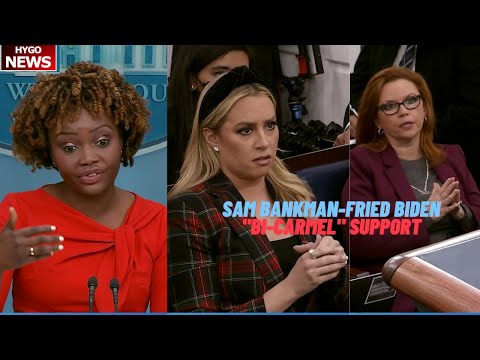
KJP Mispronounces “Bicameral” Three Times as “Bicarbonate” — Uses Hatch Act to Avoid All Questions About SBF/FTX Donations to Biden
On 12/13/2022, White House Press Secretary Karine Jean-Pierre stumbled three times with the word “bicameral” — saying “bicarbonate” instead — while defending the Respect for Marriage Act. She then used the Hatch Act to refuse multiple questions about campaign donations Biden had received from Sam Bankman-Fried and FTX, the cryptocurrency exchange that had spectacularly collapsed. “I’m covered here by the Hatch Act… I’m limited to what I can say. And I just can’t talk to political contributions or anything related to that. I cannot speak about it from here.” When a reporter noted the question had two parts and asked about Biden’s opinion separately, KJP claimed the Hatch Act covered even Biden’s opinion on whether Democrats should return FTX donations. “Even his opinion, even his thoughts about the contributions, donations, I cannot speak from it about this from here,” KJP said.
The “Bicameral” Mispronunciation
KJP’s verbal stumble happened while defending the Respect for Marriage Act. “This is an important civil rights accomplishment that achieved, that was achieved in a bicarbonate bipartisan way and it got that support, right?” KJP said.
“Bicarbonate” was clearly intended to be “bicameral” — the word for both chambers of Congress (the House and Senate). Bicarbonate is a baking ingredient (sodium bicarbonate, used in baking soda). The two words sound somewhat similar but mean entirely different things.
KJP repeated the mistake. “When the president signs it today, it will build worship and religious nonprofits. And this question was well litigated throughout the legislative process where it passed with both chambers of bipartisan support. And I think that matters, right? Bicarbonate bipartisan support was had for this piece of legislation,” she continued.
She used “bicarbonate” again later: “What we’re saying to you today is that this piece of legislation was done in a bipartisan, bicarbonate way.”
The three repetitions of “bicarbonate” where “bicameral” was intended was characteristic of KJP’s verbal pattern. She often struggled with multi-syllabic Washington terminology, producing phonetic approximations rather than correct words. The repetition of the same error suggested:
Pattern lock-in — Once she used “bicarbonate,” she kept using it.
No real-time correction — She didn’t notice the error.
Reading issue — If reading from notes, “bicameral” might have been misread.
Memory approximation — She recalled the general sound but not the exact word.
The Respect for Marriage Act Context
The legislation KJP was defending was the Respect for Marriage Act, which codified federal recognition of same-sex and interracial marriages. The bill had passed both chambers of Congress with some Republican support. Biden was signing it on December 13, 2022.
The bill represented a response to Dobbs v. Jackson concerns that other constitutional rights might be re-evaluated by the Supreme Court. Justice Clarence Thomas had written in his Dobbs concurrence that other substantive due process cases should be reconsidered — including Obergefell v. Hodges (same-sex marriage), Lawrence v. Texas (private consensual sexual activity), and Griswold v. Connecticut (contraception). Congressional Democrats had passed the Respect for Marriage Act specifically to codify these protections in federal law.
The bill’s passage had required bipartisan support — hence KJP’s repeated (and repeatedly mispronounced) emphasis on “bicameral bipartisan” support.
The Discrimination Concerns
A reporter raised concerns about the bill’s language. “Do you anticipate that this administration will go back or the Democrats will go back and try to clean up the language in the legislation so it does not codify discrimination?” the reporter asked.
The “codify discrimination” concern referenced religious exemption provisions that critics argued protected religious organizations’ ability to discriminate against same-sex couples. The bill’s language had been crafted to gain Republican votes but included provisions that LGBTQ+ advocates viewed as problematic concessions.
KJP’s response was defensive: “Look, what we’re saying to you today is that this piece of legislation was done in a bipartisan, bicarbonate way and it will make a difference for millions of Americans across the country.”
The response didn’t address the specific concern about problematic language. It repeated the bipartisan framing (with another “bicarbonate” mispronunciation) but didn’t engage with whether future legislation would need to address the language concerns.
The Sam Bankman-Fried Donation Question
The briefing then shifted to the SBF/FTX scandal. “The president received campaign donations, campaign donations for him, many prominent Democrats, and some Republicans did as well. Will the president return that donation? Does he call on all politicians who got campaign donations that may have come from customer money to return those funds?” the reporter asked.
The context was the dramatic collapse of FTX, the cryptocurrency exchange Sam Bankman-Fried had founded. FTX had filed for bankruptcy in November 2022 after revelations that customer funds had been improperly used. SBF had been a major Democratic donor — contributing approximately $40 million to Democratic causes in the 2022 cycle, making him among the top donors overall.
The questions were:
Would Biden return SBF donations — Biden had received SBF contributions.
Should politicians broadly return funds from FTX — If customer money had been used for donations.
These were legitimate questions about campaign finance and ethics. FTX customer money being used for political donations would be fraud. Politicians should return such donations as a matter of accountability.
The Hatch Act Shield
KJP’s response invoked the Hatch Act. “So look, I’m covered here by the Hatch Act,” KJP said.
The Hatch Act restricts certain political activities by federal employees. White House Press Secretary is covered by these restrictions. But the Hatch Act doesn’t prohibit discussion of campaign finance ethics generally — it prohibits using official position for partisan political activity.
KJP’s use of the Hatch Act had specific features:
Broad interpretation — Treating any campaign-related question as covered.
Selective application — Used to avoid uncomfortable questions.
Resource for deflection — Available whenever needed.
Procedural rather than substantive — Avoided engagement rather than engaged thoughtfully.
Critics argued that KJP’s Hatch Act invocation was overbroad. The Act didn’t generally prohibit discussion of campaign ethics or donor accountability. Biden’s team could engage with these questions through official channels without Hatch Act violations.
The Two-Part Question
The reporter pressed for clarification. “I’m asking the president’s opinion now. Does he want those people who?” the reporter asked.
KJP refused to engage even with the opinion question. “No, you asked me two questions. You asked me about will he return the donations and then you asked me about his opinion. I’m answering the first part, which is I’m covered by the Hatch Act from here. I am limited to what I can say. And I just can’t talk to political contributions or anything related to that. I cannot speak about it from here,” KJP said.
The reporter clarified. “And then his opinion now?”
KJP responded: “I just cannot speak to this from here. Even his opinion, even his thoughts about the contributions, donations, I cannot speak from it about this from here.”
The expansion of Hatch Act coverage to Biden’s opinion was notable. The Hatch Act governs what federal employees do — not what the President thinks. Biden could have opinions about campaign ethics that KJP could convey. The administration’s position that Biden’s opinion itself was Hatch-Act-restricted was an unusual interpretation.
”Happy to Say Over and Over Again”
KJP emphasized her Hatch Act coverage. “I am covered by the Hatch Act, which I’m happy to say over and over again,” KJP said.
The “happy to say over and over again” framing was revealing. KJP wasn’t trying to resolve the question — she was using the Hatch Act as a permanent deflection resource. Her willingness to repeat the same non-answer indicated that no further engagement would be forthcoming.
The “over and over again” pattern meant that any reporter pressing on SBF/FTX matters would hit the same wall. The administration had decided not to engage with these questions through KJP’s briefings, and no amount of persistence would change that.
The FTX Scandal Political Context
The SBF/FTX scandal had significant political dimensions:
Major Democratic donor — SBF had been a top Democratic contributor in 2022.
Scale of contributions — Approximately $40 million across Democratic causes.
Customer money questions — Whether donations used misappropriated funds.
Accountability concerns — Whether recipients should return funds.
Criminal implications — SBF was being investigated and would be charged.
The administration’s reluctance to engage with these questions suggested political concerns. If Biden acknowledged that SBF donations should be returned, it would implicitly accept that the donations had been problematic. If Biden defended keeping the donations, it would appear to defend accepting potentially-criminal money.
The Hatch Act shield allowed the administration to avoid either problematic position. By refusing to engage, KJP kept the administration’s future options open.
The Bernie Sanders War Powers Question
The briefing also included a question about Senator Bernie Sanders’s war powers resolution regarding Yemen. “Is the White House whipping against Senator Bernie Sanders war powers resolution that’s set for a vote in the Senate tonight?” a reporter asked.
KJP’s response was also deflective. “We’ve spoken to this before. I don’t have anything much more to add. I know my colleagues actually was asked this question last week. Don’t have anything more to really discuss or lean into on this.”
The reporter pressed with new information: “Bernie Sanders just said that he’s dealing with White House opposition to it right now. So just hoping for a confirmation of what all is going on there.”
KJP responded: “So look, I’ll say this, we’re in touch with members of Congress on this thanks to our diplomacy, which remains ongoing and delicate.”
This was an implicit confirmation that the administration was lobbying against the resolution without directly confirming it. The “remains ongoing and delicate” language suggested substantive engagement in Congressional negotiation.
The Pattern of Deflection
Throughout the briefing, KJP used multiple deflection techniques:
Hatch Act for FTX questions — Avoiding engagement on SBF donations.
Repetition of talking points — On Respect for Marriage Act.
“Not going to make a prediction” — On Yemen war powers.
“Don’t have anything more to add” — On multiple topics.
Verbal stumbles — Including the “bicarbonate” repetitions.
The cumulative effect was a briefing that produced little substantive information. The administration’s positions on important questions remained undisclosed. The most newsworthy elements were the “bicarbonate” mispronunciations and the refusal to address FTX matters.
Key Takeaways
- KJP mispronounced “bicameral” as “bicarbonate” three times during a defense of the Respect for Marriage Act.
- She used the Hatch Act to refuse multiple questions about whether Biden would return campaign donations from Sam Bankman-Fried and FTX.
- When pressed on Biden’s opinion (not just his action), KJP extended Hatch Act coverage to even Biden’s opinion: “Even his opinion, even his thoughts about the contributions, donations, I cannot speak from it about this from here.”
- KJP also declined to directly address Senator Bernie Sanders’s claim that the White House was opposing his Yemen war powers resolution.
- The briefing exemplified KJP’s pattern of using procedural deflections (Hatch Act, “don’t have anything to add”) to avoid substantive engagement with politically sensitive questions.
Transcript Highlights
The following is transcribed from the video audio (unverified — AI-generated from audio).
- This is an important civil rights accomplishment that achieved, that was achieved in a bicarbonate bipartisan way and it got that support.
- Bicarbonate bipartisan support was had for this piece of legislation.
- This piece of legislation was done in a bipartisan, bicarbonate way.
- I’m covered here by the Hatch Act… I just can’t talk to political contributions or anything related to that.
- Even his opinion, even his thoughts about the contributions, donations, I cannot speak from it about this from here.
- I am covered by the Hatch Act, which I’m happy to say over and over again.
Full transcript: 548 words transcribed via Whisper AI.