 HYGO News
 Kevin O'Leary on TikTok Bid: 'We'll Buy It Without the Algorithm -- That's Spyware. We'll Rebuild the Product'
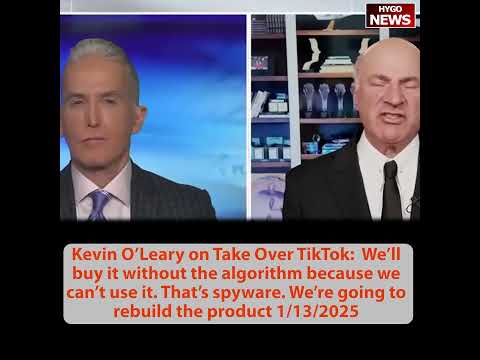
Kevin O’Leary on TikTok Bid: “We’ll Buy It Without the Algorithm — That’s Spyware. We’ll Rebuild the Product”
On January 13, 2025, investor and Shark Tank star Kevin O’Leary appeared with Trey Gowdy to outline his syndicate’s offer to purchase TikTok from its Chinese parent company ByteDance. O’Leary, working alongside Frank McCourt, described a plan to buy the platform without its controversial algorithm — which he called spyware — and rebuild the product under American ownership. The offer came as the Supreme Court was weighing the constitutionality of the bipartisan congressional ban that would force TikTok to divest or shut down, with a decision expected within days.
”We’ll Buy It Without the Algorithm”
Gowdy opened by asking O’Leary the straightforward question: why not just buy TikTok, move the servers to the United States, and address the national security and mental health concerns?
O’Leary explained that his syndicate’s offer deliberately excluded TikTok’s algorithm — the core technology that drives the platform’s content recommendations and that Congress had identified as the primary national security concern.
“Our offer, my syndicate, along with Frank McCourt, we’ve put together an offer that actually we don’t want to buy the algorithm,” O’Leary said. “One of the issues the company claimed in their case to the Supreme Court was no one’s going to buy it without the algorithm. That’s not true. We’ll buy it without the algorithm because we can’t use it. That’s spyware.”
O’Leary reframed what many saw as a weakness of the deal — operating without TikTok’s famously effective recommendation engine — as a feature: “We’re going to rebuild the product and make it much better, actually.”
Saving 6 Million Small Businesses
O’Leary emphasized that his motivation went beyond the deal’s financial value. He argued that shutting down TikTok entirely would harm millions of American small businesses that depended on the platform.
“I don’t want it shut down. It’s not good for my businesses. It’s not good for 6 million other small businesses in America that make a living off it,” O’Leary said. “We just need to take out the onerous piece, the spyware. That’s what Congress was upset about.”
The economic argument added a dimension beyond national security to the TikTok debate. While lawmakers had focused on the risk of Chinese government access to American user data and the potential for algorithmic manipulation, O’Leary highlighted the real-world economic consequences of an outright ban for American entrepreneurs and content creators who had built their livelihoods on the platform.
The Supreme Court and the Path Forward
O’Leary described a specific sequence of events he hoped would unfold following the Supreme Court’s ruling on the bipartisan congressional order requiring TikTok’s divestiture.
“If the Justices rule for upholding the law, it will go back to the executive, that’s currently Biden,” O’Leary explained. “If he can see a valid purchase offer, which we have — we’ve sent it to the company, all the shareholders, and the Chinese government, they have it now — he’ll say, ‘Look, I think you guys should negotiate in good faith. We’ll offer you, if you wish, a 90-day stay of execution,’ so to speak.”
O’Leary noted that the timeline would quickly shift the negotiations to the incoming administration: “Then we’ll be working for Donald Trump at 12:05 on January 20th.”
Bipartisan Effort with Both Administrations
O’Leary described the TikTok acquisition effort as a genuinely bipartisan project, with his syndicate engaging both Republican and Democratic leadership as well as both the outgoing and incoming presidents.
“I spent a fair amount of time, as we have in our syndicate, speaking to both the Republicans and the Democrats on a bipartisan basis,” O’Leary said. “Donald Trump — I just got back an hour ago from Mar-a-Lago — and I know my counterparts have been doing the same with Biden.”
He framed the effort as serving a national interest: “This is a very complicated bipartisan deal. It’s what we want to do to save the platform for Americans. I think it’s the right thing to do. The company should want that, too. This is the only path I see forward.”
O’Leary expressed urgency about the timeline: “Let’s see what happens. It’s going to be a very interesting week.” He added: “We really want to keep this thing going.”
The Stakes
The TikTok situation in January 2025 represented a convergence of national security concerns, free speech questions, and economic interests. Congress had passed the divestiture requirement with broad bipartisan support, but the Supreme Court’s review raised questions about whether the ban could survive First Amendment scrutiny. O’Leary’s offer to buy the platform without the algorithm attempted to thread the needle — addressing the national security concerns that motivated the legislation while preserving the platform’s economic value for its American user base. With a January 19 ban deadline looming just one day before inauguration, time was running critically short for any deal to come together.
Key Takeaways
- Kevin O’Leary and Frank McCourt offered to buy TikTok without its algorithm, which O’Leary called “spyware,” and rebuild the product under American ownership.
- O’Leary argued that shutting down TikTok would harm “6 million other small businesses in America that make a living off it.”
- The syndicate sent the purchase offer to ByteDance, its shareholders, and the Chinese government, and was working with both the Biden and incoming Trump administrations.
- O’Leary outlined a scenario where a Supreme Court ruling upholding the ban would lead to a 90-day negotiation window, with Trump’s team taking over at inauguration.
- O’Leary said he had just returned from Mar-a-Lago and described the effort as “a very complicated bipartisan deal.”