 HYGO News
 Sen. Kennedy Exposes Universal Injunctions: 27 in All of 20th Century, 86 Against Trump's First Term, 30 in Second Term
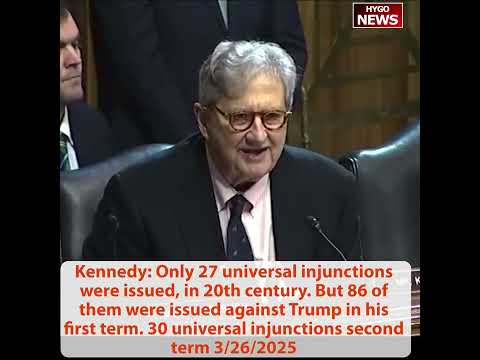
Sen. Kennedy Exposes Universal Injunctions: 27 in All of 20th Century, 86 Against Trump’s First Term, 30 in Second Term
Senator John Kennedy of Louisiana conducted a masterful Senate hearing examination of DOJ nominee Brett Shumate in March 2025, methodically establishing that universal injunctions had no basis in statute, Supreme Court precedent, or English common law — then revealing that while only 27 were issued in the entire 20th century, 86 were issued against Trump in his first term and 30 more in just the first two months of his second term. Shumate confirmed that the practice “encourages forum shopping and district shopping” and admitted: “It shouldn’t be possible, Senator, but district courts do it all the time."
"What’s the Statutory Basis?”
Kennedy opened the examination by establishing the legal foundations — or lack thereof — for universal injunctions.
“A universal injunction is what we call an order from a court enjoining the government in a way that goes beyond the parties to the case, but applies nationwide or in some cases universally,” Shumate explained.
Kennedy then began his systematic demolition.
“What’s the statutory basis for a federal judge issuing an order that affects people other than the parties before the court?” Kennedy asked.
“I’m not aware of a statutory basis, Senator,” Shumate replied.
“There is no statutory basis, is there?” Kennedy pressed.
“No, Senator.”
Kennedy moved to constitutional precedent: “What’s the United States Supreme Court opinion which interprets the Constitution in a way that allows a federal district court judge to do this? Can you name me that case?”
“I’m not aware of one, Senator.”
“There isn’t one, is there?”
“I’m not aware of one, Senator.”
In four questions, Kennedy had established that universal injunctions had no basis in federal statute and no basis in Supreme Court interpretation of the Constitution. The remedy that had been used over 100 times against the Trump administration existed in a legal vacuum — a practice invented by lower courts with no authorization from Congress, the Constitution, or the Supreme Court.
”How Is That Possible?”
Kennedy pushed for the logical explanation of how a baseless practice had become standard.
“Explain to me how this works,” Kennedy said. “How can a federal judge issue an order that affects everybody else other than those in front of him or her? How is that possible?”
Shumate’s answer was remarkably candid: “It shouldn’t be possible, Senator, but district courts do it all the time. I think on the theory that the courts need to enjoin a federal policy from going into effect, and they often will enjoin it as nationwide. So all non-parties are protected by that injunction.”
Kennedy identified the proper alternative: “I thought that if you wanted to affect parties who aren’t in court, you had to file a class action.”
“That’s correct, Senator,” Shumate confirmed.
Kennedy pressed further: “So why don’t the federal judges, instead of issuing a universal injunction with no legal basis, tell the plaintiff, ‘Look, you got to go file a class action if you want to impact parties who aren’t subject to my court.’”
Shumate explained: “Senator, the Department of Justice makes that argument all the time in our briefs. I think in many cases, class actions would be inappropriate. They wouldn’t — the plaintiffs couldn’t satisfy Rule 23 to establish a class.”
Kennedy seized on this: “So they couldn’t?”
“Correct,” Shumate confirmed. “So they prefer to ask for a universal injunction.”
The exchange revealed the fundamental dishonesty of the universal injunction mechanism. Plaintiffs used universal injunctions precisely because they could not meet the legal requirements for a class action — requirements that existed to ensure that nationwide relief was appropriate and that the plaintiffs genuinely represented the interests of the affected class. The universal injunction was an end-run around the safeguards that Congress and the courts had established to prevent a single judge from making policy for the entire nation.
Forum Shopping and Strategic Lawsuits
Kennedy asked whether the practice encouraged manipulation of the judicial system.
“Does this encourage forum shopping?” he asked.
“Yes, Senator,” Shumate said. “Not only does it encourage forum shopping, but also district shopping and filing multiple strategic lawsuits to find one judge that will enjoin a single policy nationwide. If you have five lawsuits, only one of those five cases needs to be successful.”
The “only one needs to be successful” admission was devastating. The system was designed so that opponents of any policy could file suits in multiple friendly jurisdictions, and if even one judge — out of hundreds of federal district judges — issued a universal injunction, the policy was blocked nationwide. The odds were stacked overwhelmingly against the executive branch: the government had to win every case, while the plaintiffs only had to win one.
No Basis in English Common Law
Kennedy extended his examination to the historical roots of American law.
“How about common law?” Kennedy asked. “Universal injunctions are basically an equitable remedy. Did this exist in common law courts in England on which our law is based?”
Shumate replied carefully: “I don’t believe so. I think the government has cited cases from the Supreme Court that say courts are really bound by the scope of relief that a court in equity would have granted back in England before the founding. And the courts at that time would grant relief to the parties in the case, not far beyond.”
Kennedy stated his conclusion: “The universal injunction is a remedy that is unknown in English common law. Is it not?”
“I haven’t done the research that far back, but I’m not aware,” Shumate said.
“I have,” Kennedy replied. “It’s unknown. Wasn’t part of equity.”
Kennedy had now established that universal injunctions had no basis in statute, no basis in Supreme Court precedent, no basis in Article III of the Constitution, and no basis in the English common law tradition from which American equity jurisdiction derived. The practice existed entirely because lower court judges had invented it and no one had stopped them.
The Numbers: 27 vs. 86 vs. 30
Kennedy then delivered the statistics that turned the legal analysis into a political indictment.
“Only about 27 universal injunctions were issued in the 20th century,” Kennedy said. “Does that sound about right?”
“That sounds about right, Senator,” Shumate confirmed.
“But 86 of them were issued against President Trump in his first term. Is that correct?”
“I don’t know the specific number, but there were a high number.”
“And so far in President Trump’s second term, 30 universal injunctions have been issued against him. Have they not?”
“Senator, I don’t have a specific number, but that sounds about right.”
Kennedy drew the conclusion: “The universal injunction has become a weapon against the Trump administration, has it not?”
“Yes,” Shumate confirmed.
The numbers told the story more powerfully than any argument could. In an entire century — from 1900 to 2000 — federal courts issued 27 universal injunctions total. Against Donald Trump alone, they had issued 116 (86 in the first term plus 30 in the second). One president had received more than four times as many universal injunctions as every other president in the 20th century combined.
”That’s Why God Created Class Actions”
Kennedy concluded with the solution.
“So the Congress could act and say, ‘Look, federal judges, you render a decision to a plaintiff or a defendant, but you can’t impact people outside of your courtroom other than through a class action,’” Kennedy said. “That’s why God created class actions, isn’t it?”
“Yes, Senator,” Shumate confirmed.
The legislative fix was straightforward: Congress could pass a law prohibiting universal injunctions and requiring plaintiffs to file class actions if they wanted nationwide relief. The class action requirements — numerosity, commonality, typicality, and adequacy of representation — would ensure that nationwide relief was granted only when genuinely warranted, not when a single plaintiff found a friendly judge.
Key Takeaways
- Sen. Kennedy established that universal injunctions have no basis in statute, Supreme Court precedent, Article III, or English common law.
- The numbers: 27 universal injunctions in the entire 20th century vs. 86 against Trump’s first term and 30 in his second term (116 total against one president).
- DOJ nominee Shumate confirmed: “It shouldn’t be possible, but district courts do it all the time.”
- The practice “encourages forum shopping, district shopping, and filing multiple strategic lawsuits” — plaintiffs only need one judge out of hundreds to block a policy nationwide.
- Kennedy’s solution: Congress should require class actions for nationwide relief — “That’s why God created class actions.”