 HYGO News
 RFK Jr.: 'A Healthy Person Has a Thousand Dreams, a Sick Person Only Has One'; Trump: 'Iran Very High on My Watch List'
RFK Jr.: “A Healthy Person Has a Thousand Dreams, a Sick Person Only Has One”; Trump: “Iran Very High on My Watch List”
A March 2025 compilation featured three powerful statements from senior administration figures. HHS Secretary RFK Jr. delivered his signature line: “A person who is healthy has a thousand dreams. A person who is sick has only one — to get better. And 60% of our country now has only one dream. The pathway is food. Food is medicine.” President Trump issued a direct warning to Iran: “We’re going to either have to talk and talk it out, or very bad things are going to happen to Iran. My big preference is we work it out.” VP Vance defended the Signal chat as showing “honest conversation” and reaffirmed: “I support the president’s decision to strike the Houthis.”
Kennedy: “Food Is Medicine”
Secretary Kennedy delivered the philosophical foundation of his Make America Healthy Again agenda in its most distilled form.
“We cannot have a strong country if we have sick citizens,” Kennedy said. “President Trump says that he wants to restore the American dream.”
He then offered the observation that had become his signature: “But a person who is healthy has a thousand dreams. A person who is sick has only one.”
Kennedy quantified the crisis: “And there is 60% of our country now that has only one dream, which is to get better.”
He prescribed the solution: “And we need to give them a pathway to doing that. And the pathway is food. Food is medicine.”
The “thousand dreams” metaphor was the most effective communication tool in Kennedy’s arsenal. It bypassed the policy debates about GRAS standards, food dye regulations, and FDA reform and went directly to the human experience. A healthy person could dream about career advancement, family, travel, creative pursuits, and a hundred other aspirations. A person suffering from chronic disease — diabetes, autoimmune disorders, obesity-related conditions — was consumed by the single imperative of managing their illness. Everything else became secondary.
The 60% figure was staggering. If Kennedy’s number was accurate — and the CDC’s data on chronic disease prevalence supported it — then the majority of Americans were living with conditions that limited their ability to pursue the aspirations that defined the American dream. The economic implications alone were enormous: healthcare costs, lost productivity, disability payments, and reduced quality of life for the majority of the population.
The “food is medicine” conclusion connected the diagnosis to the GRAS reform, food dye removal, and nutritional program changes that Kennedy was implementing at HHS. The solution was not more pharmaceuticals or more healthcare spending; it was fixing the food supply that was making people sick in the first place.
Trump on Iran: “Talk It Out or Very Bad Things”
Trump issued the most direct public warning to Iran of his second term.
“Iran is very high on my list of things to watch,” Trump said. “And as you probably know, I sent them a letter just recently.”
He described the ultimatum: “And I said, you’re going to have to make a decision one way or the other. And we’re going to either have to talk and talk it out, or very bad things are going to happen to Iran.”
Trump expressed his preference: “And I don’t want that to happen. I don’t want that to happen. My big preference — and I don’t say this from strength or weakness — my big preference is we work it out with Iran.”
But the warning was unmistakable: “But if we don’t work it out, bad, bad things are going to happen to Iran.”
The statement was vintage Trump diplomacy: the simultaneous offer of negotiation and the threat of overwhelming consequences. By saying he “didn’t want” bad things to happen and that his “big preference” was to work things out, Trump was giving Iran an off-ramp. By stating that “bad, bad things” would happen if they refused, he was making clear that the off-ramp had an expiration date.
The reference to sending a letter was significant. Direct presidential correspondence to a foreign leader was a high-level diplomatic tool that signaled both seriousness and the possibility of resolution. The fact that Trump had sent the letter “just recently” suggested that a diplomatic window was open but would not remain open indefinitely.
The Iran question encompassed multiple interconnected issues: the nuclear program, the Houthi proxy war that the administration had been fighting, support for Hamas and Hezbollah, and the broader destabilization of the Middle East. The Houthi strikes that the administration had already conducted were, in effect, strikes against an Iranian proxy. A direct confrontation with Iran itself would represent a dramatic escalation that Trump was clearly trying to avoid through diplomacy.
Vance: “Honest Conversation”
VP Vance provided the most nuanced defense of the Signal chat controversy.
“We’ve talked, of course, in the American media about Signalgate, as I called it, for the past week,” Vance said. “And of course, what that leak revealed, I think, is a private communication between the president’s senior advisors about how best to prepare the American people for what we all thought we had to do, about the right timing of when we should do something, and of course, surfacing the strategic questions that we needed to decide and brief the president on so that he could ultimately make the decision about what we would do.”
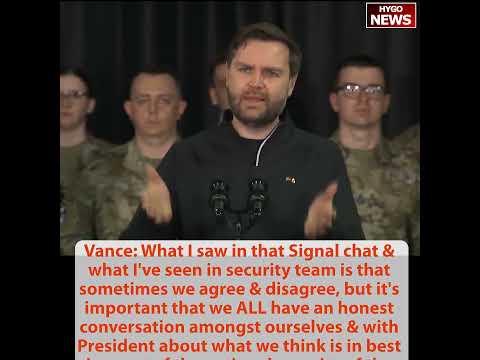
Vance then reframed the chat’s content as evidence of a healthy deliberative process: “What I saw in that Signal chat, and of course what I’ve seen in the president’s senior national security team, is that sometimes we all agree, and sometimes we all disagree. But it’s important that we all have an honest conversation amongst ourselves and with the president of the United States about what we think is in the best interest of the national security of the United States of America.”
He concluded with an unequivocal statement of support: “I support the president’s decision to strike the Houthis. I always supported the president’s decision to strike the Houthis, and I support the national security team having the argument about how best to serve the American people.”
Vance’s defense was the most intellectually sophisticated response to the Signal controversy. Rather than denying or minimizing, he acknowledged the chat’s existence and recharacterized its content. The messages did not show chaos or recklessness; they showed senior officials debating strategy, presenting different perspectives, and ultimately reaching a decision that produced a successful military outcome.
The “sometimes we agree and sometimes we disagree” admission was notable for its honesty. Rather than presenting the national security team as a monolith that operated in perfect harmony, Vance acknowledged that genuine debate occurred — and argued that this was a feature, not a bug. A national security team that never disagreed was either dishonest or groupthinking its way into bad decisions.
Three Pillars of the Administration
The compilation brought together three distinct pillars of the Trump administration’s agenda: Kennedy’s health revolution, Trump’s geopolitical strategy, and Vance’s national security defense.
Kennedy was addressing the domestic health crisis that affected 60% of Americans, arguing that food policy reform was the foundation on which every other aspiration depended. Trump was managing the most dangerous geopolitical flashpoint in the Middle East, offering diplomacy while preparing for confrontation. Vance was defending the decision-making process that had produced successful military action against Iran’s proxies.
The three statements shared a common characteristic: each official was speaking from conviction rather than talking points. Kennedy’s “thousand dreams” line carried the passion of a lifelong health advocate. Trump’s Iran warning carried the weight of a commander-in-chief who had already demonstrated willingness to use force. Vance’s defense of honest disagreement carried the credibility of someone willing to acknowledge imperfection in pursuit of good outcomes.
Key Takeaways
- RFK Jr. said “60% of our country has only one dream — to get better” and declared “food is medicine” as the pathway to restoring health and the American dream.
- Trump warned Iran: “We’re going to either talk it out, or very bad things are going to happen. My big preference is we work it out.”
- He confirmed sending a letter directly to Iranian leadership: “You’re going to have to make a decision one way or the other.”
- VP Vance defended the Signal chat as showing “honest conversation” among advisors who “sometimes agree and sometimes disagree” about national security.
- Vance: “I support the president’s decision to strike the Houthis. I always supported it. I support the team having the argument about how best to serve the American people.”