 HYGO News
 Sen. Kennedy: Federal Lands Could Generate $90B/Year but Lost $13B -- 'It's Embarrassing'; Biden 'Buried Our Lands in Red Tape'
Sen. Kennedy: Federal Lands Could Generate $90B/Year but Lost $13B — “It’s Embarrassing”; Biden “Buried Our Lands in Red Tape”
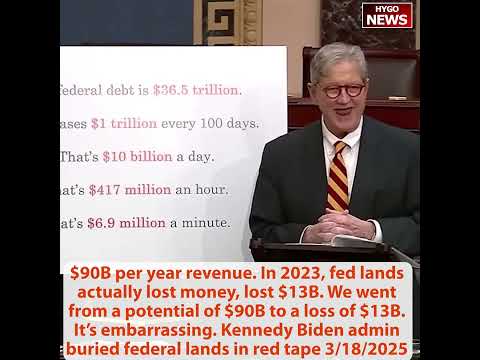
Senator John Kennedy of Louisiana delivered a devastating Senate floor speech in March 2025 laying out the case that America’s 620 million acres of federal lands could generate $90 billion per year in revenue but instead lost $13 billion in 2023 under Biden-era management. “We went from a potential of $90 billion — according to land-use experts, that’s what they ought to be generating — to a loss of $13 billion. It’s embarrassing,” Kennedy said. He detailed how the Biden administration had “buried our federal lands in red tape” by banning offshore drilling, canceling oil and gas leases, pausing LNG permits, restricting hunting and fishing, and prohibiting mining on over a million acres.
The Debt: “$10 Billion a Day”
Kennedy opened by establishing the urgency of the problem in terms that were impossible to ignore.
“25% of the land in the United States of America is owned by the federal government,” Kennedy said. “See if you can manage the land in a way to generate cash.”
He then explained why generating revenue from federal lands had become existentially important: “Our debt is $36.5 trillion. What does that mean? I mean, we throw around this figure of a trillion. We can hardly get our mind around it. At least I can hardly get my mind around it.”
Kennedy made the abstract concrete: “Our debt is so high and we’re paying so much interest that the debt grows by $1 trillion every 100 days. So this $36.5 trillion figure, 100 days from now, a little over 3 months, is going to be $37.5 trillion. That’s how fast the debt’s growing.”
He continued to zoom in on the rate: “This number is so high and we’re paying so much in interest that debt accrues at $10 billion a day — not million, $10 billion a day. $417 million goes up an hour. $6.9 million — let’s call it $7 million a minute.”
Then the rhetorical flourish that brought it to the chamber floor: “I’ve been talking three minutes. Debt just got increased $21 million. And we’ve got to pay that money back. This is not funny money.”
The per-minute calculation was Kennedy’s signature style — making enormous numbers personal and immediate. Every senator listening knew that the three minutes they had spent hearing the introduction had cost taxpayers $21 million in new debt. The abstraction of $36.5 trillion became tangible: $7 million per minute, accumulating while they debated.
$90 Billion Potential vs. $13 Billion Loss
Kennedy then turned to the specific revenue opportunity that federal lands represented.
“We have $620 million acres of land,” he said. He listed the revenue streams available: “Mineral harvesting, natural gas production, oil drilling, grazing for agriculture, hunting licenses, fishing licenses, camping permits.”
He asked the question: “You know what our federal lands actually generate in money?”
Then the answer: “We know the potential — $90 billion a year. That helps us pay down this debt.”
And the reality: “In 2023, our federal lands actually lost money. They lost $13 billion. We went from a potential of $90 billion — according to land-use experts, that’s what they ought to be generating — to a loss of $13 billion. It’s embarrassing.”
The $103 billion gap — from a potential gain of $90 billion to an actual loss of $13 billion — was one of the most striking fiscal statistics in the entire federal budget debate. The federal government was not merely failing to monetize its assets; it was spending more to manage them than they generated. The American people owned a quarter of all land in the country and were losing money on it.
”They Buried Our Federal Lands in Red Tape”
Kennedy then detailed exactly how the Biden administration had produced the $13 billion loss.
“Under President Biden — not him, but his people, he appointed them,” Kennedy said, adding the caveat about Biden’s personal involvement that had become standard in the post-autopen era.
The catalog of restrictions was comprehensive: “They abandoned offshore drilling off of most of America’s coastlines. They prohibited mining on over a million acres of lands. They canceled leases for oil and natural gas production. They paused all new permits for LNG, which Europe is hungry for.”
The restrictions extended beyond energy: “They restricted hunting. They restricted fishing. They restricted hiking. And they buried our federal lands in red tape.”
Kennedy connected the restrictions to the financial result: “That’s why we lost $13 billion instead of gaining $90 billion a year.”
The “Europe is hungry for” aside about LNG was particularly pointed. The Biden administration had paused LNG export permits while European allies were desperate for American natural gas to replace Russian supplies. The United States had the product; Europe had the demand; the Biden administration had blocked the transaction — costing revenue for the American government and leverage against Russia simultaneously.
The State Model: “$14.51 for Every $1”
Kennedy then presented the evidence that better management was possible — not from theory but from practice.
“The states have worked very hard to increase the revenue on their state lands while preserving them,” Kennedy said. “Arizona, Idaho, Montana, New Mexico — all we have to do is copy them.”
He provided the return-on-investment comparison: “Their monetizing of their state lands has produced over the past few years an average return of $14.51 for every $1 those states have invested. So the states spend $1 on their state lands — they get back $15. Pretty good return.”
He noted that the success had not come at the expense of the environment: “And they haven’t sacrificed air quality. They’ve protected their lakes and rivers, and they’ve preserved their state.”
Then the federal comparison: “The federal government, for every $1 we spend on our public land, we get back $0.73.”
Kennedy drew the conclusion: “You don’t have to be Euclid to see that we’re going backwards. You don’t have to be an astrophysicist to figure this out.”
The comparison was devastating. States were generating $14.51 per dollar invested in their lands. The federal government was generating $0.73 — a return of negative 27 cents on the dollar. The states were making money; the federal government was losing money. And both were managing the same type of resource.
”Call Arizona and Buy Them a Soda”
Kennedy concluded with the solution, delivered in his trademark folksy style.
“All we got to do is call Arizona, Idaho, Montana, New Mexico, and probably West Virginia,” he said. “And just say, would y’all come up to Washington? We’ll buy you a soda and give you a nice hat. If you’ll come on up here and tell us how you’re doing it, and just copy what they’re doing.”
The humor masked a serious point. The federal government did not need to invent a new approach to land management. It needed to adopt the approach that was already working in states across the country. The models existed. The data was clear. The only missing element was the political will to change federal policy from preservation-at-all-costs to responsible monetization — the same approach that states had successfully implemented.
Kennedy’s speech complemented the Trump administration’s broader strategy of reducing spending while simultaneously increasing revenue. DOGE was cutting waste from the expense side of the ledger; Kennedy was arguing that the revenue side had been equally mismanaged. Between the $13 billion being lost annually on federal lands and the $90 billion that could be generated, the United States had more than $100 billion per year in fiscal improvement available simply by managing its own property the way states managed theirs.
Key Takeaways
- Federal lands could generate $90 billion per year but lost $13 billion in 2023: “We went from a potential of $90B to a loss of $13B. It’s embarrassing.”
- The national debt was growing at $10 billion per day, $417 million per hour, $7 million per minute.
- Biden’s administration “buried federal lands in red tape”: banned offshore drilling, canceled oil/gas leases, paused LNG permits, restricted hunting, fishing, and mining.
- States like Arizona, Idaho, Montana, and New Mexico earned $14.51 for every $1 invested in their lands; the federal government earned just $0.73.
- Kennedy’s solution: “Call Arizona, buy them a soda and a nice hat, and just copy what they’re doing.”