 HYGO News
 Katie: nothing short attack; Rosas: Antifa is real, Dems & mainstream media refusing to ack
Katie: nothing short attack; Rosas: Antifa is real, Dems & mainstream media refusing to ack
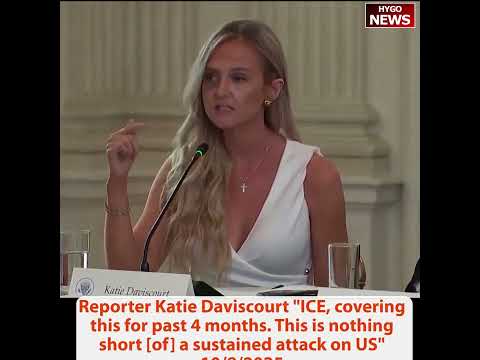
Three independent journalists delivered firsthand accounts of Portland’s ongoing unrest at a White House roundtable. Investigative reporter Katie Daviscourt of the Post Millennial — a decade-long Antifa embed — called the situation “nothing short of a sustained attack on the United States.” Daviscourt appeared with a visible black eye and reported concussion after being struck with a metal pole while covering the ICE facility the prior week. Portland Police, she said, refused to detain the suspect she chased down herself. Former Marine and The Blaze national correspondent Julio Rosas backed the framing: “Antifa is real. It’s real, it’s a threat.” Independent journalist Brandi Kruse, who has covered Antifa for 15 years, thanked the administration for being “the first in a position of authority” to acknowledge the group’s existence, saying people “would be dead today” without the terror-organization designation. Daviscourt: “This is nothing short [of] a sustained attack on the United States, which is being supported by Democratic elected officials.” Rosas: “The reason why there’s such a big problem is because we have Democrats and a lot of people in the mainstream media refusing to acknowledge that they even exist.” Kruse: “I genuinely believe there would be people at these tables who would be dead today.”
Daviscourt: Decade Inside Antifa
Daviscourt opened with her credentials. “I’m an investigative journalist from Seattle. I work for the Post Millennial alongside Andy Ngo and Jack Posobiec. I have been infiltrating Antifa cells in Seattle and Portland for the past decade.”
Andy Ngo is known for extensive Antifa coverage and has been physically attacked multiple times by the group. Jack Posobiec is a conservative commentator. The Post Millennial has been one of a small number of outlets systematically documenting Antifa activity in the Pacific Northwest.
“I know their inner workings and Antifa uses extreme political violence to crush the civil rights of their political enemies and believes that violence is justified by any means necessary.”
The framework: Antifa is not defensive anti-fascism but offensive political violence, aimed at silencing enemies rather than protecting targets.
Portland ICE Facility
“But today I want to focus on what is happening in Portland at the ICE facility. I’ve been covering this for the past four months, and this is a call out to corporate media who has completely ignored this story or has falsely reported on it.”
Daviscourt’s claim: mainstream outlets have either ignored or misrepresented the ICE facility situation. Her framework: corporate media bias on the story is clear.
“This is nothing short other than a sustained attack on the United States, which is being supported by Democratic elected officials.”
The charge against elected officials is specific: Democratic officials in Portland and Oregon are not merely failing to stop the attacks — they are supporting them through inaction, funding, and rhetorical cover.
Portland Police Abandonment
“The Portland Police Bureau has completely abandoned several blocks outside the ICE facility, giving away their jurisdiction to a terrorist group who has spent the past four months harassing, assaulting, and intimidating anyone they perceive to be against their cause.”
The jurisdiction abandonment claim: Portland Police are not merely outnumbered but have effectively ceded city blocks to Antifa-aligned militants. The federal ICE facility is surrounded by what amounts to a hostile zone.
“Not only have federal agents been relentlessly assaulted for more than 100 consecutive days, black clad anarchist militants concealing their identities behind black facial coverings have been assaulting reporters just for trying to cover their crimes.”
100 consecutive days of federal agent assaults. The “black clad” description references the distinctive Antifa tactical wardrobe — black bloc uniforms, masks, goggles, gloves — designed to prevent identification and evade prosecution.
Personal Attack
“Today I am sitting here with a black eye in a concussion after being violently hit in the face with a metal pole while reporting outside the ICE facility just this past week.”
Daviscourt’s visible injuries were the evidence of her own account — not secondhand reporting, but firsthand experience. A journalist covering the story was physically attacked while covering the story.
“After the attack, I immediately went to three Portland Police officers who refused to detain the suspect. I took the time to chase down the suspect in the streets, had her held for 35 minutes. I was waiting for Portland Police to come, and they never came.”
The sequence is striking: journalist attacked with a metal pole, reports to three nearby PPB officers, officers refuse to detain the attacker, journalist pursues and detains the attacker herself for 35 minutes, police still do not respond. The attacker was ultimately released.
Kruse: “Would Be Dead Today”
Brandi Kruse followed with longer-term context. “Some of us have been covering Antifa for 15 years and have never had anyone in a position of authority, even acknowledged their existence.”
15 years of coverage. No authority figure — local, state, or federal — had acknowledged Antifa as an organized threat until this administration.
“And I’ll also tell you that I think that had you not done the single most powerful thing you’ve done to deal with this scourge has been acknowledging that Antifa is a real thing.”
Kruse’s framework: acknowledgment itself is the core policy. Everything that follows — law enforcement coordination, investigations, prosecutions — requires first accepting that Antifa exists as an organized entity.
“I genuinely believe there would be people at these tables who would be dead today and would have been killed in Portland, had you not called them a terror organization and said we’re gonna bring the full weight of the federal government to bear.”
Kruse’s direct claim: the terror-organization designation and federal response saved lives. Without it, attacks that escalated to assassination attempts would have succeeded.
Rosas: “Antifa Is Real”
Julio Rosas took the broader national framework. “Antifa is real. It’s real, it’s a threat. I just saw him last weekend over in Portland while they’re causing mayhem over there.”
Rosas is a Marine veteran and national correspondent for The Blaze. He has covered riots and political violence across the country for years.
“And the reason why there’s such a big problem is because we have Democrats and a lot of people in the mainstream media refusing to acknowledge that they even exist, right?”
The problem diagnosis: denial of existence enables continuation. If an entity does not exist in official or media framework, it cannot be targeted by law enforcement, cannot be condemned by politicians, cannot be investigated by journalists.
“So how can we as a country begin to address it and we have large swaths of these people who are supposedly decision makers and people who are supposed to inform, they don’t wanna say that it exists."
"No Registered LLC”
Rosas addressed the technical counter-argument used to deny Antifa’s organizational nature. “Because the common argument is like, well, they’re not a real organization because there’s no national leadership, they don’t have a national headquarters, so how can law enforcement go after a group that doesn’t exist like that?”
This is the standard denial framework: no formal structure, therefore no group.
“Well, law enforcement goes after criminal groups that organize to rob banks or do smash and grabs. They don’t have a registered LLC, they don’t have official membership cards, they don’t have a business address, but law enforcement still goes after them because they’re working as a group.”
Rosas’s counter: criminal groups routinely operate without formal structure. Law enforcement regularly prosecutes organized crime, gangs, and coordinated theft rings that have no LLC, no HR department, no registered headquarters.
“These people don’t just show up randomly at the same time to do the same thing dressed in a very similar fashion, espousing the same ideology.”
The observable evidence of coordination: simultaneous presence, identical tactics, matching dress, shared ideology. These are not random individuals — they are a coordinated group by any functional definition.
”Yes, It’s an Ideology”
“And they say, well, it’s an ideology. It’s like, well, yes, it’s an ideology because there’s people alive, present that believe in it and they’re acting on it.”
Rosas’s response to the “ideology, not organization” deflection: ideology + adherents + coordinated action = functional organization. The “it’s just an ideology” framework is a rhetorical dodge, not an analytical distinction.
The people acting on Antifa ideology are real people making real decisions to show up at real places with real weapons to conduct real attacks. Whether or not they fill out 501(c) paperwork is legally and tactically irrelevant.
Key Takeaways
- Daviscourt on Portland ICE facility: “This is nothing short [of] a sustained attack on the United States, which is being supported by Democratic elected officials … The Portland Police Bureau has completely abandoned several blocks outside the ICE facility.”
- Daviscourt on her own attack: “I am sitting here with a black eye in a concussion after being violently hit in the face with a metal pole while reporting outside the ICE facility just this past week. After the attack, I immediately went to three Portland Police officers who refused to detain the suspect.”
- Kruse on 15 years: “Some of us have been covering Antifa for 15 years and have never had anyone in a position of authority, even acknowledged their existence … I genuinely believe there would be people at these tables who would be dead today … had you not called them a terror organization.”
- Rosas on denial: “The reason why there’s such a big problem is because we have Democrats and a lot of people in the mainstream media refusing to acknowledge that they even exist.”
- Rosas on organization framework: “Law enforcement goes after criminal groups that organize to rob banks or do smash and grabs. They don’t have a registered LLC, they don’t have official membership cards, they don’t have a business address, but law enforcement still goes after them because they’re working as a group.”