 HYGO News
 Karine Jean-Pierre Refuses To Say If Biden Supports Reparations
By HYGO News
Published
· Updated
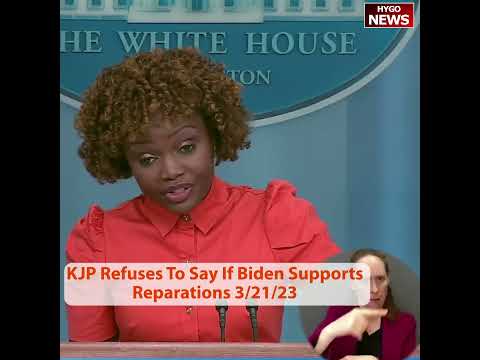
Karine Jean-Pierre Refuses To Say If Biden Supports Reparations
White House Press Secretary Karine Jean-Pierre declined to state President Joe Biden’s position on reparations for Black Americans during a March 2023 briefing, instead pointing reporters to pending congressional legislation studying the issue and to Biden’s executive order applying an “equality lens” across federal policy. The exchange came as San Francisco completed a reparations hearing and other cities and states — including the District of Columbia — moved to create their own reparations commissions.
The San Francisco Commission
- Reparations hearing: San Francisco’s reparations commission held hearings considering potential payments for institutional racism.
- Proposed payments: The commission had floated draft recommendations including payments of roughly $5 million to eligible Black residents.
- Eligibility criteria: Draft recommendations included residency requirements and other eligibility factors.
- Historical basis: San Francisco’s commission documented specific local histories of discrimination including housing policies.
- National attention: The San Francisco hearing generated national coverage and fueled renewed reparations debate.
Multi-City Momentum
- City-level initiatives: Cities including Providence, Chicago, Detroit, and Boston had established or were considering reparations commissions.
- State proposals: California had launched a state-level reparations task force that was developing detailed recommendations.
- D.C. consideration: The District of Columbia was actively considering establishing its own commission.
- Federal H.R. 40: The House bill to study reparations had been introduced by Rep. Sheila Jackson Lee and had growing support.
- Framework variation: Different jurisdictions considered different eligibility criteria and payment structures.
Jean-Pierre’s Non-Answer
- Deflection to Congress: The press secretary pointed to H.R. 40’s study authorization rather than Biden’s substantive position.
- “Equality lens” framing: She cited Biden’s executive order applying an equity analysis to federal policy.
- No direct answer: Jean-Pierre refused to state Biden’s personal position on reparations directly.
- Pardon request: Her response included asking to “pardon” herself mid-sentence, suggesting discomfort with the question.
- Pivot to policy: The press secretary attempted to pivot to broader equity work rather than reparations specifically.
The H.R. 40 Context
- Bill origin: The legislation originated with Rep. John Conyers in 1989 and has been reintroduced every Congress since.
- Study authority: H.R. 40 would establish a commission to study and develop reparations proposals.
- House majority support: The bill achieved majority Democratic co-sponsorship in the House but no floor vote.
- Senate barrier: The Senate filibuster rule made passage of substantive legislation nearly impossible.
- Biden position: The administration had expressed support for H.R. 40’s study framework without endorsing specific proposals.
Biden’s Executive Orders on Equity
- January 2021 order: Biden’s first-day executive order directed federal agencies to pursue racial equity across policy.
- Second order: The February 2023 follow-up order referenced by KJP strengthened agency accountability for equity work.
- Office of Management and Budget: OMB released equity assessment guidance for federal agencies.
- Data collection: The orders authorized enhanced demographic data collection to identify disparate impacts.
- Agency action plans: Federal agencies submitted equity action plans identifying barriers and proposed reforms.
The Political Complexity
- Democratic divisions: Democrats split on direct reparations payments, with some preferring race-neutral policies.
- Progressive base: Progressive Democrats and racial justice advocates pushed for stronger federal action.
- Moderate caution: Moderate Democrats worried about political backlash from cash payments.
- Republican opposition: Republicans uniformly opposed reparations, calling them divisive and unconstitutional.
- 2024 calculus: The White House’s caution reflected broader political anxieties about the 2024 election.
Constitutional and Legal Questions
- Equal protection: Some legal scholars questioned whether race-specific reparations could survive equal protection scrutiny.
- Supreme Court pending: The Court’s pending affirmative action cases would inform legal constraints.
- Takings issues: Potential reparations programs raised questions about compensation authority and funding sources.
- Individual vs. descendant: Debates existed over whether reparations should flow to individuals or be invested in community programs.
- Precedent from history: Historical precedents including Japanese American reparations offered partial templates.
Biden’s Campaign Record
- Primary campaign: As a 2020 primary candidate, Biden expressed openness to studying reparations but declined to endorse cash payments.
- Racial equity emphasis: The campaign positioned racial equity as a core governing principle.
- Build Back Better: Biden emphasized race-neutral programs with disproportionate benefits for communities of color.
- Truth and reconciliation: The campaign included rhetoric about historical racial reckoning without specific reparations commitments.
- Economic equity: Focus on targeted investments in communities of color rather than direct cash reparations.
The “Equality Lens” Concept
- Equity in policy: The approach aims to ensure federal policies benefit historically disadvantaged communities.
- Disparate impact: Analysis focuses on how policies affect different demographic groups.
- Data infrastructure: Building data systems to measure and track equity outcomes.
- Procurement and contracting: Increasing federal contracts with minority-owned businesses.
- Limitations: Critics argue general equity policies are inadequate substitute for specific historical redress.
Key Takeaways
- Jean-Pierre refused to state Biden’s direct position on reparations for Black Americans during the briefing.
- The press secretary pointed to H.R. 40 congressional legislation studying reparations rather than endorsing specific policy.
- She cited Biden’s February 2023 executive order applying an “equality lens” to federal policy as the administration’s equity work.
- The San Francisco reparations hearing and multi-city momentum intensified pressure for the administration to take a clearer position.
- The Biden administration maintained a careful posture avoiding direct endorsement or rejection of reparations payments.
- Democratic political strategists saw reparations as a potential 2024 flashpoint requiring careful messaging.
Transcript Highlights
The following quotations are drawn from an AI-generated Whisper transcript of the briefing and should be considered unverified pending official transcript release.
- “We understand that there’s a legislation on the Hill currently on the study of reparations.” — Karine Jean-Pierre
- “We think put that equality lens as they were moving forward with dealing with policy.” — Karine Jean-Pierre
- “San Francisco just held a hearing on reparations for decades of institutional racism.” — Reporter framing
- “Where does this administration stand on reparations for slavery and segregation and similar historic wrongs specifically pertaining to black Americans?” — Reporter question
- “Clearly that’s on the federal level.” — Karine Jean-Pierre
- “Just last month he issued a second order reaffirming the administration’s commitment to deliver on…” — Karine Jean-Pierre
Full transcript: 121 words transcribed via Whisper AI.