 HYGO News
Jean-Pierre on the House GOP's Lower Energy Costs Act: 'I Don't Have Anything Else Beyond That' (March 30, 2023)
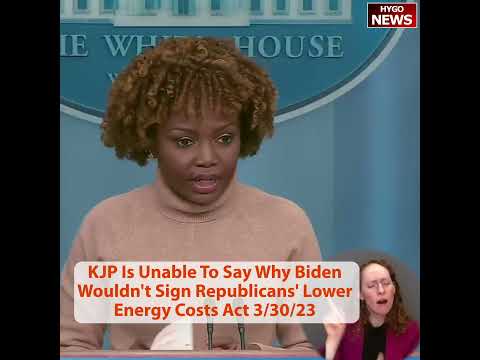
On March 30, 2023, the House voted 225 to 204 to pass H.R. 1, the Lower Energy Costs Act, the new Republican majority’s top legislative priority. The bill would sharply increase domestic production of oil, natural gas and coal and ease permitting rules that delay pipelines, refineries and other projects; four Democrats voted for it, and one Republican voted against it [4][5]. At the White House briefing that day, a reporter asked Press Secretary Karine Jean-Pierre why President Biden would not sign a bill that had passed with bipartisan support. This short clip shows her answer. Quotes are from the official transcripts published by the American Presidency Project [1][2].
Key Moments
”If it’s bipartisan, why wouldn’t the President sign it?”
“So H.R. 1 passed the House earlier today. And the House Speaker said it would open up permits for drilling and lower energy prices. And it was bipartisan,” the reporter said. “So if it’s bipartisan, why wouldn’t the President sign it if it hits his desk?” “Look, I le- — I talked about this earlier in the week about — specifically about our thoughts about H.R. 1. I don’t have anything else beyond that to share,” Jean-Pierre said. “What I stated, I think two days ago, stands. Just don’t have anything else to share” [1].
What she had said earlier in the week
On March 27, Jean-Pierre had said: “The President has also made clear he will veto H.R. 1, another bill that House Republicans have put forward to drive energy costs up for middle-class families, pad the pockets of big oil companies, and endanger the health and safety of all Americans.” She said it “would double the cost of energy efficiency upgrades that family need to reduce household bills,” would repeal parts of the Inflation Reduction Act, and would let refineries that use hydrofluoric acid “avoid any requirements to consider safer — safer alternatives.” “It is no wonder the bill was endorsed by big oil companies,” she said [2].
”There should be no negotiations”
The same reporter followed up on the debt ceiling, noting it had been 58 days since the president had met with the speaker. “It should be done without conditions. There should be no negotiations,” Jean-Pierre said. “We should not be negotiating on the debt ceiling. We should just not be doing that” [1].
Background: The White House’s Objections
The administration’s formal Statement of Administration Policy, issued March 27, called the bill “a thinly veiled license to pollute.” It said H.R. 1 “would double the cost of energy efficiency upgrades that families need to reduce household bills,” would repeal the Greenhouse Gas Reduction Fund and “$1.5 billion in investments focused on curbing methane leaks,” and would let companies “skirt the Clean Air Act.” It concluded: “if presented to the President in its current form, he would veto it” [3]. The administration also said it “wants to work in bipartisan manner with Congress to address lowering energy costs, permitting reform, and addressing energy challenges” [3].
Fact Check
- “It was bipartisan.” Narrowly. Four Democrats joined all but one Republican [4][5]. Twenty-nine Democrats voted for a separate amendment on gas stoves during debate [5].
- Why Biden would not sign it. Jean-Pierre did not answer on March 30, but the reasons were on the record: the March 27 statement and her briefing that day [2][3].
- The White House’s own production claim. The statement said that “both oil and natural gas production in the United States are projected to reach record highs this year” [3]. That proved accurate for oil: U.S. crude production averaged 12.9 million barrels a day in 2023, “breaking the previous U.S. and global record of 12.3 million b/d, set in 2019,” the Energy Information Administration reported [6].
- “Double the cost of energy efficiency upgrades.” That was the administration’s estimate of the effect of repealing the Inflation Reduction Act’s household energy rebates and credits [3]; we did not find an independent analysis of the figure.
For other statements by Jean-Pierre that the record contradicted, including “we will not negotiate” on the debt ceiling, see our article on her “$70 per gallon” mistake and other statements of hers that proved wrong.
What Happened Next
- In the Senate: Majority Leader Chuck Schumer called the bill “dead on arrival” [4], and it did not become law.
- Permitting: Two months later, the debt ceiling deal between the White House and Speaker Kevin McCarthy included an overhaul of energy permitting, designating “a single lead agency” for environmental reviews with “a clear, public timeline,” and approved the remaining permits for the Mountain Valley Pipeline. Republicans called it the first significant change to the National Environmental Policy Act since 1982, CBS News reported [7].
- The Inflation Reduction Act: In July 2025, the “big, beautiful bill” that President Trump signed terminated numerous Inflation Reduction Act tax incentives “for clean energy, electric vehicles and energy efficiency programs that benefited consumers,” CBS News reported [8].
Sources
- The American Presidency Project: Press Briefing by Press Secretary Karine Jean-Pierre (March 30, 2023)
- The American Presidency Project: Press Briefing by Press Secretary Karine Jean-Pierre (March 27, 2023)
- The American Presidency Project: Statement of Administration Policy, H.R. 1, Lower Energy Costs Act (March 27, 2023)
- AP via PBS NewsHour: House Republicans pass energy bill to roll back regulation of fossil fuel production (March 30, 2023)
- Fox News: Republicans vote to end Biden’s ‘war on energy,’ only 4 Dems agree (March 30, 2023)
- U.S. Energy Information Administration: United States produces more crude oil than any country, ever (March 11, 2024)
- CBS News: What’s in the debt ceiling deal, and what’s not (June 2, 2023)
- CBS News: Trump signs “big, beautiful bill” in July Fourth ceremony at White House (July 4, 2025)