 HYGO News
 Kamala Harris Delivers Another Word Salad On Foreign Policy During AP Interview In Indonesia
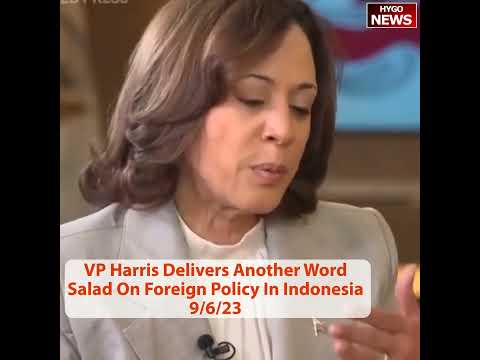
Kamala Harris Delivers Another Word Salad On Foreign Policy During AP Interview In Indonesia
In September 2023, Vice President Kamala Harris represented the United States at the ASEAN Summit in Indonesia after President Biden chose not to attend. During an interview with the Associated Press on the sidelines of the summit, Harris offered her assessment of U.S. foreign policy: “I feel very strongly about the importance as a general matter of engaging in U.S. policy as it relates to foreign affairs in a way that we pay attention, of course, to the immediate concerns and threats if they exist, but that we also pay attention to 10, 20, 30 years down the line and what we are developing now that will be to the benefit of our country then.”
The Statement
Harris’s 70-word sentence was immediately identified by critics as another example of the communication style that had earned her the persistent “word salad” label. The statement contained no specific policy position, no reference to any particular country or challenge in the Indo-Pacific region, and no actionable commitment. It said, in essence, that the United States should pay attention to both short-term and long-term foreign policy considerations.
This is not a controversial position. It is not, in fact, a position at all. Every administration in the history of American foreign policy has been concerned with both immediate threats and future strategic interests. Harris’s statement managed to take this universal truism and express it in a way that required 70 words and multiple dependent clauses without adding any substance beyond the obvious.
The construction “the importance as a general matter of engaging in U.S. policy as it relates to foreign affairs” was particularly tortured. “U.S. policy as it relates to foreign affairs” is another way of saying “U.S. foreign policy” — a concept that already has a widely understood two-word label. The phrase “as a general matter” further diluted any specificity, signaling that Harris was not about to say anything particular about any particular situation.
The Context: ASEAN and the Indo-Pacific
Harris was speaking at a moment when the Indo-Pacific region was at the center of several significant geopolitical developments. China’s increasingly assertive behavior in the South China Sea, Taiwan Strait tensions, North Korea’s ongoing missile program, and competition for influence among Southeast Asian nations were all active policy concerns.
The ASEAN Summit brought together leaders from ten Southeast Asian nations along with representatives from the world’s major powers. It was an opportunity for the United States to articulate a clear vision for its role in the region, to reassure allies, and to signal resolve to competitors.
Biden’s decision not to attend personally was itself a diplomatic signal. The ASEAN nations had long complained about being overlooked by Washington, and previous administrations had been criticized for sending lower-ranking officials to the summit. Obama had prioritized his “pivot to Asia” in part by attending ASEAN events personally. Biden’s absence — while Harris represented the United States — sent an ambiguous message about the administration’s priorities.
In this context, Harris’s AP interview was an opportunity to demonstrate that the vice president brought substance and strategic clarity to the table. Instead, the interview produced a statement that could have been made about any region, at any time, by any official, without the audience learning anything about what the United States actually intended to do in the Indo-Pacific.
The “Word Salad” Pattern
Harris’s Indonesia remarks fit a pattern that critics and commentators had identified throughout her vice presidency. The pattern typically involved several elements:
First, an expression of strong feeling or commitment. Harris frequently opened substantive questions with phrases like “I feel very strongly” or “I am very clear-eyed” that signaled emphasis without content.
Second, a general framework or principle stated at a high level of abstraction. In this case, the framework was “pay attention to both immediate and long-term concerns” — a statement so broad it was unfalsifiable.
Third, the absence of specifics. Harris’s statement did not name any country, any treaty, any military commitment, any economic initiative, or any diplomatic objective. A listener could not determine from the statement whether the United States was planning to increase naval deployments, expand trade agreements, confront China on intellectual property theft, or do anything else in particular.
Fourth, grammatical complexity that obscured the simplicity of the underlying idea. The sentence’s nested dependent clauses — “in a way that we pay attention, of course, to… but that we also pay attention to…” — created the impression of a sophisticated thought being articulated when the thought itself was elementary.
Why It Mattered
The “word salad” criticism was not merely about Harris’s speaking style. It reflected a substantive concern about the vice president’s command of policy.
When a senior official is asked about foreign policy in a major interview during an international summit, the expectation is that the official will demonstrate knowledge of the specific challenges in the region, articulate the administration’s strategic objectives, and explain how those objectives advance American interests. Harris’s response did none of these things.
The concern was compounded by the fact that Harris had been given several high-profile foreign policy assignments during the vice presidency, most notably the “root causes” portfolio on Central American migration. That assignment had also produced moments of communication difficulty, including the widely criticized exchange with Lester Holt in which Harris responded to a question about why she had not visited the border with “and I haven’t been to Europe.”
For an administration that was sending the vice president to represent the United States at a major international summit in the president’s absence, Harris’s inability to articulate specific policy positions in a prepared interview setting raised questions about the depth of the administration’s engagement with the region.
The Diplomatic Implications
Foreign diplomats and officials pay close attention to the language used by American leaders. At ASEAN summits, where multiple countries are evaluating the reliability and commitment of the United States as a partner, the substance of American officials’ public statements matters.
Southeast Asian nations were navigating relationships with both the United States and China, and many were looking for clear signals about American commitment to the region. Harris’s statement — that the United States pays attention to both short-term and long-term considerations — would not have provided the reassurance that regional partners were seeking.
In contrast, China’s diplomatic engagement in the region had become increasingly specific: infrastructure investments through the Belt and Road Initiative, trade agreements, and direct bilateral commitments. The gap between China’s concrete proposals and Harris’s abstract generalities was a recurring concern for American allies in the Indo-Pacific.
Key Takeaways
- At the ASEAN Summit in Indonesia in September 2023, VP Harris told AP she felt “very strongly about the importance as a general matter of engaging in U.S. policy as it relates to foreign affairs” — a 70-word statement containing no specific policy position.
- Harris was representing the United States after Biden chose not to attend the summit personally, making the quality of her remarks more consequential.
- The statement fit a recurring pattern of Harris using complex sentence structures to express elementary ideas without policy substance.
- The Indo-Pacific context — China’s growing assertiveness, South China Sea tensions, and ASEAN nations’ search for reliable American commitment — made the vagueness of her remarks particularly notable.
- The “word salad” label, applied by critics throughout Harris’s vice presidency, reflected substantive concerns about her command of policy rather than merely a stylistic preference.