 HYGO News
 Jonathan Turley: is NOT a criminal case; Gowdy: hard nanosecond; Kerri: Trump supporters & flags
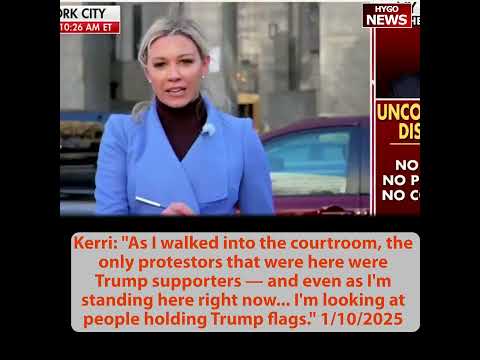
Jonathan Turley: is NOT a criminal case; Gowdy: hard nanosecond; Kerri: Trump supporters & flags
In the aftermath of President-elect Trump’s sentencing hearing on January 10, 2025, legal scholar Jonathan Turley declared the case “not a criminal case” due to the absence of an underlying crime, former Congressman Trey Gowdy said it was impossible to spend even a “nanosecond” in Judge Merchan’s courtroom without perceiving bias against the defense, and reporter Kerri noted that the only protesters outside the courthouse were Trump supporters waving flags. The combined analysis painted a picture of a prosecution that had achieved its political objective of labeling Trump a felon while failing to impose any meaningful consequence.
Turley: No Underlying Crime
Jonathan Turley, the Georgetown law professor who had become one of the most authoritative voices analyzing the Manhattan case, offered his bluntest assessment yet of the prosecution’s legal foundation.
“The fact is that this is not a criminal case in my view, because there’s no underlying crime,” Turley said. “Bragg took a dead misdemeanor, zapped it back into life as this pile of felonies. He essentially tried a series of federal crimes. The Department of Justice rejected it.”
Turley’s argument centered on the prosecution’s legal structure. The falsification of business records charge was ordinarily a misdemeanor under New York law. To elevate it to a felony, DA Alvin Bragg needed to tie the alleged falsification to another crime that Trump was supposedly trying to conceal. The problem, in Turley’s view, was that the underlying crimes Bragg invoked were federal in nature — and the federal Department of Justice had already declined to prosecute them.
“He was only able to do that by this enabling judge,” Turley continued, pointing to Judge Juan Merchan’s rulings as essential to the prosecution’s ability to proceed with what Turley viewed as a legally unprecedented theory.
Turley noted that his own views had hardened after personally attending the trial. “I was not nearly as harsh on Juan Merchan until I sat in his courtroom,” he said. “I was quite shocked with his rulings. I thought that they were well outside the strike zone and showed a lot of bias.”
He offered one point of optimism for the defense: “The good news is that this case can be appealed in whole and those decisions can be reviewed.”
Gowdy: Unprecedented Judicial Bias
Former Congressman and federal prosecutor Trey Gowdy delivered his assessment in characteristically sharp terms. “It’s really hard to have spent like a nanosecond in that courtroom and not view Juan Merchan as being biased against the defense,” Gowdy said.
He then added a qualifier that gave his critique additional weight. “Look, I’m pro prosecution. I’ve never seen a judge as pro-prosecution as Juan Merchan,” Gowdy said. Coming from a former prosecutor known for his tough-on-crime reputation, the observation carried particular credibility. If even a self-described pro-prosecution legal mind viewed Merchan’s conduct as excessively favorable to the prosecution, the characterization of bias was difficult to dismiss as partisan spin.
Gowdy then addressed the sentencing outcome itself, arguing that Merchan’s decision to impose no prison time and no probation was motivated by personal vanity rather than justice. “That’s why he signaled no active prison time. That’s why he said it’s no probation,” Gowdy said. “So he could go forward and go to all of his cocktail parties and say, ‘I’m the one that made Donald Trump a felon.’”
But Gowdy argued that Merchan’s self-congratulation was incomplete. “What he also needs to add, though, is, ‘I helped him get reelected. I helped him become Grover Cleveland Part Two,’” Gowdy said. “Because if he doesn’t add that part of it, he’s being disingenuous.”
The reference to Grover Cleveland — the only president to serve two non-consecutive terms before Trump — placed the sentencing in historical context. Gowdy argued that the lawfare against Trump had actually contributed to his political strength rather than diminishing it.
The Lawfare Effect
Gowdy expanded on the political consequences of the prosecution. “This lawfare, this taking of a misdemeanor and putting some costume jewelry on it and calling it a felony, is part of why he won the most popular vote in the Electoral College,” Gowdy said. The argument — that voters viewed the prosecution as political persecution and rallied behind Trump because of it — had been a central claim of the Trump campaign and was now being cited as validated by the election results.
The analysis noted Trump’s own courtroom statement as particularly effective. “Donald Trump gave a pretty effective statement where he said, quite simply, I was indicted because my accountant labeled legal expenses legal expenses,” the discussion noted. “And that’s why I’m here. He said this person could have labeled them concrete or electrical or anything like that. They didn’t. They were legal expenses because they were payments to a lawyer. They were logged as such. And now I’ve been indicted.”
The Colangelo Connection
The analysis again highlighted the presence of Matthew Colangelo in the courtroom — the former senior DOJ official who had left the Biden Department of Justice to join Bragg’s office and help prosecute Trump. Trump had pointed Colangelo out on the courtroom screen during his remarks.
“He pointed him out and said, you know, this is evidence that the Department of Justice was involved,” the report noted. Colangelo’s career move from a top federal post to a state prosecutor’s office specifically to work on the Trump case remained one of the most politically charged aspects of the prosecution, lending credibility to claims that the case was coordinated at the federal level.
Trump Supporters Outside the Courthouse
Reporter Kerri provided a ground-level view of the scene outside the courtroom that contrasted sharply with the political narratives inside. “As I walked into the courtroom, the only protesters per se who were here were Trump supporters,” Kerri reported. “And even as I’m standing here right now, I’m looking into a square and I’m looking at people holding Trump flags. I’m looking at a person who has a sign that says ‘Enough is enough. We voted. We don’t want this lawfare anymore.’”
The observation was significant: at a sentencing hearing that Democrats had championed as historic accountability, the physical space outside the courthouse was dominated entirely by Trump’s supporters. There was no corresponding celebration from the prosecution’s political allies, suggesting that even those who had backed the case understood that its political utility had been exhausted.
The Audio Double Standard
Kerri also noted a telling inconsistency in Judge Merchan’s approach to courtroom transparency. During the trial itself, there had been no audio and no cameras permitted. But for the sentencing, Merchan agreed to allow audio broadcast.
“I can’t help but think it’s because he wants the world to hear his voice sentence Donald Trump, because we were not able to have that before,” Kerri observed. The selective transparency — blocking public access during the trial proceedings but permitting it for the sentencing — reinforced the perception that the case was as much about political theater as legal substance.
Key Takeaways
- Jonathan Turley declared the case “not a criminal case” because there was no underlying crime, arguing Bragg “zapped a dead misdemeanor back into life” with an enabling judge.
- Trey Gowdy, a self-described pro-prosecution former prosecutor, said he had “never seen a judge as pro-prosecution as Juan Merchan.”
- Gowdy argued Merchan imposed no punishment so he could claim credit for making Trump a felon while avoiding the political backlash of actual incarceration.
- The only protesters outside the courthouse were Trump supporters, with signs reading “Enough is enough. We voted.”
- Merchan allowed audio for the sentencing after blocking cameras and audio during the trial itself, raising questions about selective transparency.
Transcript Highlights
The following is transcribed from the video audio:
- The fact is that this is not a criminal case in my view, because there’s no underlying crime. Bragg took a dead misdemeanor, zapped it back into life as this pile of felonies.
- It’s really hard to have spent like a nanosecond in that courtroom and not view Juan Merchan as being biased against the defense. I’ve never seen a judge as pro-prosecution as Juan Merchan.
- So he could go forward and go to all of his cocktail parties and say, I’m the one that made Donald Trump a felon.
- This lawfare, this taking of a misdemeanor and putting some costume jewelry on it and calling it a felony, is part of why he won.
- The only protesters who were here were Trump supporters. I’m looking at people holding Trump flags.
- I can’t help but think it’s because he wants the world to hear his voice sentence Donald Trump.
Full transcript: 630 words transcribed via Whisper AI.