 HYGO News
 Joe Biden Says There Are Still Some Deniers Out There In Terms Of...Climate Change
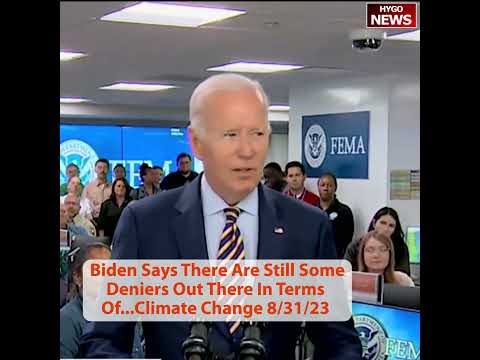
Biden Says “There Are Still Some Deniers Out There” on Climate Change, Asks for More Money During FEMA Visit
On August 31, 2023, President Joe Biden visited FEMA headquarters to deliver remarks on Hurricane Idalia, which had struck Florida’s Big Bend region as a Category 3 storm the previous day. During his remarks, Biden used the hurricane as an opportunity to attack “climate change deniers” and request additional emergency funding, saying there were “still some deniers out there in terms of whether or not climate change can do anything to do with any of this” and that the government was “going to need a whole lot more money to deal with emergency appropriations.”
The visit came after Biden had originally scheduled no public events for the day, adding the FEMA appearance only after facing intense backlash over his perceived indifference to the Maui wildfire disaster and his plans to head to the beach for the weekend while Hurricane Idalia was still affecting the southeastern United States.
Biden’s Climate Change Remarks
During the FEMA visit, Biden struggled to articulate his climate change point, visibly searching for words before arriving at his message.
“We’re in a situation where, you know, we’re, how can I say it?” Biden began, pausing to gather his thoughts. “There’s still some deniers out there in terms of whether or not climate change can do anything to do with any of this.”
He then pivoted to a funding request: “And we’re going to need a whole lot more money to deal with emergency appropriations to deal with all you’re taking care of.”
The statement accomplished two things simultaneously: it framed the hurricane as evidence of climate change without providing any specific scientific basis for the claim, and it set up a request for more government spending. The combination was characteristic of the Biden administration’s approach to natural disasters, which critics described as using extreme weather events as justification for the administration’s climate spending agenda rather than focusing on immediate relief and preparedness.
Hurricanes Are Not New
Biden’s implication that Hurricane Idalia was evidence of climate change was challenged by basic historical context. Hurricanes have been a regular feature of the Atlantic season for as long as records have been kept, and the Gulf of Mexico and Caribbean have experienced major hurricanes throughout American history.
The Atlantic hurricane season runs from June through November, with peak activity occurring between August and October. Warm ocean temperatures during these months have always been the primary fuel for tropical cyclone development. Biden’s suggestion that Hurricane Idalia’s occurrence was somehow connected to climate change ignored the simple fact that major hurricanes have always hit the Florida coast during hurricane season.
Idalia was, in fact, the first major hurricane to make landfall in Florida’s Big Bend region in over 125 years. While this could be interpreted as evidence of an intensifying pattern, it could equally be cited as evidence that the region had been remarkably fortunate for over a century without a direct hit. The long interval between major landfalls in the Big Bend region undermined rather than supported the narrative that hurricanes were becoming more frequent or severe in that area.
The Intergovernmental Panel on Climate Change’s own assessments have noted that while warming ocean temperatures may contribute to the intensification of individual storms, there is no clear evidence of an increasing trend in the total number of hurricanes globally. The relationship between climate change and hurricane activity remained a subject of ongoing scientific study, far more nuanced than Biden’s dismissive reference to “deniers” suggested.
The Funding Request
Biden’s request for “a whole lot more money” for emergency appropriations revealed the political dimension of his FEMA visit. The administration was using Hurricane Idalia, along with the still-ongoing Maui wildfire recovery, to build a case for additional spending from Congress.
This approach drew criticism from those who noted that FEMA’s preparedness and response capabilities should not be dependent on emergency supplemental spending after each disaster. Critics argued that if the federal government was serious about disaster preparedness, it would fund FEMA’s operations through the regular appropriations process at levels adequate to handle major events, rather than using each new disaster as a justification for additional spending that could be directed toward the administration’s broader policy priorities.
The framing also allowed the administration to position any Republican resistance to additional spending as evidence that they did not care about disaster victims, a political tactic that conveniently ignored questions about how effectively previous disaster funding had been deployed, as illustrated by the Maui $700 payment controversy.
The Forced Public Appearance
The context surrounding Biden’s FEMA visit was as notable as the remarks themselves. Biden had originally scheduled no public events for August 31, a continuation of the light schedule that had become characteristic of his presidency. The FEMA visit was added only after the administration faced a firestorm of criticism over Biden’s handling of multiple overlapping disasters.
The Maui wildfires had been a public relations disaster for the White House. Biden’s “no comment” from the beach, his vacation at Lake Tahoe while Maui residents were displaced, his tone-deaf comparison of the Lahaina catastrophe to a kitchen fire at his own home, and the $700 FEMA payment had all generated sustained negative coverage. With Hurricane Idalia now adding a second concurrent disaster, the pressure on Biden to demonstrate engagement became too great to ignore.
Even the optics of the FEMA visit were managed carefully. Biden was photographed sitting at a table looking at screens and talking to officials, images designed to project competence and engagement. However, the visit’s late addition to the schedule and Biden’s stumbling delivery during his remarks undercut the intended message.
The Climate Agenda and Natural Disasters
The Biden administration had a consistent pattern of using natural disasters to advance its climate policy agenda. Every hurricane, wildfire, flood, and heat wave was cited as evidence that climate change demanded massive government spending, regardless of whether specific scientific evidence linked the particular event to long-term climate trends.
This approach served multiple purposes. It allowed the administration to frame its climate spending not as an ideological priority but as a practical necessity. It positioned opponents of climate spending as uncaring about disaster victims. And it created a narrative arc in which every natural disaster reinforced the administration’s core policy agenda.
Critics argued that this approach was both scientifically dishonest and practically counterproductive. By focusing on climate change as the root cause of natural disasters, the administration diverted attention from more immediate and actionable factors: inadequate building codes, poor land use planning, aging infrastructure, insufficient emergency warning systems, and the kind of specific government failures that had turned the Maui fires into a catastrophe.
Additional Context
Biden’s FEMA visit came during a week in which the administration was simultaneously dealing with the aftermath of the Maui wildfires, Hurricane Idalia’s damage to Florida and the southeastern United States, and ongoing questions about the president’s fitness for office and his vacation habits. The convergence of these issues created a period of sustained negative coverage that the FEMA visit was intended, but largely failed, to mitigate.
Biden’s use of the word “deniers” was itself a political choice. By likening skeptics of specific climate claims to deniers of scientific reality, Biden was attempting to shut down debate rather than engage with the substantive questions about the relationship between climate change and specific weather events.
Key Takeaways
- Biden used a FEMA headquarters visit to call out “climate change deniers” and blame climate change for Hurricane Idalia without offering specific scientific evidence linking the particular storm to long-term climate trends.
- Biden requested “a whole lot more money” for emergency appropriations, using the hurricane to build a case for additional government spending.
- The FEMA visit was not originally on Biden’s schedule for the day and was added only after intense backlash over his handling of the Maui wildfires and his planned beach vacation during Hurricane Idalia.
- Hurricanes have been a regular feature of Atlantic hurricane seasons throughout recorded history, and Idalia was the first major hurricane to hit Florida’s Big Bend in over 125 years.
- Biden struggled to articulate his climate message, visibly searching for words before delivering his remarks about deniers and funding.