 HYGO News
 Joe Biden Ignores Questions Again
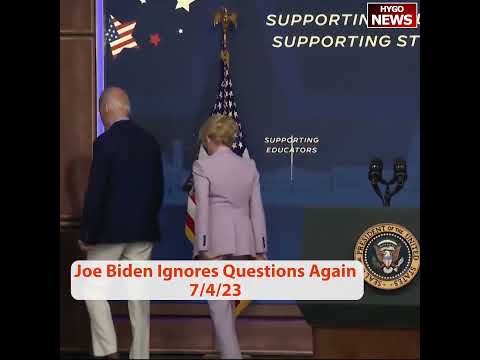
Biden Ignores Reporters’ Questions Again After Mumbling Through Remarks to Educators
On July 5, 2023, President Biden delivered remarks to educators at a National Education Association event held in the South Court Auditorium — the stage sometimes referred to as the “fake White House set” because it features a backdrop designed to look like the White House interior. After stumbling through his prepared remarks, Biden turned around and walked away as reporters shouted questions, with First Lady Jill Biden escorting him out of the room. The scene unfolded just days after cocaine was discovered in the West Wing and as multiple news stories swirled about topics the President was avoiding.
The Scene: Biden Turns and Walks Away
The clip captures what had become a familiar pattern during the Biden presidency. The President arrives at a controlled event with a prepared script, delivers remarks of limited duration, and then departs without taking questions from the press. Reporters, positioned to capture the moment, shout questions as the President exits, and the President either ignores them entirely or responds with a brief, often dismissive comment.
In this instance, Biden concluded his remarks to the National Education Association gathering and immediately turned to leave. Dr. Jill Biden, who had been present at the event, accompanied the President as he exited. Reporters’ shouted questions went unanswered.
The setting itself was notable. The South Court Auditorium in the Eisenhower Executive Office Building has been used extensively by the Biden administration for presidential events, press conferences, and scripted appearances. It features a stage set that includes a mock window with a garden view and interior furnishings designed to evoke the White House. Critics dubbed it the “fake White House” and questioned why the administration preferred this controlled environment over the Oval Office or other traditional presidential settings.
The Questions Biden Was Avoiding
The timing of Biden’s refusal to take questions was significant. On this particular day, reporters had questions about multiple developing stories that the White House found politically inconvenient.
The most immediate question was about the cocaine found in the West Wing. Discovered on Sunday, July 2, the substance had become a major story, and the White House press secretary had spent the day’s briefing deflecting questions about the investigation, the location, and the administration’s cooperation with the Secret Service. Reporters wanted to hear directly from the President, particularly given speculation about Hunter Biden and the White House’s insistence that the entire Biden family was at Camp David during the relevant period.
Additionally, reporters had questions about Biden’s continued failure to visit East Palestine, Ohio, more than five months after the catastrophic train derailment. A New York Times story about Hunter Biden’s daughter in Arkansas — whom Biden had refused to acknowledge as his granddaughter — was also generating coverage. And Gallup had just released a poll showing only 31 percent of Americans had confidence in the federal government.
Each of these topics carried political risk for the President, and the administration’s strategy of routing all media engagement through the press secretary rather than allowing direct presidential Q&A sessions reflected a calculated effort to minimize Biden’s unscripted interactions with the press.
The Pattern of Avoiding the Press
Biden’s refusal to take questions was not an isolated incident but part of a documented pattern. Multiple media organizations tracked presidential press conferences and found that Biden held significantly fewer open press conferences than his recent predecessors at comparable points in their presidencies.
The avoidance strategy extended beyond formal press conferences. Biden frequently limited his public appearances to scripted events — remarks at summits, speeches at union halls, statements in the Roosevelt Room — that did not include question-and-answer sessions. When he did take questions, they were often limited to a small number of pre-selected reporters, and handlers frequently attempted to end the sessions quickly.
The White House defended this approach by pointing to Biden’s engagement with reporters in informal settings, such as shouted exchanges on the South Lawn before Marine One departures. Critics argued that these brief, noisy interactions were not a substitute for the kind of sustained, sit-down questioning that held presidents accountable.
Concerns About the President’s Performance
The clip also reignited ongoing concerns about Biden’s physical and verbal stamina. At 80 years old, Biden was the oldest sitting president in American history. His remarks to the educators were described by observers as halting and difficult to follow, with the President appearing to struggle with his delivery.
The South Court Auditorium setting amplified these concerns. The use of teleprompters, controlled lighting, and a carefully staged environment suggested an effort to optimize conditions for the President’s performance. When even these optimized conditions produced a notably weak delivery, it raised questions about Biden’s capacity for the unscripted, high-pressure interactions that the presidency demands.
First Lady Jill Biden’s visible role in escorting the President out of the event also drew attention. While the First Lady’s presence at presidential events is normal, the specific image of her guiding Biden away from reporters contributed to a narrative about the President’s dependence on handlers and family members to manage his public appearances.
The “Fake White House” Controversy
The South Court Auditorium stage set had been a recurring point of criticism throughout the Biden presidency. The set was originally constructed to provide a professional backdrop for virtual meetings and press events, but its use expanded significantly under the Biden administration.
Critics argued that the set allowed the administration to create an illusion of presidential authority and engagement without subjecting Biden to the unpredictability of the actual White House press briefing room or Oval Office. The set could be configured with specific camera angles, lighting, and teleprompter placement that might not be available in traditional presidential settings.
The administration maintained that the auditorium was simply a practical venue for events that required more space or different configurations than traditional White House rooms could provide. However, the frequency of its use and the controlled nature of the events held there supported the criticism that it served as a stage-managed alternative to genuine presidential accessibility.
Key Takeaways
- Biden ignored reporters’ shouted questions after delivering halting remarks to National Education Association educators at the South Court Auditorium, with Dr. Jill Biden escorting him out of the room.
- The refusal to take questions came amid multiple politically sensitive stories including the White House cocaine discovery, the East Palestine non-visit, Biden’s refusal to acknowledge his seventh grandchild, and a Gallup poll showing 31 percent confidence in government.
- Biden’s avoidance of the press was part of a documented pattern in which the administration minimized unscripted presidential interactions with reporters compared to recent predecessors.
- The event took place in the South Court Auditorium “fake White House set,” which critics argued was used to optimize conditions for Biden’s appearances while avoiding the unpredictability of traditional presidential settings.
- The President’s halting delivery and his need for First Lady assistance in exiting the event reignited concerns about Biden’s physical and verbal stamina at 80 years old.