 HYGO News
 Joe Biden Appears To Forget The Website Name He Wants People To Go To
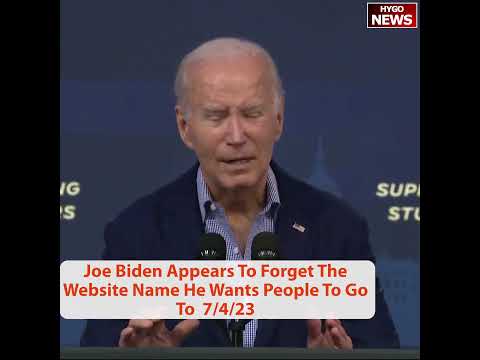
Biden Appears to Forget the Website Name He Wants People to Visit During NEA Event
On July 5, 2023, during remarks to the National Education Association at the South Court Auditorium, President Biden appeared to forget the name of a website he was directing audience members to visit. Mid-sentence, Biden said “Go to, anyway, you ought to contact us to make sure you know exactly how to qualify,” abandoning the attempt to name the specific URL and pivoting to a general instruction. The moment was brief but added to a growing catalog of public instances in which the 80-year-old President lost his train of thought during scripted remarks.
The Moment
The clip captures Biden in the middle of what was clearly intended to be a specific call to action. Presidential remarks routinely include directions to government websites where citizens can access information about programs, benefits, or services. These website names are included in the prepared text and displayed on the teleprompter.
Biden began: “Go to…” He then paused, appeared to lose the website name, and pivoted: “anyway, you ought to contact us to make sure you know exactly how to qualify.”
The recovery was a familiar Biden technique. Rather than stopping to locate the correct information, the President redirected to a general statement that conveyed the same basic message without the specific detail he had been unable to recall. The approach minimized the visible disruption but could not disguise the fact that a piece of prepared information had escaped him mid-delivery.
For viewers watching in real time, the moment was instantly recognizable as a lost-word event. The “Go to…” followed by the abrupt “anyway” signaled the exact point where the President’s recall failed. The transition was smooth enough to avoid a complete breakdown in the flow of his remarks but not smooth enough to pass unnoticed.
The Context: A Difficult Day at the “Fake White House”
The NEA event took place in the South Court Auditorium of the Eisenhower Executive Office Building, a venue the Biden administration used extensively for presidential appearances. The auditorium features a stage set with a backdrop designed to resemble the White House interior, including fake windows and carefully positioned lighting. Critics had long referred to it as the “fake White House set,” arguing that it was used to create controlled conditions that minimized the risk of presidential gaffes.
The irony was that even in this optimized setting — with teleprompters, controlled lighting, and a supportive audience of educators — Biden still struggled with his delivery. The NEA audience was friendly, the topic was education policy, and the format did not include the pressure of hostile questions or adversarial exchanges. Yet the President’s performance raised the same concerns that emerged in more challenging settings.
Biden had returned to the White House from Camp David the previous day, July 4, for the Independence Day celebration. The return coincided with the cocaine-in-the-West-Wing story that was dominating the news cycle. The combination of the cocaine controversy, the demanding July 4 event, and the follow-up NEA appearance may have contributed to what appeared to be a particularly challenging day for the President’s verbal performance.
The Pattern of Lost Words and Lost Thoughts
The website name incident was one of many similar moments throughout Biden’s presidency that became viral clips on social media and talking points for political commentators. The President had a well-documented history of verbal stumbles dating back decades, and his supporters argued that these were consistent with a lifelong stutter and the natural imperfections of extemporaneous speech.
However, the frequency and nature of the incidents had shifted during his presidency. Earlier in his career, Biden’s gaffes tended to be misspeakings or malapropisms — using the wrong word or making an inappropriate joke. The incidents during his presidency increasingly involved losing his place in prepared remarks, trailing off mid-sentence, struggling to complete thoughts, and appearing confused about where he was or what he was supposed to do next.
The website name moment fell into the category of lost recall during scripted remarks. This was distinct from a spontaneous slip or an intentional departure from the text. Biden was reading from prepared remarks, encountered a specific piece of information (the website URL), could not retrieve or read it, and improvised a workaround. The fact that this occurred during a telepromptered speech rather than a free-form exchange made it more difficult to attribute to the normal imperfections of public speaking.
The Age Question in American Politics
Biden was 80 years old at the time of this event, making him the oldest serving president in American history. Public polling consistently showed that a majority of Americans, including many Democrats, had concerns about his age and fitness for office. A February 2023 AP-NORC poll found that 77 percent of Americans believed Biden was too old to be effective for four more years.
The administration’s response to age concerns was to point to Biden’s legislative accomplishments, his foreign policy engagement, and his work schedule. Supporters argued that the President’s record of achievement spoke for itself and that verbal stumbles were an unfair metric by which to judge competence.
Critics countered that the presidency demands sharp real-time cognitive function, particularly in crisis situations where the President must process information quickly, communicate clearly, and make consequential decisions. Moments like the website name gaffe, while individually minor, accumulated into a broader pattern that fed public anxiety about whether the President was fully capable of meeting these demands.
The debate would intensify significantly in the following months, culminating in Biden’s disastrous June 2024 debate performance that ultimately led to his decision to withdraw from the presidential race.
What the Clip Reveals About Presidential Communications
The incident also highlighted the mechanics of modern presidential communications. The fact that a simple website URL could become a public stumble illustrated the narrow margin for error in presidential appearances. Every word, pause, and hesitation is captured on camera and distributed instantly to millions of viewers through social media.
Previous presidents had the benefit of a more forgiving media environment. A lost word during a speech might be noticed by those in the room but would not necessarily become a national news story. In the era of short-form video, every presidential appearance is essentially a live performance where any moment can be clipped, shared, and commented on before the event is even over.
The Biden White House’s reliance on the South Court Auditorium, teleprompters, and controlled settings was in part a response to this reality. By minimizing variables — no hostile questions, no unpredictable settings, no extended unscripted interactions — the administration sought to reduce the risk of viral moments. The website name incident showed the limits of this strategy: even in the most controlled environment possible, the President’s verbal performance could produce exactly the kind of clip the administration was trying to prevent.
Key Takeaways
- Biden appeared to forget a website name mid-sentence during remarks to the National Education Association, saying “Go to, anyway, you ought to contact us” instead of providing the specific URL.
- The incident occurred in the South Court Auditorium “fake White House set” during a telepromptered speech to a friendly audience, conditions designed to minimize the risk of such moments.
- The gaffe added to a growing pattern of verbal stumbles during Biden’s presidency that shifted from occasional misspeakings to more frequent instances of lost recall during prepared remarks.
- Public polling consistently showed majority concern about Biden’s age and fitness, with 77 percent telling AP-NORC in February 2023 that he was too old to be effective for four more years.
- The moment illustrated the narrow margin for error in modern presidential communications, where any stumble is instantly clipped and distributed to millions through social media.