 HYGO News
 Jeffries: not to invade Greenland not rename Gulf of Mexico; Schumer: Trump crazy zany new ideas
Jeffries: not to invade Greenland not rename Gulf of Mexico; Schumer: Trump crazy zany new ideas
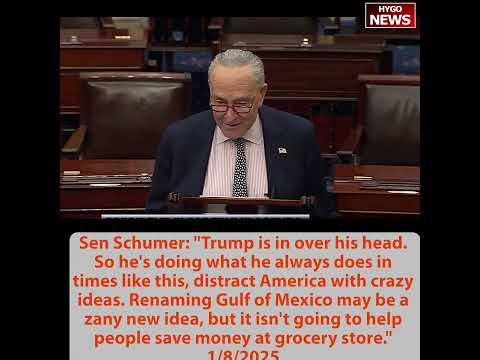
In the immediate aftermath of President-elect Trump’s January 7, 2025, press conference at Mar-a-Lago, top Democratic leaders in Congress responded with sharp criticism, attempting to redirect public attention from Trump’s proposals to the cost of living. House Minority Leader Hakeem Jeffries declared that Democrats were “not sent to Washington to invade Greenland, rename the Gulf of Mexico, or seize the Panama Canal by force,” while Senate Minority Leader Chuck Schumer accused Trump of being “in over his head” and using “crazy ideas” to distract from his inability to deliver on campaign promises.
Jeffries: Focused on the Cost of Living, Not Renaming Oceans
House Minority Leader Hakeem Jeffries used his response to Trump’s press conference to draw a stark contrast between the incoming president’s priorities and what he characterized as the concerns of ordinary Americans.
“House Democrats believe that we are not sent to Washington to invade Greenland, rename the Gulf of Mexico, or seize the Panama Canal by force,” Jeffries declared. “We were sent to Washington to lower the high cost of living in the United States of America.”
Jeffries expanded on the economic framing: “America is too expensive for working-class families and for middle-class folks all across the country. That should be our mission. And that’s what we’re going to focus on.”
Addressing Trump’s Gulf of America proposal directly, Jeffries offered a conditional response that served as both a critique and a political maneuver: “I’d agree to work with Donald Trump on renaming the Gulf of Mexico only if he first agrees to work with us on an actual plan to lower costs for Americans. That’s what the American people want us to focus on. First, not on renaming bodies of water.”
Jeffries framed the Democratic position as more closely aligned with public priorities: “Our priorities, our Democratic priorities, are so much more closely aligned with the concerns of the American people than Donald Trump seemed to be.”
Schumer: “In Over His Head” with “Crazy Ideas”
Senate Minority Leader Chuck Schumer went further, directly questioning Trump’s fitness for the challenges ahead and characterizing his proposals as deliberate distractions.
“The incoming president knows he has a tall task ahead of him,” Schumer said. “He spent years on the campaign trail making outlandish promises he won’t be able to keep. In fact, he’s getting ready to do the opposite of what he promised by cutting tax cuts for the very, very wealthy.”
Schumer’s sharpest attack framed Trump’s various proposals as evidence of inadequacy rather than ambition: “Donald Trump is in over his head, so he’s doing what he always does in times like this: distract America with crazy ideas. Renaming the Gulf of Mexico may be a zany new idea, but it isn’t going to help people save money at the grocery store.”
Like Jeffries, Schumer offered a conditional framework for cooperation: “If Donald Trump wants to rename an ocean to sound more patriotic, I’d say we’ll help him on one condition and only on one condition. Let’s come up with a real plan first — not a concept of a plan — to lower prices for Americans. Let’s do that first. Then Donald Trump can have his fun.”
The “concept of a plan” language was a callback to a phrase Trump had used during the 2024 presidential campaign regarding his healthcare policy, which Democrats had seized upon as evidence of a lack of substance behind his rhetoric.
Trump’s Original Announcement: “What a Beautiful Name”
The Democratic responses were triggered by Trump’s announcements during his January 7 press conference at Mar-a-Lago, the day after Congress certified his 2024 election victory. Trump had covered a wide range of topics, but the Gulf of Mexico renaming and his refusal to rule out military or economic coercion regarding Greenland and the Panama Canal drew the most attention.
On the Gulf of Mexico, Trump had stated: “We’re going to be changing the name of the Gulf of Mexico to the Gulf of America, which has a beautiful ring that covers a lot of territory. The Gulf of America, what a beautiful name. And it’s appropriate. It’s appropriate.”
Trump connected the renaming to broader immigration and trade concerns: “Mexico is really in trouble, a lot of trouble. Very dangerous place. Mexico has to stop allowing millions of people to pour into our country. They can stop them. And we’re going to put very serious tariffs on Mexico and Canada because Canada, they come through Canada too.”
He added: “The drugs that are coming through are at record numbers, record numbers. So we’re going to make up for that by putting tariffs on Mexico and Canada, substantial tariffs.”
The Strategic Dimension of the Democratic Response
The coordinated response from Jeffries and Schumer reflected a deliberate Democratic strategy to redirect the political conversation away from Trump’s provocative proposals and toward pocketbook issues that polls showed were a top concern for voters.
By framing Trump’s Greenland, Panama Canal, and Gulf of America proposals as distractions, Democrats sought to position themselves as the party focused on practical, everyday concerns. The approach mirrored messaging that Democrats had used throughout 2024, when they attempted to contrast their economic agenda with what they characterized as Republican extremism on cultural and geopolitical issues.
However, the strategy carried risks. Trump’s proposals, while provocative, addressed issues of national security, energy independence, and American sovereignty that resonated with many voters. By dismissing them as “crazy” and “zany,” Democrats risked appearing dismissive of legitimate concerns about Chinese influence in the Panama Canal, Arctic security dynamics, and immigration enforcement.
The coordinated messaging also highlighted the challenge facing Democrats in the minority. With Republicans controlling both chambers of Congress and the White House, Democratic leaders had limited legislative power and were largely restricted to using media appearances and press conferences to shape public opinion.
Additional Context
Trump’s press conference proposals came during a period of intense transition activity. In addition to the Gulf of America renaming, Trump had announced a $20 billion investment by DAMAC Properties, praised SoftBank’s $200 billion investment commitment, issued an ultimatum to Hamas regarding hostages, and laid out his approach to budget reconciliation. The breadth of the announcements underscored the incoming administration’s intent to move on multiple fronts simultaneously.
Democrats’ decision to focus their response on the most provocative elements of the press conference rather than the investment announcements or policy details reflected a calculation that the Greenland, Panama, and Gulf of Mexico proposals offered the clearest contrast with their economic messaging.
Key Takeaways
- House Minority Leader Jeffries declared Democrats were “not sent to Washington to invade Greenland, rename the Gulf of Mexico, or seize the Panama Canal by force,” insisting the focus should be lowering the cost of living.
- Senate Minority Leader Schumer accused Trump of being “in over his head” and using “crazy ideas” like renaming the Gulf of Mexico to distract from his inability to keep campaign promises.
- Schumer offered to help rename the Gulf of Mexico on “one condition”: that Trump first agree to “a real plan, not a concept of a plan, to lower prices for Americans.”
- Trump had announced the renaming at his January 7 Mar-a-Lago press conference, calling it “the Gulf of America, what a beautiful name,” while also announcing tariffs on Mexico and Canada.
- The coordinated Democratic response reflected a strategy to redirect attention from Trump’s geopolitical proposals toward pocketbook issues that polls showed were a top voter concern.