 HYGO News
 Jean-Pierre: It 'Was Planned' For Biden To Abruptly Leave Medal Of Honor Ceremony Before It Was Over
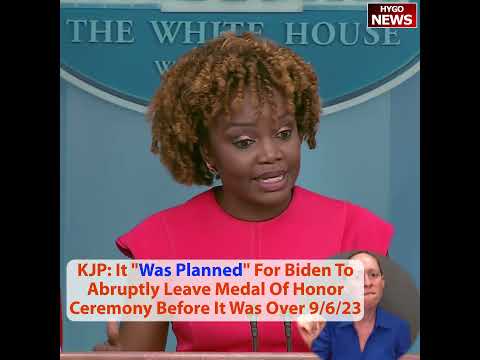
Jean-Pierre: It “Was Planned” For Biden To Abruptly Leave Medal Of Honor Ceremony Before It Was Over
On September 6, 2023, White House Press Secretary Karine Jean-Pierre addressed criticism of President Biden’s abrupt departure from a Medal of Honor ceremony the previous day. Biden had left the event honoring Captain Larry Taylor before the program concluded, prompting social media users to accuse him of disrespecting the Vietnam War hero. Jean-Pierre insisted the early exit was “planned” and designed to “minimize his close contact” with other attendees — a defense that raised more questions than it answered.
What Happened at the Ceremony
On September 5, 2023, President Biden presented the Medal of Honor to Captain Larry Taylor, recognizing his extraordinary heroism during the Vietnam War. Taylor had piloted his helicopter into heavy enemy fire to rescue a four-man Army reconnaissance team in June 1968, an act of valor that took more than fifty years to receive formal recognition.
Biden was attending the ceremony while on COVID close-contact protocol. First Lady Jill Biden had recently tested positive for COVID-19, and under CDC guidelines, Biden was expected to wear a high-quality mask whenever he was indoors around others. He wore the mask for part of the ceremony, removed it to deliver remarks, and then departed the event before the program was finished.
Video of the departure circulated widely on social media. Observers noted that Biden appeared to leave quickly, without the customary lingering to speak with the honoree, family members, and guests that typically follows such ceremonies. The optics of a president rushing away from a Medal of Honor presentation — the highest military honor the nation bestows — struck many viewers as disrespectful, regardless of the reason.
The “Planned” Defense
At the September 6 briefing, a reporter pressed Jean-Pierre on the departure, noting that CDC guidelines for COVID close contacts required wearing a high-quality mask “anytime you are around others inside your home or indoors in public.” Biden had removed his mask during the ceremony and had not replaced it before leaving.
Jean-Pierre’s response leaned heavily on the word “planned”: “And he left, as planned — as it was planned, he left when there was a pause in the program in order to minimize — to minimize his close contact with attendees who were — who were about to participate in a reception.”
The repetition of “as planned — as it was planned” had the cadence of someone who had been briefed on a specific talking point and was determined to deploy it. The emphasis on planning was meant to counter the perception that Biden had impulsively bolted from the room. But characterizing the departure as deliberate and pre-arranged carried its own problems.
If the White House had planned in advance for Biden to leave the Medal of Honor ceremony early, that meant someone on the presidential staff had decided before the event that honoring Captain Taylor’s heroism would be truncated to accommodate COVID protocols. The planning did not make the departure look better — it made it look like a calculated decision to short-change a war hero.
The “Minimize Close Contact” Contradiction
Jean-Pierre’s stated rationale — that Biden left to “minimize his close contact with attendees who were about to participate in a reception” — was internally inconsistent with what had already occurred.
Biden had removed his mask to deliver remarks in the same room. If close contact was a concern significant enough to justify an early exit, it should have been a concern significant enough to keep the mask on while speaking. The administration’s position was effectively that Biden needed to leave to protect others from potential COVID exposure, even though he had already been unmasked among those same people.
Jean-Pierre then tried to enlist the press corps as validation: “And I — you all reported that, noticed that he left when there was a pause in the program, because, again, he wanted to minimize, certainly, his impact on folks who were there.”
The appeal to journalists having “reported” and “noticed” the departure was an unusual rhetorical move. Jean-Pierre was citing media coverage of the departure — coverage that was largely critical — as evidence that it was a normal, planned occurrence. The fact that reporters noticed Biden leaving was not proof that the exit was acceptable; it was proof that the exit was conspicuous.
The “Different Phase” Deflection
When the specific contradictions in the COVID protocol became difficult to navigate, Jean-Pierre pivoted to a broader framing: “And so, look, you know, we have to take this all into context. I think it’s important that we do this. We are in a different phase — right? — as we have said many times.”
The “different phase” language was a retreat position the administration had used repeatedly as COVID restrictions became politically inconvenient. It allowed Jean-Pierre to acknowledge that the rules existed while suggesting they no longer needed to be followed strictly. But if the country was in a “different phase” that made COVID protocols less urgent, then the planned early departure to avoid close contact was unnecessary. And if close contact was still a genuine concern, then the “different phase” framing was misleading.
The phrase “we have to take this all into context” was a request to stop examining the specific facts and instead accept a broader narrative. It was the same deflection technique Jean-Pierre used throughout the briefing on related masking questions — demanding that reporters evaluate the situation holistically rather than applying the administration’s own stated rules to the president’s behavior.
The Pattern of “Planned” Explanations
The White House’s use of “it was planned” as a defense for Biden’s public missteps had become a recurring feature of the Jean-Pierre era. When Biden appeared confused or made an unexpected departure, the default response was to insist the behavior was intentional and scheduled. The Medal of Honor exit was one of several instances where the “planned” defense was deployed after public criticism of the president’s actions.
The problem with the “planned” defense was that it required the audience to believe the White House had deliberately chosen the worse of two options. Leaving a Medal of Honor ceremony early was worse than staying for the full program. If it was truly planned, that raised the question of why the plan was not simply to have Biden remain for the entire ceremony while masked, which would have satisfied both the COVID protocol and the demands of the occasion.
Key Takeaways
- On September 6, 2023, KJP said Biden’s early departure from Captain Taylor’s Medal of Honor ceremony was “planned” to “minimize his close contact” with attendees.
- The “planned” defense was undermined by the fact that Biden had already removed his mask in the room, making the early departure an inconsistent application of COVID protocol.
- Jean-Pierre cited reporters having “noticed” Biden’s departure as though media attention validated the exit rather than highlighted its awkwardness.
- The “different phase” framing contradicted the close-contact rationale: if COVID was in a different phase, the early exit was unnecessary; if it was not, the unmasked remarks were a violation.
- The incident fit a broader pattern of the White House using “it was planned” as a retroactive justification for behavior that drew public criticism.