 HYGO News
 Jean-Pierre Claims Biden Has 'Done More To Secure The Border' Than Anyone Else Amid Border Crisis
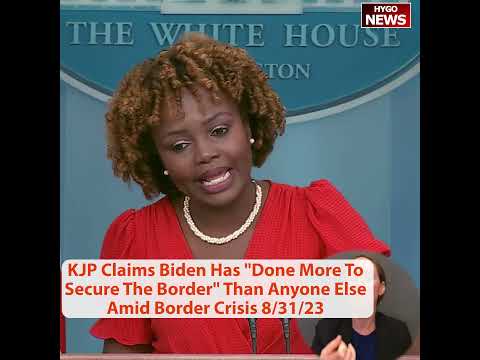
Jean-Pierre Claims Biden Has “Done More to Secure the Border” Than Anyone Else Amid Record Border Crisis
On September 1, 2023, White House Press Secretary Karine Jean-Pierre made one of the most audacious claims of her tenure at the podium, declaring that “the president has done more to secure the border and to deal with this issue of immigration than anybody else. He really has!” The statement came as the Biden administration was presiding over the worst border crisis in recorded American history, with illegal crossings at the southern border shattering previous records month after month.
Jean-Pierre’s claim was met with immediate disbelief from critics who pointed to the stark contrast between the administration’s rhetoric and the reality on the ground, where overwhelmed Border Patrol agents, overcrowded processing facilities, and record-breaking migrant encounters told a very different story.
The Full Exchange
The exchange began with a reporter pressing Jean-Pierre about criticism from fellow Democrats that the White House had not taken up their recommendations for additional executive action on immigration.
Jean-Pierre deflected to her standard talking point about Republican obstruction: “They want to make it — they, meaning Republicans in Congress, want to make it a political issue. Look, but the system is broken. We want to do this in a bipartisan way. Republicans refuse to do that.”
When pressed on the specific charge from Democratic lawmakers, Jean-Pierre escalated her defense: “The president has done more to secure the border and to deal with this issue of immigration than anybody else. He really has. And let’s not forget, we expanded. We’ve expanded the pathway to citizenship under this president.”
She then attempted to position Biden as a lone warrior against a broken system: “And mind you, he’s been doing this on his own. We need Republicans to do this. We just do. But they keep turning it into a political stunt.”
Jean-Pierre also offered a broader defense of the administration’s approach: “The president has done what he can from here, from the federal government, from the White House to put forth and manage our border in a safe and humane way to respect the dignity of every human, as he says all the time, and making sure that our communities are safe.”
The Border Crisis by the Numbers
Jean-Pierre’s claim that Biden had done more to secure the border than anyone else was directly contradicted by virtually every metric used to measure border security.
In fiscal year 2023, which was approaching its end when Jean-Pierre made these remarks, U.S. Customs and Border Protection recorded approximately 2.5 million encounters at the southern border. This followed fiscal year 2022’s record of 2.4 million encounters, which itself had broken fiscal year 2021’s then-record of approximately 1.7 million encounters.
For context, during the final full fiscal year of the Trump administration (FY2020), border encounters totaled approximately 458,000. The surge under Biden represented an increase of roughly 400 to 500 percent over the levels that had prevailed before his presidency.
The increase in illegal crossings was not a continuation of a pre-existing trend. Border encounters had been declining in the later years of the Trump administration following the implementation of policies such as the Remain in Mexico program, Title 42 expulsions, safe third country agreements with Central American nations, and accelerated wall construction. Biden systematically dismantled or reversed these policies upon taking office, and the border crisis began almost immediately.
Known “gotaways,” migrants who entered the country illegally without being apprehended, were estimated at over 600,000 in fiscal year 2023 alone. Over the full course of the Biden presidency, the total number of gotaways was estimated to exceed 1.7 million, representing an entirely separate category of illegal entry beyond the record-setting encounter numbers.
Biden’s Border Policies
The disconnect between Jean-Pierre’s claims and reality was rooted in the specific policy choices the Biden administration made beginning on its first day in office.
On January 20, 2021, Biden issued executive orders halting construction of the border wall, ending the Remain in Mexico policy (formally known as the Migrant Protection Protocols), and imposing a 100-day moratorium on deportations. In the weeks and months that followed, the administration terminated safe third country agreements with Guatemala, Honduras, and El Salvador, narrowed ICE enforcement priorities to reduce interior enforcement, and ended the use of Title 42 for certain migrant populations.
Each of these changes sent a signal to would-be migrants that the enforcement landscape had fundamentally shifted. Smuggling organizations, which closely monitored U.S. immigration policy, adjusted their messaging to potential clients accordingly, and the resulting surge in border crossings was both predictable and predicted by Border Patrol officials and immigration policy experts.
When pressed on these policy choices, the Biden White House consistently blamed the prior administration for leaving a “broken system,” argued that immigration required congressional action, and characterized Republican criticism as political stunts. Jean-Pierre’s September 1 remarks followed this exact template.
The Blame-Shifting Strategy
Jean-Pierre’s insistence that “the system is broken” and that Republicans “refuse” to work in a bipartisan way was a key element of the administration’s border messaging strategy. By framing the crisis as a systemic problem requiring legislative action rather than executive enforcement, the White House attempted to deflect responsibility for the consequences of its own policy decisions.
This argument was undermined by several inconvenient facts. The border had been relatively secure under the Trump administration’s executive actions, demonstrating that the executive branch had significant authority to manage border enforcement without new legislation. Biden had used executive authority extensively to dismantle Trump-era border policies, proving he believed the president had the power to shape immigration enforcement. And Biden’s own administration had resisted bipartisan border proposals when they included enforcement provisions the White House considered too restrictive.
The claim that Biden had expanded “pathways to citizenship” was particularly telling. Rather than securing the border, the administration’s primary immigration focus had been on making it easier for migrants to enter and remain in the United States through programs like humanitarian parole, Temporary Protected Status expansions, and the CBP One app, which allowed migrants to schedule appointments for processing at ports of entry.
Impact on American Communities
By September 2023, the consequences of the border crisis were being felt far beyond the border states. Cities across the country, including New York, Chicago, Denver, and others, were grappling with the arrival of tens of thousands of migrants who had been transported from the border region.
New York City Mayor Eric Adams, a Democrat, was publicly criticizing the federal government’s handling of the situation, warning that the migrant influx would “destroy” the city. Chicago was housing migrants in police stations and airports. Denver was spending millions on migrant services. Even traditionally progressive cities were reaching their breaking point as local resources were overwhelmed.
The political impact was significant. Immigration consistently ranked among the top concerns of American voters throughout 2023 and into 2024, and Biden’s handling of the border was one of the weakest points in his approval ratings. Even among Democratic voters, frustration with the administration’s border management was growing.
Additional Context
Jean-Pierre’s claim about Biden doing “more to secure the border than anyone else” was a particularly bold example of the administration’s strategy of asserting the opposite of observable reality and daring critics to challenge it. The approach relied on the assumption that mainstream media coverage would either not fact-check the claim or would present it as one side of a “both sides” debate.
The border crisis continued to worsen in the months following these remarks. December 2023 saw the highest single month of border encounters in history, with over 300,000 recorded. The crisis became a dominant issue in the 2024 presidential campaign, and the Biden administration eventually attempted a belated pivot toward enforcement messaging, though these efforts were widely viewed as insufficient and politically motivated.
Key Takeaways
- Karine Jean-Pierre claimed on September 1, 2023 that Biden had “done more to secure the border and to deal with this issue of immigration than anybody else,” a claim directly contradicted by record-breaking illegal crossings under his administration.
- Border encounters reached approximately 2.5 million in fiscal year 2023, compared to roughly 458,000 in the final full fiscal year of the Trump administration, an increase of over 400 percent.
- Jean-Pierre blamed Republicans for refusing to work on bipartisan solutions while defending the administration’s reversal of Trump-era enforcement policies that had effectively reduced illegal crossings.
- The press secretary also claimed Biden had expanded “pathways to citizenship,” focusing on entry facilitation rather than border enforcement.
- Cities across the country, including New York and Chicago, were struggling with the downstream consequences of the crisis, with even Democratic mayors publicly criticizing the federal response.