 HYGO News
 Italy PM Meloni keeps rolling her eyes PRICELESS; Zelensky HAS CANCELED interview with Fox
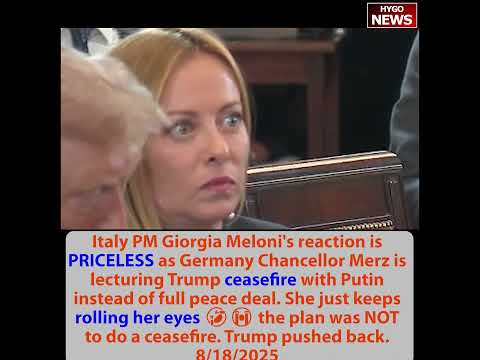
Italy PM Meloni keeps rolling her eyes PRICELESS; Zelensky HAS CANCELED interview with Fox
A meme-generating moment. German Chancellor Friedrich Merz lecturing Trump on the need for a ceasefire before a peace deal — while Italian PM Giorgia Meloni visibly rolled her eyes. Ukrainian President Zelensky canceled his planned Fox News interview to fly out and presumably meet with Putin. Zelensky confirmed Ukraine is ready for trilateral meeting. Macron endorsed the trilateral format as the only way to fix the conflict. And Trump reiterated his now-consistent “no ceasefire required” position. Merz: “The credibility of these efforts we are undertaking today are depending on at least a ceasefire from the beginning of the serious negotiations from next step on.” Zelensky on a Putin date: “No, no, we don’t have any date … we confirmed that we are ready for a trilateral meeting.” Trump: “All of us would obviously prefer an immediate ceasefire while we work on a lasting peace … In the six wars that we stopped we haven’t had a ceasefire so I don’t know that it’s necessary.” Zelensky afterward: “We had a very good conversation with President Trump … it was really good. We spoke about very sensitive points.” Macron: “Everybody around this table is in favor of peace … This is why the idea of a trilateral meeting is very important because this is the only way to fix it.”
Merz Lecturing on Ceasefire
German Chancellor Friedrich Merz’s specific posture. “The credibility of these efforts we are undertaking today are depending on at least a ceasefire from the beginning of the serious negotiations from next step on. So I would like to emphasize this aspect and would like to see a ceasefire from the next meeting which should be a trilateral meeting wherever it takes place.”
Merz is arguing that the negotiations’ credibility requires a preliminary ceasefire. Without ceasefire, the current discussions lack specific credibility. The next meeting (the trilateral) should begin with a ceasefire.
That is a specific German position. Germany has been comparatively cautious on Ukraine throughout the war — providing weapons later than allies, limiting specific weapons types, periodically pulling back specific commitments. Merz is consistent with Germany’s specific strategic culture emphasizing process and legitimacy.
Meloni’s Eye Roll
The described moment. “The Prime Minister of Italy Giorgia Meloni’s reaction is PRICELESS as Germany Chancellor Merz is lecturing Trump that he needs to go to a ceasefire with Putin instead of a full peace deal. She just keeps rolling her eyes.”
That is a specific visual moment. Meloni — one of the leaders who earlier in the session praised Trump’s diplomacy — visibly expressing frustration with Merz’s lecturing. The eye roll communicates specific skepticism about Merz’s position.
“The plan was NOT to do a ceasefire. Trump pushed back.” That is the subtext. The coordinated approach agreed by the European leaders and Trump did not include preliminary ceasefire as requirement. Merz was freelancing — raising a specific German priority that had not been agreed as the unified position.
Meloni’s eye roll signals: this is not our agreed approach, why are you bringing this up publicly, this complicates our unity. The specific moment became a viral image because it captured inter-European tension that is usually kept private.
Trump’s Pushback
“Well we’re going to let the president go over and talk to the president.”
Trump’s specific response. Deflecting the Merz argument. Not engaging with the ceasefire demand. Returning the floor to Zelensky to address the Russia meeting question.
That is a specific diplomatic move. Trump does not relitigate the ceasefire question in public. He does not publicly challenge Merz. He simply moves past the German position and continues the substantive discussion on its intended track.
Zelensky Cancels Fox Interview
“Zelensky HAS CANCELED his interview with Fox News tonight - he’s flying out instead. This comes after the leaders stayed at the White House much longer than anticipated.”
That is significant. Zelensky had scheduled Fox News interview. He canceled to fly out instead. “Flying out” likely means heading to a specific next step — potentially a pre-scheduled meeting preparing for the Putin meeting, consultation with Ukrainian security officials, or return to Ukraine for specific political preparations.
“A lot is in the works right now.” The cancellation suggests specific operational momentum. Zelensky making specific scheduling changes because of specific developing situations. Fox News interview — which would have generated helpful media coverage — is less important than the specific operational activity.
”No, We Don’t Have Any Date”
A reporter’s question to Zelensky. “Is there a date for you to meet with President Putin?”
Zelensky’s response. “No, no, we don’t have any date. We don’t have any date. We just confirmed after this productive meeting with president and then with all our colleagues and the partners we confirmed that we are ready for trilateral meeting.”
Two negations emphasize the answer. No specific date yet. But specific readiness confirmed. Ukraine is prepared for the trilateral. The scheduling remains pending.
“And if Russia proposed to president of the United States bilateral and then we will see that the result of bilateral and then it can be trilateral.”
The potential sequencing. Russia might propose another bilateral with Trump first. That bilateral would potentially produce results. Those results then inform whether trilateral proceeds.
That is diplomatic flexibility. Multiple possible sequences. Ukraine is prepared for any format — bilateral leading to trilateral, direct trilateral, or other configurations. Ukraine’s specific requirement is “on the level of leaders” — the heads of state directly engaged.
”Ukraine Will Never Stop on the Way to Peace”
“So I said always so Ukraine will never stop on the way to peace and we are ready for any kind of formats but on the level of leaders.”
Zelensky’s specific commitment. Ukraine does not withdraw from the peace process. Ukraine remains engaged. Ukraine accepts any format that puts heads of state directly in contact.
That commitment matters because Russia has historically demanded specific process characteristics (e.g., negotiations at lower levels, specific Russian-friendly mediators, specific Russian positions as preconditions). Zelensky rejecting specific preconditions beyond head-of-state-level engagement keeps Ukraine flexible on format while firm on substance.
Trump: “Preferred Immediate Ceasefire”
Trump’s response to the Merz position. “All of us would obviously prefer an immediate ceasefire while we work on a lasting peace and maybe something like that could happen as of this moment it’s not happening but President Zelensky and President Putin can talk a little bit more about that.”
“All of us would prefer.” Trump acknowledging the ceasefire preference. Not opposing ceasefire in principle. But recognizing specific tactical considerations that prevent immediate ceasefire.
“As of this moment it’s not happening.” The specific factual acknowledgment. Despite everyone’s preference, ceasefire is not occurring today.
“Zelensky and Putin can talk a little bit more about that.” The ceasefire question gets delegated to the principals. Trump is not going to resolve the ceasefire question at this meeting. The Zelensky-Putin direct engagement will address that specific question.
”Six Wars We Stopped We Haven’t Had a Ceasefire”
“You know in the Sixer Soars that we stopped we haven’t had a ceasefire so I don’t know that it’s necessary you can do it through the war but it would be I like the ceasefire from another standpoint you immediately stop the killing.”
Trump’s consistent framing. Six wars ended without preliminary ceasefires. Ceasefire is not operationally necessary for peace deals. The Ukraine-Russia situation does not need to be structurally different from those six.
“But it would be I like the ceasefire from another standpoint you immediately stop the killing.” Trump’s humanitarian argument for ceasefire. Not that it is diplomatically necessary. That it saves specific lives immediately.
Both positions — ceasefire not diplomatically required, ceasefire humanitarianly desirable — coexist in Trump’s thinking. The choice between them depends on whether Russia will actually agree to ceasefire as part of the framework.
”Peace Agreement Is Very Attainable”
“But I believe a peace agreement at the end of all of this is something that’s very attainable and it can be done in the near future.”
Trump’s specific assessment. Peace agreement is “very attainable.” Not aspirational. Not distantly possible. Very attainable. “In the near future” — not years from now. Soon.
“With all of the wars that I got involved in we only have this one left of course as I walk out the door there will probably be a new one starting and I’ll get that stopped too but I thought this was going to be one of the easier ones it’s actually one of the most difficult very complex.”
Trump’s specific self-assessment. Six wars stopped. This one remains. Expected to be easier, actually most difficult. But still within reach.
Zelensky: “Really Good” Conversation
Zelensky’s post-meeting assessment. “I think that we had very good conversation with President Trump. And it really was the best one or sorry maybe the best one will be in the future but it was really good and we spoke about very sensitive points.”
“Very good conversation.” Contrast with the February 2025 Oval Office meeting, which was characterized as contentious. The current conversation is “very good.”
“The best one will be in the future.” Zelensky suggesting the best Trump-Zelensky conversations are still ahead. Optimistic framing about continued productive engagement.
“We spoke about very sensitive points.” Substantive rather than purely ceremonial. Specific difficult issues were discussed. Territorial questions, security guarantees, timeline commitments, trade-offs that Ukraine is being asked to consider.
Macron: “Robust and Long-Standing Peace”
French President Macron’s framing. “Thank you Mr. President for organizing this meeting and for your commitment and everything was said but I have to I just have to say here everybody around this table is in favor of peace and we work very hard and we’ve worked very hard during the past few years to have a peace which is a robust and long-standing peace.”
“Robust and long-standing peace.” Two specific qualifiers. Robust — can withstand pressures. Long-standing — durable across time. Not merely cessation of current hostilities. Specific architecture that prevents return to war.
“Everybody around this table is in favor of peace.” Macron emphasizing unanimity. No one at the meeting opposes peace. The specific differences are about how to achieve peace, not whether to pursue it.
“We’ve worked very hard during the past few years.” Recognition of European diplomatic engagement. European leaders have invested in specific Ukraine-related diplomacy. Macron framing the current Trump-led moment as building on that work rather than replacing it.
”Trilateral Is the Only Way to Fix It”
“This is why the idea of a trilateral meeting is very important because this is the only way to fix it.”
Macron’s specific endorsement. Trilateral as the only path. Not an option among alternatives. The only way to resolve the conflict.
Why only trilateral? Because:
- Bilateral Russia-Ukraine has not produced progress over 3.5 years
- Multilateral formats (UN, etc.) have no Russian buy-in
- Only trilateral with Trump provides both Russia engagement and Ukrainian agency with American mediation
- Trump is the specific necessary condition (per Rubio’s earlier observation that no other leader can bring Putin to table)
Four Distinct Elements
Merz’s ceasefire lecture (German position outside unified framework). Meloni’s eye roll (Italian frustration with German freelancing). Zelensky’s Fox cancellation (specific operational movement). Trump’s pushback on ceasefire (maintaining diplomatic flexibility). Macron’s trilateral endorsement (French alignment with Trump’s framework).
Together, they show specific European diplomatic dynamics. Not all European leaders are perfectly aligned. Germany specifically pushes positions that other Europeans find problematic. Italy and France are more aligned with the Trump approach. The specific tensions within European coordination affect how the collective engagement plays out.
Key Takeaways
- German Chancellor Friedrich Merz lecturing: “The credibility of these efforts we are undertaking today are depending on at least a ceasefire from the beginning of the serious negotiations from next step on.”
- The Meloni eye roll moment: “The Prime Minister of Italy Giorgia Meloni’s reaction is PRICELESS … She just keeps rolling her eyes. The plan was NOT to do a ceasefire.”
- Zelensky on a Putin meeting date: “No, no, we don’t have any date … we confirmed that we are ready for a trilateral meeting … Ukraine will never stop on the way to peace.”
- Trump’s consistent ceasefire position: “In the six wars that we stopped we haven’t had a ceasefire so I don’t know that it’s necessary … But I believe a peace agreement at the end of all of this is something that’s very attainable and it can be done in the near future.”
- French President Macron: “Everybody around this table is in favor of peace … This is why the idea of a trilateral meeting is very important because this is the only way to fix it.”