 HYGO News
 Israeli PM Netanyahu on nominating Trump for Nobel Peace Prize; Huckabee: foes better fear us
Israeli PM Netanyahu on nominating Trump for Nobel Peace Prize; Huckabee: foes better fear us
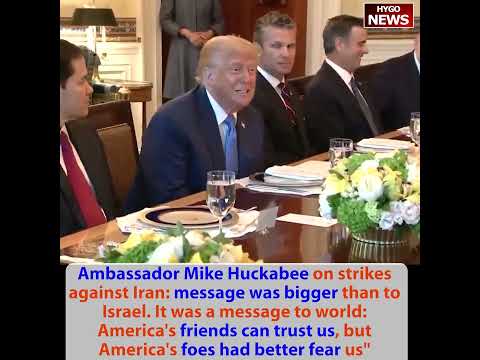
Israeli Prime Minister Benjamin Netanyahu visited the White House on July 7 and delivered a memorable diplomatic moment — personally presenting Trump with the letter Netanyahu had sent to the Nobel Peace Prize Committee nominating Trump for the prize. The nomination adds to the prior Pakistani nomination (for India-Pakistan de-escalation) and the pending Congolese Tshisekedi nomination (for Rwanda-Congo peace). Trump, receiving the letter, called it “very meaningful” coming from Netanyahu personally. Ambassador to Israel Mike Huckabee — whom Trump praised as “respected and loved by everybody” — delivered the most memorable framing of the day: “America’s friends can trust us, but America’s foes had better fear us."
"The Letter I Sent To The Nobel Prize Committee”
Netanyahu presented the letter formally. “The President has already realized great opportunities. He forged the Abraham Accords. He’s forging peace as we speak in one country and one region after the other. So I want to present to you, Mr. President, the letter I sent to the Nobel Prize Committee.”
The presentation is substantial. Netanyahu had already submitted the nomination letter to the Nobel Committee. His White House visit provided the occasion for formal presentation of the nomination to Trump in person.
“The Abraham Accords” is the specific first-term achievement Netanyahu is referencing. During Trump’s first term, the administration brokered the Abraham Accords establishing formal diplomatic relations between Israel and four Arab states (UAE, Bahrain, Morocco, Sudan). Those Accords represented the first major Israeli-Arab normalization in decades.
“Forging peace as we speak in one country and one region after the other” extends the framework. The Iran-Israel ceasefire. The Rwanda-Congo peace. The India-Pakistan de-escalation. The continuing Gaza negotiations. Each represents a specific peace-brokering effort that the administration has been pursuing simultaneously.
”It’s Nominated For The Peace Prize”
Netanyahu continued. “It’s nominated in view for the Peace Prize, which is well deserved. And you should get it.”
“You should get it” is the strong endorsement. Netanyahu is not just nominating Trump — he is arguing that Trump should receive the prize. The direct endorsement goes beyond the procedural act of nomination.
Trump’s Response
“Oh. Thank you very much. Yes, I didn’t know. Well, thank you very much. Coming from you in particular, this is very meaningful. Thank you very much, baby. Thank you.”
“I didn’t know” suggests Trump had not been pre-briefed on the specific moment. Netanyahu’s presentation of the letter was a surprise during the public portion of their meeting.
“Coming from you in particular, this is very meaningful” captures the specific weight of Netanyahu’s nomination. Netanyahu, as Israeli prime minister and as Trump’s long-term political ally, is the specific figure whose nomination carries particular political and personal significance.
“Thank you very much, baby” is characteristic Trump informality. The warmth captures the genuine personal friendship between the two leaders.
The Multiple Nominations
The Netanyahu nomination joins the prior nominations already on record. Pakistan has nominated Trump for the India-Pakistan mediation. Congolese President Tshisekedi has indicated intent to nominate Trump for the Rwanda-Congo peace. Netanyahu’s nomination adds Israel to that list.
Multiple head-of-state nominations create specific institutional dynamics. The Nobel Committee receives many nominations each year, but nominations from foreign heads of state for specific diplomatic achievements carry particular weight. Three such nominations for three distinct diplomatic achievements is unusual.
Whether the Committee actually awards Trump the prize is a separate question. Committee decisions have, in recent decades, often favored candidates aligned with European and progressive diplomatic preferences rather than with American nationalist-oriented leaders. Trump’s prior complaints about the Committee’s bias — “they only give it to liberals” — reflect that pattern.
”It’s An Honor To Have Bibi And Sara”
Trump’s opening remarks at the bilateral meeting. “It’s an honor to have Bibi and Sarah with us and friends of mine for a long time. And we had a tremendous success together. And I think it will only go on to be even greater success in the future.”
“Bibi” is Netanyahu’s informal nickname used by close allies. Trump’s use of the informal name captures the personal dimension of the relationship. “Sarah” is Sara Netanyahu, the Israeli prime minister’s wife.
“Tremendous success together” acknowledges the track record. Trump and Netanyahu worked closely during Trump’s first term — on the Iran nuclear deal withdrawal, on the Jerusalem embassy move, on the Abraham Accords, on broader strategic alignment. That track record produces the personal friendship that supports the current diplomatic engagement.
“Greater success in the future” is the forward-looking framing. The current moment, despite the Iran operation and the Gaza situation, is not the peak of the relationship. More successes lie ahead.
”Nothing Like The White House”
Trump’s asides continued. “So it’s really nice to have you at the White House. It’s nothing like the White House. It’s great to have you both and all of your wonderful people around.”
“Nothing like the White House” is Trump’s characteristic framing. The White House is unique among world venues. Hosting foreign leaders there is distinct from hosting them anywhere else.
“All of your wonderful people around” acknowledges the broader Israeli delegation. Netanyahu did not travel alone. Israeli staff, security personnel, and various other officials traveled with him. Their presence at the White House bilateral meeting expands the working-level engagement beyond just the principals.
The First-Term Relationship
Trump’s review of the track record. “We’ve worked together for a long time. We’ve done well together. We had a great time. We say there’s a lot of work, but we had a great result recently. And we’re going to have a lot of great results.”
“A great result recently” is the Iran operation. Trump and Netanyahu had coordinated closely on the Israeli strikes and the American follow-up strikes. The combined operation produced the damage to Iran’s nuclear program that both leaders have been emphasizing.
“A lot of great results” projects continuation. The working partnership between the two leaders is not a one-time coordination. It is a continuous relationship that will produce additional results on additional issues.
The Huckabee Introduction
Trump then introduced Ambassador Huckabee. “We have a man with us who thought this was going to be a very glamorous, easy job. He’s the ambassador to Israel, Mike Huckabee, former governor, former everything.”
Mike Huckabee — the former governor of Arkansas, former presidential candidate, and long-standing Trump ally — serves as U.S. Ambassador to Israel. The ambassadorship is one of the most prestigious and most politically sensitive American diplomatic posts.
“Former governor, former everything” captures Huckabee’s career breadth. Before his ambassadorial role, Huckabee had built a career that included state executive experience, presidential primary candidacy, and decades of political commentary.
”Loved By Everybody”
Trump’s characterization. “He’s a former everything and respected and loved by everybody. And he loves Israel. He loves the state of Israel. And nobody loves it much more. He’s not Jewish and he loves Israel.”
The parenthetical “he’s not Jewish and he loves Israel” is important. Huckabee is a devout Christian whose Christian-Zionist theological framework produces deep commitment to Israeli security and Israeli sovereignty. That commitment runs through multiple dimensions of his political engagement.
For Americans who support strong U.S.-Israel relations based on geopolitical strategic interests, Huckabee’s theological motivation adds a specific dimension. His support for Israel is not merely political calculation — it is grounded in theological conviction that connects contemporary Israel to Biblical prophecy and Christian theological frameworks.
”Every Bunker You Could Be In”
Trump added a specific story. “And he wanted to be there. I said, you know, Mike, it could be dangerous. No, no, no. Well, at least I was right about that. He was in every bunker you could be in. He was running around from bunker to bunker, but he’s still with us, fortunately, and he’s done a great job.”
During the Iran-Israel exchange, Huckabee was stationed in Israel. Iranian missile attacks on Israeli targets meant that the ambassador had to take shelter in bunkers multiple times. Trump’s observation that Huckabee “was running around from bunker to bunker” captures the specific exposure the ambassador faced during the active conflict phase.
“He’s still with us, fortunately” is the relief. Despite the bunker episodes, Huckabee survived the conflict phase unharmed. His continued service as ambassador reflects both his commitment and his good fortune in avoiding injury.
Huckabee’s Remarks
Huckabee then spoke. “I just want to say one honor is to serve you, Mr. President, and to see a historic horizon that we’re looking at in the Middle East.”
“Historic horizon” captures Huckabee’s framing. The Middle East is, in his view, entering a specific historical period that differs from the recent past. The combination of the Iran operation, the Abraham Accords expansion, the Gaza negotiations, and the broader regional realignment is producing transformational changes.
The Syrian Engagement
Huckabee then addressed a specific initiative. “And when the President made his trip to the Middle East and then he really reached out to the new Syrian government, knowing they needed the partner and knowing that they could pick the wrong partner. And what the President did, which took us all off guard, but the strategic move in that has set up something that is absolutely historic.”
The “new Syrian government” reference is to the post-Assad Syrian regime. Syria’s government transitioned in late 2024 when Assad’s regime collapsed. The new government faced the specific choice of which international partners to align with — potentially Russia, Iran, Turkey, the United States, or some combination.
Trump’s engagement with the new Syrian government, in Huckabee’s framing, was strategically significant. The “took us all off guard” language suggests the engagement was unexpected internally as well as externally. But the specific strategic move — whatever it was — has set up outcomes that Huckabee characterizes as “absolutely historic."
"Impact On The Region”
Huckabee’s expansive framing. “And Mr. President, I don’t even think you fully comprehend the impact that you’re having on the region in a way that is so remarkable.”
The comment is interesting. It suggests that Trump, despite being the specific actor driving the changes, may not fully appreciate the cumulative effect. The Middle East is being transformed by a specific sequence of American actions that Trump has been authorizing.
From outside the administration, observers can sometimes see patterns that the actors inside cannot. Huckabee, positioned as the specific ambassador to Israel, sees the cumulative effect in ways that Trump, moving from decision to decision, may see less comprehensively.
”When The B-2s Went In”
Huckabee then addressed the specific operational moment. “Your leadership, your foresight, you did that when the B2s went in. The celebration, the sense of partnership that you gave with the Israeli people was so dramatic, but the message was bigger than to Israel.”
The B-2 strikes are Huckabee’s anchor point. The specific decision to authorize American strikes on Iranian nuclear facilities was the pivotal moment. What followed — the ceasefire, the broader regional realignment, the Saudi-Israeli normalization possibilities — flowed from that specific decision.
“The celebration, the sense of partnership that you gave with the Israeli people” captures the Israeli response. Israelis who had been watching Iranian missiles land on their cities saw specific American action that addressed the existential threat. That action produced genuine celebration and deepened partnership.
”A Message To The World”
Huckabee’s most-quoted line. “America’s friends can trust us, but America’s foes had better fear us. And that is a message that the President sent to everyone on the planet, and it is a message that will resonate toward a matter of peace, the likes of which I don’t think we’ve ever seen.”
The formulation is quotable. Friends can trust. Foes should fear. The message goes beyond Israel to every country considering its relationship with the United States.
“America’s friends can trust us” is the alliance reassurance. Countries that align with American interests can depend on American support. Specific actions demonstrate the reliability of American commitment.
“America’s foes had better fear us” is the deterrence message. Countries that oppose American interests face specific consequences. Iran’s recent experience is the specific example others must consider.
Why The Huckabee Formulation Matters
The formulation captures the administration’s operating framework in a politically digestible form. American foreign policy, under this framework, has clear incentives and clear consequences. Countries do not need to guess about American responses. The pattern is visible.
For foreign governments deciding whether to align with American interests or to resist them, the framework provides specific guidance. Alignment produces trust-based benefits. Resistance produces fear-based consequences. The choice is clear.
“A matter of peace, the likes of which I don’t think we’ve ever seen” is the projection. If the framework holds — if friends continue to trust and foes continue to fear — the resulting regional and global environment could produce peace at a scale that exceeds historical experience.
”They Really Respect Them And Love Them”
Trump’s close. “Great job, you know, they love you all, and they really respect them and they love them.”
“They love you all” is the cross-reference. Huckabee and others in the administration are loved by the American people. The respect and love captures the emotional register of the administration’s relationship with its supporters.
The framing connects Huckabee’s specific work in Israel to the broader administration project. The ambassador is not operating in isolation — he is part of a team whose members are collectively loved and respected by the constituents the administration serves.
The Bilateral Meeting Framework
The Trump-Netanyahu bilateral meeting on July 7 focused on multiple ongoing issues:
The Gaza situation — Hostage return, ceasefire implementation, post-war Gaza governance, humanitarian access.
The Iran situation — The post-strike settlement, continuing intelligence monitoring, the possibility of a permanent deal.
The broader regional architecture — Saudi-Israeli normalization prospects, Abraham Accords expansion, other potential normalization agreements.
Bilateral economic relationships — Trade, defense cooperation, technology partnerships, security assistance.
Each issue requires continuing engagement. The July 7 meeting was not a one-time event — it was part of continuing coordination that will extend across the rest of the administration’s term.
Key Takeaways
- Netanyahu’s Nobel Peace Prize nomination: “I want to present to you, Mr. President, the letter I sent to the Nobel Prize Committee.”
- Trump’s response: “Coming from you in particular, this is very meaningful.”
- Trump on Huckabee: “He’s a former everything and respected and loved by everybody. And he loves Israel. He’s not Jewish and he loves Israel.”
- On Huckabee’s exposure during the conflict: “He was in every bunker you could be in. He was running around from bunker to bunker.”
- Huckabee’s signature formulation: “America’s friends can trust us, but America’s foes had better fear us. And that is a message that the President sent to everyone on the planet.”