 HYGO News
 Is White House incompetent, or believe in open borders? Sen kennedy Questions DHS Sec Mayorkas
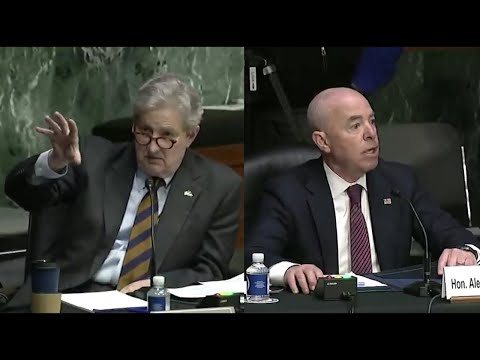
Kennedy to Mayorkas: “Are They Just Incompetent, or Do They Believe in Open Borders?” — Lists Biden’s Campaign Promises on Immigration
On November 16, 2021, Senator John Kennedy (R-LA) took an unusual approach during the Senate Judiciary Committee hearing with DHS Secretary Alejandro Mayorkas. Rather than beginning with specific policy questions, Kennedy opened by telling Mayorkas he didn’t deserve to be the one answering for the border crisis because “I don’t think you’re calling the shots. I think those shots are being called out of the White House.” Kennedy then posed a binary question about the White House officials directing border policy: “Are they just incompetent, or do they believe in open borders?” He proceeded to list Biden’s campaign platform promises on immigration — amnesty for 11.7 million, ending Remain in Mexico, ending Safe Third Country agreements, eliminating the border wall, encouraging sanctuary cities, and pledging not to deport people — and asked whether “you don’t have to be Mensa material to understand that’s an open border policy.” Kennedy also pressed Mayorkas on releasing COVID-positive migrants, releasing migrants with criminal records, migrants going on welfare, and Vice President Harris’s last conversation about securing the border.
”Deserves Got Nothing to Do with It”
Kennedy set the tone for his questioning with a movie reference that doubled as a political argument. “There’s a famous movie line, I’m sure you’ve heard it: ‘Deserves got nothing to do with it,’” Kennedy said. The line comes from the Clint Eastwood film “Unforgiven.”
Kennedy then applied it: “I don’t think you deserve to have to be here today to answer questions about immigration, because I don’t think you’re calling the shots. I think those shots are being called out of the White House. I think they ought to be here.”
The framing was strategically sympathetic to Mayorkas personally while being devastating to the administration. By suggesting that Mayorkas was not the decision-maker, Kennedy was arguing that the border crisis was not the product of bureaucratic failure at DHS but of deliberate policy choices made at the highest levels of the White House.
“The people determining our border policy, in your opinion, are they just incompetent, or do they believe in open borders?” Kennedy asked.
Mayorkas declined the binary choice: “Senator, I’m intensely and immensely proud to be a member of President Biden’s cabinet, and for the policies that are promulgated, I should be held accountable.”
Biden’s Platform: The Open Borders Checklist
Kennedy then shifted from the question of who was responsible to the question of intent. He said he had looked up Biden’s presidential campaign platform the night before and proceeded to list its immigration positions.
“He supported amnesty for the 11.7 million people in our country illegally. He promised he would end the Remain in Mexico program. He promised he would end the Safe Third Country agreements. He promised he would get rid of the border wall. He promised to encourage sanctuary cities, and he said, ‘I’m not going to deport people,’” Kennedy recited.
He then posed his question: “Can we agree that you don’t have to be Mensa material to understand that’s an open border policy?”
Mayorkas pushed back: “Senator, a few of your recitations, if I may respectfully submit, were not accurate portrayals of the President’s policy. He did not say—”
Kennedy interrupted: “I looked up his platform last night. It’s right there.”
Mayorkas tried again: “Senator, again, I would respectfully disagree with your characterization of the President’s policy.”
The exchange encapsulated the Republican argument that the border crisis was not an unintended consequence of the Biden administration’s policies but the predictable and inevitable result of campaign promises that, taken together, signaled to the world that the United States would not enforce its immigration laws.
COVID-Positive Releases, Criminal Records, and Welfare
Kennedy then fired a series of rapid-fire questions, each designed to establish facts that Mayorkas could not fully deny but attempted to qualify.
“Your administration has released thousands of people into our country who are COVID positive, have you not?” Kennedy asked.
Mayorkas began with policy: “Senator, as I mentioned earlier, it is our policy to test and as necessary, isolate and quarantine.”
“I know, but you’ve still released thousands who are positive,” Kennedy pressed.
“There have been individuals who have been released,” Mayorkas acknowledged, before attempting to provide context. Kennedy cut him off: “Mr. Secretary, I’ve got limited time and I understand the procedure, but I’m just trying to get you to answer my questions.”
Kennedy moved to criminal records: “Your administration, the Biden administration, has released into our country, people coming across the border, thousands of them who have criminal records. Isn’t that the case?”
Mayorkas’s denial was carefully worded: “Senator, I’m not aware of thousands of individuals with criminal records who are released into the interior of the United States.”
Kennedy then raised welfare: “Your department has released into our country, thousands of people who have promptly gone on welfare. Isn’t that the case?”
Mayorkas attempted a legal distinction: “I don’t believe that individuals who are unlawfully present in the United States qualify for welfare, but that is something that I’m happy to find—”
“You ever been to California?” Kennedy interjected.
“I grew up for most of my life in California,” Mayorkas replied.
“Okay, check their rolls,” Kennedy said. The exchange highlighted the gap between federal law, which generally prohibits welfare benefits for undocumented immigrants, and state-level programs in places like California that provide various forms of assistance regardless of immigration status.
Kennedy then acknowledged Mayorkas’s personal story: “I wasn’t born in this country.” Kennedy responded: “Yes, sir, I know. And I think we ought to tell the Cuban-American success story every chance we get.” The moment of personal warmth amid the combative questioning reflected Kennedy’s opening premise — that his quarrel was with White House policy, not with Mayorkas personally.
The “Historically High” Admission
Kennedy pressed Mayorkas on the scale of the crisis. When Mayorkas noted that “the number that we have encountered of different individuals this year is at a historic level,” Kennedy pushed for specifics.
“Like the highest in 60 years, right?” Kennedy asked.
“I’m not familiar with the timeframe, but it is certainly a historically high number, Senator,” Mayorkas confirmed.
Kennedy also raised the Washington Post’s reporting that approximately 1,000 migrants per day were crossing the border undetected in addition to those who were apprehended. He noted that Biden had claimed such crossings “happen every single solitary year.”
“Is he wrong on that or right on that?” Kennedy asked. Mayorkas could not agree with the president’s characterization without contradicting his own acknowledgment that the numbers were historically unprecedented.
Harris and the Border: “Several Weeks Ago”
Kennedy’s final question concerned Vice President Harris. “Vice President Harris, our border czar — what kind of grade would you give her?” he asked.
Mayorkas offered his standard correction: “Vice President Harris is not the border czar. Vice President Harris has been asked by the President of the United States to focus on root causes.”
Kennedy then asked: “When was the last time you talked to her about securing the border?”
“Several weeks ago,” Mayorkas answered.
The response reinforced a theme that had emerged throughout the hearing from multiple Republican senators: that the vice president designated to address migration was not in regular communication with the DHS secretary responsible for border security. “Several weeks ago” suggested that even the limited engagement Mayorkas had described earlier — “more than a handful” of meetings — had not included recent conversations about the immediate crisis.
Key Takeaways
- Kennedy told Mayorkas he didn’t deserve to be answering for the border crisis because “I don’t think you’re calling the shots,” then posed the question that framed his entire examination: “The people determining our border policy — are they just incompetent, or do they believe in open borders?”
- Kennedy listed six Biden campaign promises — amnesty for 11.7 million, ending Remain in Mexico, ending Safe Third Country agreements, eliminating the border wall, encouraging sanctuary cities, and pledging not to deport people — and asked if “you don’t have to be Mensa material to understand that’s an open border policy.”
- Mayorkas acknowledged releasing COVID-positive individuals, said he was “not aware” of releasing thousands with criminal records, denied illegal immigrants qualify for welfare (Kennedy replied “you ever been to California?”), and confirmed his last conversation with Vice President Harris about the border was “several weeks ago.”