 HYGO News
 IRS reporting, spending & inflation, Sen Tim Scott Questions Fed Powell & Treasury Sec. Yellen
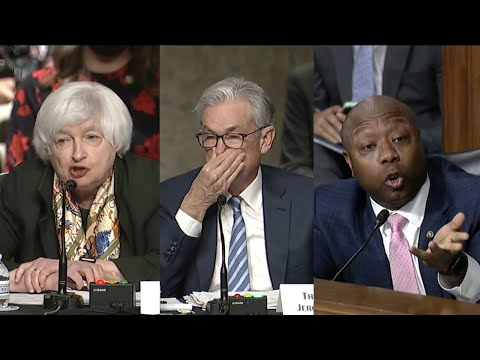
Scott to Powell and Yellen: “One Lost Seat in Georgia May Cost Taxpayers $5 Trillion” — Inflation Erasing Wage Gains, IRS Targeting Minimum Wage Workers
On November 30, 2021, Senator Tim Scott (R-SC) used his questioning time at a Senate Banking Committee hearing to draw a direct line from the January 2021 Georgia Senate runoff losses to $5 trillion in government spending, confronting both Fed Chairman Jerome Powell and Treasury Secretary Janet Yellen. Scott argued that with inflation over 6 percent and wage growth under 3 percent, “your buying power is going down, not up” — and that the administration “wants you to believe what they say and not what you see and are experiencing.” He then pressed Yellen on her continued support for IRS bank reporting requirements that would flag accounts starting at $600 (later revised to $10,000), arguing the threshold would target “every single working American at minimum wage or higher” rather than the millionaires and billionaires the administration claimed to be pursuing.
”One Single Seat, Five Trillion Dollars”
Scott opened with a political calculation that connected the Georgia runoffs to the spending that followed. He described conversations with South Carolinians over Thanksgiving about “the consequences of elections.”
“Perhaps no finer point that elections have consequences is simply losing a single seat in Georgia January 5th,” Scott said. “The result of one lost seat in Georgia may cost taxpayers just this year five trillion dollars in additional spending.”
He broke down the figure: “$1.9 trillion on a COVID relief package that had $1 billion for vaccines and less than 9 percent for COVID-related health. $1.2 trillion dollars for an infrastructure package with only 10 percent of that $1.2 trillion going to roads and bridges in the next five years. And now we’re talking about overheating the economy with another $2 trillion.”
The framing was politically charged but mathematically grounded. The three bills — the American Rescue Plan, the Infrastructure Investment and Jobs Act, and the proposed Build Back Better Act — did total approximately $5 trillion. Scott’s point was that the slim Democratic majority created by the Georgia runoffs had enabled spending at a scale that would have been impossible under a Republican-controlled Senate.
”What You See and Are Experiencing”
Scott’s central argument challenged the administration’s economic messaging head-on. “What I’ve heard so far is that the administration wants you to believe what they say and not what you see and are experiencing,” he said.
He laid out the contradiction: “They say by putting another $2 trillion in the economy, it will make things more affordable for you. But what you see and are experiencing is inflation, in part caused by trillions of dollars of government spending and the anticipation of even more money.”
Scott provided the math that the administration’s “wages are up” messaging obscured: “When inflation is over 6 percent and your wage growth is under 3 percent, your buying power is going down, not up. And they want you to believe that spending more money is going to solve this problem.”
He personalized the impact for South Carolinians on fixed incomes: “South Carolinians on a fixed income, like Social Security averaging around $1,500 per month — they’re spending, because of this ‘transitory’ inflation — I don’t know what the definition of transitory is anymore — a third of their Social Security income on putting gas in their cars, heating their houses, and fixing up the places they live in.”
Powell Confirms the Pain
Scott turned to Powell with a pointed question: “Is it your impression that the Biden administration has a clear understanding that rising prices are hitting people the hardest who are on Social Security, families struggling paycheck to paycheck, and single moms?”
Powell declined to assess the administration’s understanding — “It’s not appropriate for me to comment on what the Biden administration thinks” — but confirmed the underlying reality: “I think that’s right. I think that if you think about families that are living paycheck to paycheck, they’re feeling high gas prices, soon enough heating oil prices, food prices. They’re certainly feeling that.”
Powell acknowledged the Fed’s responsibility: “This is our job. Our role is to make sure that this higher inflation does not become entrenched.”
He also addressed the labor market puzzle that complicated the unemployment narrative. Since the pandemic, the U.S. had seen a loss of about 1.7 percent in labor force participation. Scott noted that the administration’s celebration of a 4.6 percent unemployment rate masked this reality: “When you have fewer people looking for work, your unemployment rate goes down because your long-term unemployment goes up, which means that your labor force participation rate also goes down.”
The IRS Bank Reporting Fight
Scott saved his sharpest exchange for Yellen, pressing her on the IRS bank reporting proposal that would require financial institutions to report account information to the IRS.
“Can you tell the American people today, Secretary Yellen, whether you still support any form of the IRS bank reporting requirements your department proposed earlier this year, which would provide the IRS with currently undisclosed taxpayer information for the purpose of targeting essentially every single working American at minimum wage or higher?” Scott asked.
Yellen confirmed: “I do support it. I think it’s important that the IRS have visibility into opaque income streams. And that’s an important way of improving tax compliance.”
Scott challenged the logic directly: “If you’re looking to catch tax cheats, why in the world would we start with something as low as $600 and then revamp it to $10,000? If you’re trying to find millionaires and billionaires, they’re not running lemonade stands — I don’t think they are — and they’re certainly not making minimum wage.”
When Yellen attempted to clarify that the reporting involved aggregate information rather than detailed transaction data, Scott cut in: “Aggregated information going to the IRS is the scariest proposal, and there’s no way that it has to be anywhere near the thresholds you’ve started with in order to find a way to take accountability for those complex organizations.”
Chairman Brown intervened to end Scott’s time. Scott pushed back: “Chairman, if we’re going to have a conversation, we’re going to have a dialogue.”
“Well, you’ve had the dialogue,” Brown replied.
Yellen used the additional time to offer a more complete defense: the proposal had been “worked carefully with Congress to narrow the scope of the reporting” and was intended to “exempt wage earners and federal beneficiaries.” She explained that the low reporting threshold was “meant to make evasion more difficult by opening multiple accounts” and that the proposal requested “exactly two pieces of information: aggregate inflows and aggregate outflows over the course of the year.”
The Fundamental Disconnect
The exchange crystallized the debate over the administration’s economic approach. Yellen viewed the IRS reporting proposal as a reasonable tool for closing the tax gap. Scott viewed it as government overreach targeting ordinary Americans while claiming to pursue the wealthy. Powell confirmed that inflation was hurting the most vulnerable Americans. Scott argued that the same administration asking for more spending power was also asking for more surveillance power over the bank accounts of people making minimum wage.
Key Takeaways
- Scott calculated that “one lost seat in Georgia” enabled $5 trillion in spending — $1.9T in COVID relief (less than 9% health-related), $1.2T in infrastructure (10% for roads/bridges), and $2T more proposed — while Americans on Social Security spent “a third of their income” on gas, heating, and housing as inflation ran above 6% against sub-3% wage growth.
- Powell confirmed that families living paycheck to paycheck were “certainly feeling” high gas, food, and heating prices, while declining to comment on whether the Biden administration understood the impact, and acknowledged a 1.7% drop in labor force participation that made the 4.6% unemployment rate misleading.
- Yellen confirmed she “still supports” the IRS bank reporting requirement despite the $600/$10,000 threshold, and Scott argued it would target “every single working American at minimum wage or higher” rather than the wealthy tax cheats the administration claimed to be pursuing.