 HYGO News
 Iran's foreign minister admits seriously & heavily damaged; Socialist Mamdani not capitalism
Iran’s foreign minister admits seriously & heavily damaged; Socialist Mamdani not capitalism
Iran’s foreign minister, appearing on international media, publicly acknowledged that Iranian nuclear facilities “have been seriously and heavily damaged” — a concession that undermines weeks of Democratic and media framing suggesting the strikes were less than complete. Trump’s comment on Gaza — “very firm” with Netanyahu, expecting “a deal next week” — signaled accelerating diplomatic work on the hostage and ceasefire questions. Mamdani was captured on video stating bluntly that he does “not” like capitalism. And Representative Suzan DelBene’s claim that costs had not declined under Trump was contradicted by specific data points — gas down 12.5%, energy down 3.5%, and inflation at its lowest level since 2021.
The Iranian Foreign Minister’s Admission
The video opened with Iranian foreign ministry commentary. “What we know so far is that the facilities have been seriously and heavily damaged.”
The speaker, an Iranian foreign ministry representative, is acknowledging what the administration has been claiming. The nuclear facilities targeted by the American strikes are, in Iran’s own characterization, “seriously and heavily damaged."
"Obliterated” Versus “Heavily Damaged”
The reporter pressed. “President Trump has made it clear multiple times that Iran’s nuclear facilities targeted in those U.S. strikes were, in his words, obliterated. Have they been obliterated?”
The Iranian response. “It appears that they have been heavily and seriously damaged. No one at the moment says that the facilities have remained intact. It is the technology and know-how that is still there.”
The Iranian framing is revealing. The word “obliterated” is not confirmed, but the word “intact” is explicitly denied. “No one at the moment says that the facilities have remained intact” is a clear concession.
“It is the technology and know-how that is still there” is the Iranian attempt to preserve some face. The facilities are damaged. But the Iranian expertise — the scientific and technical knowledge — remains. That framing allows Iran to claim that rebuilding is possible while acknowledging the physical destruction.
Why The Iranian Admission Matters
The admission is strategically important for multiple audiences.
For American voters, the admission from Iran itself validates the administration’s “obliteration” framing. CNN’s reporting that questioned the damage assessment is contradicted by the target state’s own foreign ministry. The media framework that had been deployed against the administration’s characterization loses credibility when the target state confirms substantial damage.
For the international community, the admission signals that Iran is engaging diplomatically rather than militarily. States that are preparing for continued conflict do not publicly acknowledge their own vulnerabilities. Iran’s willingness to acknowledge the damage indicates its diplomatic posture is moving toward settlement rather than escalation.
For Iranian domestic audiences, the admission is harder to interpret. The regime’s acknowledgment of damage could either rally domestic support for reconstruction or generate domestic questioning of the decisions that led to the damage. The regime’s calculus in making the public admission is not fully transparent.
The Newsom Question
A reporter asked Trump about Governor Newsom. “President, Mr. President, what message to the government of the IDUSA inside of this facility?”
The question references the Alligator Alcatraz facility. The reporter is asking what Trump would say to Newsom — who has been publicly critical of the administration’s immigration enforcement — in the context of the Florida detention facility.
Trump’s response. “Well, the first thing we should do is go here and burn something. Because they don’t do this.”
The transcript is garbled. The substance appears to be that Newsom should come to Alligator Alcatraz and learn about effective immigration enforcement. California, under Newsom, has been a sanctuary jurisdiction that has fought federal enforcement. Florida, under DeSantis, has partnered with federal authorities to build and operate facilities like Alligator Alcatraz.
The message is that Florida’s approach is producing specific operational outcomes that California’s approach cannot match. Newsom’s policies, in Trump’s framing, are preventing California from building equivalent infrastructure that serves shared public safety interests.
Trump On Gaza
The video then pivoted to Trump’s comment on the Gaza situation. “How far were you going to be with Netanyahu about ending the war in Gaza? Very far. I’m very far. But he wants it to. I will say. He’s coming here next week. He wants to end it too.”
“Very firm” with Netanyahu captures the administration’s diplomatic posture. Trump is prepared to push the Israeli prime minister toward settlement even on a war that Israel has been conducting. The pressure is significant because Netanyahu has been politically committed to continuing the Gaza operation until specific objectives are achieved.
“He wants it to” — meaning Netanyahu wants to end the war — is Trump’s characterization. Whether Netanyahu’s actual position matches Trump’s characterization depends on what Netanyahu has told Trump privately versus what Netanyahu says publicly. The Israeli prime minister’s public posture has remained committed to continued operations. His private communications with Trump may be different.
”A Deal Next Week”
Trump’s specific prediction. “And I think we’ll have a deal next week. That’s what I think.”
“A deal next week” is a specific timeline. The reference is to the Netanyahu meeting Trump had previously mentioned. During that meeting, Trump expects to finalize the terms of a Gaza settlement.
The specific terms would presumably include the return of remaining Israeli hostages, some form of ceasefire framework, and potentially broader regional arrangements involving Saudi Arabia, the UAE, and other Gulf partners. The Abraham Accords expansion Leavitt had referenced would fit within this framework.
Whether the deal actually materializes in a week is a separate question. Middle Eastern diplomatic timelines are notoriously unpredictable. But Trump’s confidence in the specific prediction suggests that behind-the-scenes negotiations are at an advanced stage.
”Iran Has Massive Sanctions”
Trump then referenced the ongoing Iran situation. “We had a tremendous success with Iran. Somebody said, when are you going to sign? I said, sign? They are so bummed out. Did you see the report issued this morning? The place was decimated. It’ll be years before anybody even gets down there.”
“They are so bummed out” captures Trump’s characterization of Iran’s current position. The regime has lost its nuclear program, its missile deterrent, and its proxy forces. Negotiating from that position is substantially less attractive than negotiating from a position of capability.
“The place was decimated. It’ll be years before anybody even gets down there” reaffirms the damage characterization. Subsequent reports, including the Israeli Atomic Energy Commission letter, have validated the damage. The Iranian foreign minister’s own admission now joins that validation.
”They Have Massive Sanctions”
Trump referenced the economic dimension. “You know, they have massive sanctions right now, biting sanctions. It’s going to be very hard for them to do anything with those sanctions.”
American sanctions against Iran have been expansive and long-running. They limit Iranian oil exports, restrict Iranian access to global financial systems, and constrain Iranian trade broadly. With the nuclear program destroyed, Iran has lost the primary bargaining chip it had used to demand sanctions relief. The regime now must decide whether to accept the American terms for settlement or continue under sanctions indefinitely.
”Maybe There’ll Be A Time When We Get Along”
Trump offered a longer-term vision. “I look forward to maybe there’ll be a time when we get along with them and they can rebuild their country.”
The framing is expansive. Trump is not committed to permanent hostility with Iran. If the regime accepts the nuclear settlement and moves toward normal international behavior, an improved American-Iranian relationship is possible. Iran could rebuild. Sanctions could be relieved. The Iranian people could experience economic improvement.
Whether the Iranian regime accepts the terms is the question. A theocratic regime that has defined itself for 46 years in opposition to the United States faces substantial internal obstacles to reversal. But the alternative is continued isolation, continued economic deterioration, and continued vulnerability to further military action if reconstitution is attempted.
”Do You Like Capitalism?”
The video then captured a clip of Mamdani. “Do you like capitalism? No. I have many critiques of capitalism.”
The direct statement is consequential. Mamdani, the Democratic nominee for mayor of New York City, is on video stating that he does not like capitalism. That statement will be quoted in every subsequent discussion of his candidacy.
Why The Statement Matters
Mamdani’s statement matters for several reasons.
First, it is definitive. Politicians rarely offer such categorical answers to ideological questions. Most politicians hedge with “I have concerns about some aspects” or “I support a mixed approach.” Mamdani’s “No” is categorical.
Second, New York City’s economic foundation is capitalism. The city is a global capitalist center — finance, media, real estate, technology, retail. A mayor who does not like capitalism will face ongoing tensions with the economic institutions that make New York function.
Third, the statement provides a political handle for opponents. Republicans and moderate Democrats can now point to Mamdani’s own words rather than requiring the characterization of his views. “The candidate who does not like capitalism wants to run the world’s capitalist capital” is a framing that writes itself.
”Many Critiques Of Capitalism”
Mamdani’s follow-up softens slightly but does not reverse. “I have many critiques of capitalism.”
“Critiques of capitalism” is the academic framing. Intellectual engagement with capitalism’s problems is a legitimate scholarly activity. Conservative and progressive thinkers alike have offered critiques of capitalism across the centuries. Mamdani’s specific critiques, presumably, align with the democratic socialist tradition.
The question is whether New York voters want a mayor whose intellectual orientation is hostile to the economic system that makes their city function. The general election will test that question directly.
DelBene On Costs
Representative Suzan DelBene (D-WA) offered the Democratic framing on costs. “Republicans promised they were going to lower costs on day one. It’s a number one issue for families across the country. They promised they were going to lower costs. That’s a broken promise. This big ugly bill is also a big broken promise.”
The claim is that Republicans promised cost reductions and failed to deliver. Evaluating the claim requires comparing promises to observed outcomes.
The administration’s framework on costs has been:
- Gas prices have declined substantially.
- Energy prices overall have declined.
- Consumer price inflation has moderated to the lowest level since 2021.
- Egg prices (a specific high-salience item) have fallen month-over-month repeatedly.
The specific data points the video cites:
- Gas is down 12.5%
- Energy is down 3.5%
- Inflation is at its lowest level since 2021
Those are measurable improvements from the Biden-era inflation peaks. DelBene’s claim that costs have not declined is contradicted by the specific data.
Why The DelBene Framing Struggles
The DelBene framing requires voters to ignore what they see at the gas pump, on their utility bills, and at the grocery store. Voters who fill their cars know whether gas prices have declined. Voters who pay electric bills know whether energy costs have changed. Voters who buy groceries know whether inflation has moderated.
If the specific improvements are real — which the data supports — voters will discount political claims that contradict their own experience. DelBene’s framing may persuade voters who do not directly experience gas prices, utility bills, or grocery prices, but those voters are a small minority of the electorate.
The administration’s bet is that the cumulative effect of measurable cost improvements will outweigh the political messaging that denies those improvements. Voters who experience the improvements will credit the administration. Voters who accept Democratic messaging despite their own experience are a smaller group than voters who trust their own observation.
The Returned Trump
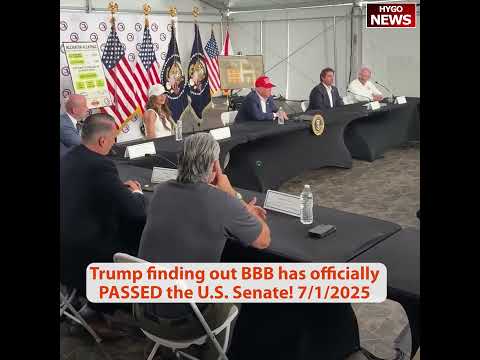
The video closed with Trump’s return from Alligator Alcatraz. “POTUS Trump is back after a quick trip to check on the Alligator Alcatraz illegal immigrant detention facility in Florida.”
The return is procedural. The facility visit is complete. The Senate vote has occurred. The next phase of legislative activity is the House vote on the bill. Trump returns to Washington to manage that phase.
The Day’s Integration
The day’s multiple threads integrate around the administration’s operating themes. The Iranian foreign minister’s admission validates the administration’s Iran framing. The Gaza meeting with Netanyahu advances the broader Middle East peace agenda. Mamdani’s capitalism critique creates political material for the November election. DelBene’s denial of cost improvements is contradicted by the data. Trump’s return from Florida to Washington continues the cycle of policy activity.
The cumulative effect is an administration that is operating across multiple fronts simultaneously, each producing its own specific outcomes, cumulatively supporting the political narrative the administration has been cultivating.
Key Takeaways
- Iran’s foreign minister: Their nuclear facilities “have been seriously and heavily damaged…No one at the moment says that the facilities have remained intact.”
- Trump on the Iranian damage: “The place was decimated. It’ll be years before anybody even gets down there.”
- Trump on Netanyahu and Gaza: “Very firm…I think we’ll have a deal next week.”
- Mamdani’s capitalism answer: “Do you like capitalism?” “No. I have many critiques of capitalism.”
- The data vs. DelBene’s claim: Gas down 12.5%, energy down 3.5%, inflation at its lowest level since 2021 — directly contradicting the claim that costs have not gone down.