 HYGO News
 WHCA President Daniels: 'We Are Not the Enemy of the People'; Trump Skips Correspondents' Dinner -- 'We Invite Presidents to Remind Them'
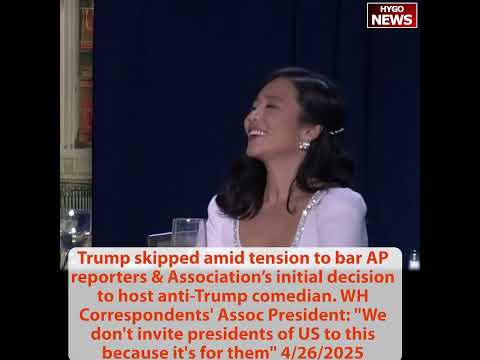
WHCA President Daniels: “We Are Not the Enemy of the People”; Trump Skips Correspondents’ Dinner — “We Invite Presidents to Remind Them”
White House Correspondents’ Association President Eugene Daniels delivered a defensive address at the April 2025 dinner, indirectly calling out the Trump administration for its characterization of the media. “We journalists are a lot of things. We are competitive and pushy, we are impatient, and sometimes we think we know everything,” Daniels said. “But what we are not is the opposition. What we are not is the enemy of the people. And what we are not is the enemy of the state.” Trump skipped the dinner — he was in Rome for Pope Francis’s funeral — and Daniels addressed the absence: “We don’t invite presidents because it’s for them. We invite them to remind them that they should be defenders of the First Amendment and a free press."
"Not the Enemy of the People”
Daniels opened with an attempted humanization of the press corps.
“We journalists are a lot of things,” Daniels said. “We are competitive and pushy. We are impatient and sometimes we think we know everything.”
He added the personal dimension: “But we’re also human. We miss our families and significant life moments in service to this job.”
He stated the professional commitment: “We care deeply about accuracy and take seriously the heavy responsibility of being stewards of the public’s trust.”
Then he delivered the three denials: “What we are not is the opposition. What we are not is the enemy of the people. And what we are not is the enemy of the state.”
The triple denial was a direct response to language Trump had used to describe hostile media outlets since his first presidential campaign. Trump’s “enemy of the people” characterization had become one of the most contentious elements of his relationship with the press, with journalists arguing it endangered reporters and Trump arguing it accurately described outlets that published false stories.
Daniels’s defense raised an uncomfortable question: if the media was not the opposition, not the enemy, and cared deeply about accuracy, why had public trust in journalism fallen to historic lows? Alex Thompson — who had received his Aldo Beckman Award earlier that same evening — had provided the answer: the press had participated in covering up Biden’s cognitive decline, and the public had noticed.
The “enemy of the people” debate was ultimately a question of accountability. Trump’s characterization was not directed at all journalists; it was directed at outlets that, in the administration’s view, consistently published false stories, coordinated hostile narratives, and functioned as the communications arm of the Democratic Party. Daniels’s blanket defense — “we are not the opposition” — did not address the specific examples that had generated the characterization.
”We Invite Them to Remind Them”
Daniels addressed Trump’s absence with a philosophical argument about the purpose of the presidential invitation.
“As you all know, every year we invite the president to this dinner,” Daniels said. “For decades, presidents on both sides of the political spectrum get gussied up and join us.”
He clarified: “I want to be clear about something. We don’t invite presidents of the United States to this because it’s for them.”
He continued: “We don’t invite them because we want to cozy up to them or curry favor.”
He stated the principle: “We don’t only extend invites to the presidents who say they love journalists or who say they are defenders of the First Amendment and a free press. We invite them to remind them that they should be.”
He concluded: “We invite them to demonstrate that those of us who have chosen the public service of journalism aren’t doing it because we love flights on Air Force One or walking into the Oval Office. It’s to remind them why a strong Fourth Estate is essential for democracy.”
The speech was well-crafted but landed in an environment that made its arguments difficult to sustain. Daniels was arguing that the press served as a check on power — a “Fourth Estate” essential for democracy. But the same evening had featured Thompson’s admission that the press had failed at that very function during the Biden years.
The contradiction was glaring. In one segment of the evening, a reporter was honored for finally covering a story the press had covered up for years. In the next segment, the association’s president was insisting that the press was a fearless guardian of democracy. The audience was being asked to believe both things simultaneously.
The Trump Administration’s Absence
Trump’s absence from the dinner was not a boycott — he was in Rome attending Pope Francis’s funeral. But the timing was convenient. The correspondents’ dinner had become an annual exercise in mutual self-congratulation between journalists and celebrities, with a comedic roast of the president as the centerpiece. Trump had skipped the dinner during his first term as well, reflecting his view that the event represented everything wrong with the Washington establishment: media elites in formal wear celebrating themselves while the public they claimed to serve lost faith in their institutions.
The administration had also been engaged in a running dispute with the WHCA over media access reforms. The White House’s decision to expand the press pool beyond legacy outlets, reduce the AP’s privileged position, and invite podcasters and new media to the briefing room had all been implemented over WHCA objections. Daniels’s speech was, in part, a response to these changes.
The Trust Problem
Daniels’s insistence that “we are not the enemy” ran headlong into the data. Gallup’s annual survey on media trust showed that only 31% of Americans had “a great deal” or “a fair amount” of trust in mass media. Among Republicans, the figure was in the single digits. Among independents, it was below 30%.
These numbers were not the result of Trump’s rhetoric — they were the result of the media’s behavior. Years of false stories, retracted narratives, coordinated hit pieces, and the Biden cover-up had demonstrated to the American public that major media outlets operated with political agendas that compromised their journalism.
Daniels’s claim that journalists “care deeply about accuracy” was contradicted by the parade of corrections, retractions, and debunked stories that had characterized media coverage of the Trump presidency. From the Russia collusion hoax to the “very fine people” fabrication to the “suckers and losers” story to the suppression of Biden’s decline, the track record made claims of journalistic commitment to accuracy ring hollow.
”Public Service of Journalism”
Daniels’s characterization of journalism as “public service” was the most contested claim in his speech. Public service implied sacrifice for the common good — working for the benefit of the public rather than for personal or institutional gain.
The White House correspondents who attended the dinner in formal wear, surrounded by Hollywood celebrities, at tables sponsored by major corporations, were not the picture of public servants sacrificing for the greater good. The event itself was a symbol of the insularity and self-regard that had eroded public trust. While Thompson’s speech had acknowledged this disconnect, Daniels’s speech reinforced it.
The contrast between the two speeches — Thompson’s honesty and Daniels’s defensiveness — captured the divide within the media establishment. One faction recognized that the profession had failed and needed reform. The other faction insisted that the profession was vital and that any criticism was an attack on democracy. Until the Daniels faction embraced the Thompson faction’s honesty, public trust would continue to decline.
Key Takeaways
- WHCA President Daniels: “What we are not is the opposition. What we are not is the enemy of the people. What we are not is the enemy of the state.”
- On Trump’s absence (at Pope’s funeral in Rome): “We invite presidents to remind them they should be defenders of the First Amendment.”
- Daniels attempted to humanize the press: “We miss families, we care about accuracy, we take stewardship of trust seriously.”
- The speech came the same evening Alex Thompson admitted: “We missed a lot of the Biden decline story. People trust us less because of it.”
- Media trust stood at 31% (Gallup) — the defensive posture highlighted the gap between the press’s self-image and public perception.