 HYGO News
 In striking down Biden's student loan forgiveness, Supreme Court Roberts & majority cited Pelosi
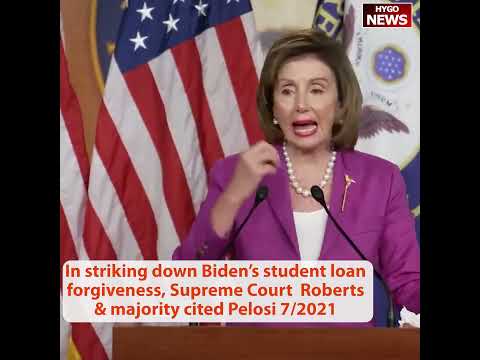
In Striking Down Biden’s Student Loan Forgiveness, Supreme Court Roberts and Majority Cited Pelosi
On June 30, 2023, the Supreme Court struck down President Biden’s $400 billion student loan forgiveness scheme in a decision that carried an unexpected twist: Chief Justice John Roberts and the majority opinion directly cited former House Speaker Nancy Pelosi as part of the legal reasoning for why the program exceeded presidential authority. The ruling effectively ended Biden’s plan to cancel up to $20,000 in student loan debt for millions of borrowers and highlighted the administration’s own internal contradictions on the legality of such sweeping executive action.
Pelosi’s Own Words Used Against the Administration
In what many observers described as the Supreme Court trolling Nancy Pelosi, the majority opinion referenced the former Speaker’s July 2021 press conference in which she explicitly stated that the President of the United States did not have the power to cancel student loan debt unilaterally.
Pelosi had said at the time: “People think that the President of the United States has the power for debt forgiveness. He does not. He can postpone. He can delay. But he does not have that power. That has to be an act of Congress.”
The irony was not lost on legal analysts or political commentators. Pelosi, one of the most powerful Democrats in Congress and a close ally of the Biden administration, had publicly stated the constitutional position that the Supreme Court ultimately adopted in its ruling. The majority cited her remarks as evidence that even leading members of the President’s own party understood the limits of executive authority on this matter.
The Supreme Court’s Ruling
The Court’s decision in Biden v. Nebraska found that the administration had exceeded its authority under the HEROES Act of 2003, which allows the Secretary of Education to “waive or modify” student loan provisions during national emergencies. Roberts wrote that the administration’s interpretation of “modify” stretched the statute far beyond its intended scope, effectively creating a new program rather than modifying an existing one.
The major questions doctrine played a central role in the ruling. The Court held that decisions of such vast economic and political significance required clear congressional authorization, which the administration could not demonstrate. The $400 billion price tag and the sweeping nature of the program, which would have affected tens of millions of borrowers, demanded explicit legislative approval rather than a creative reading of emergency powers.
Roberts and the majority found it significant that prominent members of Congress, including Pelosi, had recognized the need for legislative action on student debt relief. The Speaker’s 2021 comments served as a powerful acknowledgment from within the Democratic Party’s own leadership that the constitutional framework required Congress to act, not the President alone.
Pelosi’s 2021 Press Conference
The July 2021 press conference where Pelosi made her remarks about presidential authority on student debt came at a time when progressive Democrats were intensifying pressure on Biden to cancel student loan debt through executive action. Pelosi had been responding to questions about whether the President could bypass Congress and act unilaterally.
Her full statement was unequivocal: “People think that the President of the United States, is this more on the subject than you ever want to know, or you’ll let me know, people think that the President of the United States has the power for debt forgiveness. He does not. He can postpone, he can delay, but he does not have that power. That would have to be an act of Congress.”
The statement was notable both for its clarity and for the fact that it came from the most senior Democrat in the House of Representatives. Pelosi was not expressing a tentative legal opinion but rather stating what she understood to be a settled constitutional principle: debt cancellation on this scale required legislation.
Biden Administration’s Reversal
Despite Pelosi’s public statements in 2021, the Biden administration moved forward in August 2022 with a plan to cancel up to $10,000 in federal student loan debt for borrowers earning under $125,000 and up to $20,000 for Pell Grant recipients. The administration justified the action under the HEROES Act, arguing that the COVID-19 pandemic constituted a national emergency that authorized broad relief.
The decision to proceed despite Pelosi’s earlier legal assessment created an awkward situation for the Democratic Party. The administration was effectively arguing that the President possessed precisely the authority that the party’s most prominent legislative leader had said he lacked. This contradiction became a central element of the legal challenge and ultimately featured in the Supreme Court’s reasoning.
Political Fallout
The ruling placed blame squarely on the administration’s legal strategy. Critics argued that the White House had raised false hopes among millions of borrowers by promising relief that it lacked the constitutional authority to deliver. The decision to pursue executive action rather than working with Congress on a legislative solution meant that when the program was struck down, borrowers were left with nothing.
For Pelosi, the ruling created an unusual legacy on the issue. Her 2021 comments, intended as a straightforward assessment of constitutional law, became one of the most cited pieces of evidence against her own party’s signature education policy. The fact that the Supreme Court’s conservative majority relied in part on the Democratic Speaker’s words to justify striking down a Democratic President’s program was a striking illustration of how political statements can have lasting legal consequences.
The ruling also intensified the debate over the proper scope of executive power. The Biden administration had argued that emergency powers granted broad authority to address the financial hardship caused by the pandemic, while the Court held that such transformative economic policy required explicit congressional authorization.
Key Takeaways
- The Supreme Court struck down Biden’s $400 billion student loan forgiveness program on June 30, 2023, with Chief Justice Roberts and the majority citing Nancy Pelosi’s own 2021 statement that the President lacked unilateral authority to cancel student debt.
- Pelosi had said in a July 2021 press conference that Biden “does not” have the power for debt forgiveness and that “it has to be an act of Congress,” a position the Court ultimately adopted.
- The ruling applied the major questions doctrine, holding that a program of such vast economic significance required clear congressional authorization rather than a creative interpretation of emergency powers.
- The decision highlighted a contradiction within the Democratic Party, as the administration pursued executive action that its own most senior legislative leader had publicly said was beyond presidential authority.
- Critics argued the administration raised false hopes among millions of borrowers by promising relief it could not constitutionally deliver through executive action alone.