 HYGO News
 I'll Ask One More Time, You Scared The Heck Out Of Them, Sen. Rounds To OCC Nominee Saule Omarova
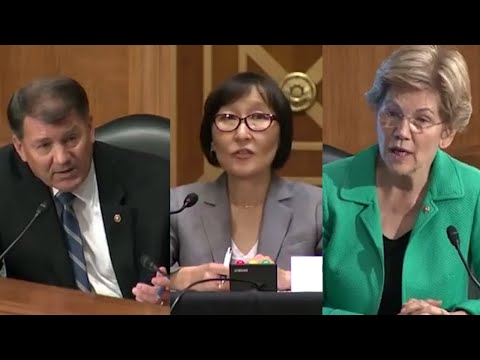
“You’ve Scared the Heck Out of Them”: Rounds Presses Omarova on Community Banks, “Socially Suboptimal” Activities, and Warren Cries “Red Scare”
On November 18, 2021, Senator Mike Rounds (R-SD) took a measured but persistent approach to questioning Saule Omarova, Biden’s nominee to lead the Office of the Comptroller of the Currency. Rounds told Omarova she had “clearly scared the heck out of” the nation’s bankers, said he could picture her having “entertaining” classroom discussions at Cornell but was “really challenged to see how that could be put into” the role of overseeing America’s banking system, and repeatedly pressed her to define the term “socially suboptimal activities” — a phrase from her academic writings that critics argued would give government regulators the power to decide which businesses deserved financing. Omarova refused to provide a specific example three times, insisting the definition was “a policy decision for Congress.” The hearing also featured Senator Elizabeth Warren’s defense of Omarova, in which she accused Republicans of waging a campaign of “sexism, racism, pages straight out of Joe McCarthy’s 1950s red scare tactics.”
South Dakota’s 67 Community Banks
Rounds grounded his questioning in the practical reality of community banking in his home state. “I come from South Dakota where we’ve got 67 community banks. They have 393 different branches,” he said, establishing that his concerns were not abstract but connected to institutions that served real communities.
He then asked the question at the heart of Republican opposition to Omarova’s nomination: “How would you justify removing the critical relationship between bankers and their communities that has allowed for decades of locally sponsored economic growth, other than your belief that the government seems to always know best?”
Rounds framed Omarova’s academic proposals as fundamentally incompatible with community banking: “It would appear that you advocate for a full migration of demand deposits under the Fed’s balance sheet.”
He acknowledged her academic credentials while drawing a sharp line between the classroom and the regulatory office: “It would seem to me that in a classroom, you would have a very lively discussion with members of your class — and I suspect that would be entertaining — but I’m really challenged to see how that could be put into and that you would be trusted to be the person responsible for the management, or at least the oversight of these different banks.”
The framing was polite but devastating: Omarova was an interesting professor whose ideas were too dangerous to implement.
Omarova’s Defense: “I Believe in Community Banking”
Omarova used Rounds’s question as an opportunity to distance herself from the most radical interpretations of her writings. “I find it difficult to explain what is a complex piece of academic work in simple buzzwords, if you will,” she said. “But I want to make one thing clear. I believe in the American banking system. I believe in the community banking system.”
She argued that whatever Congress might decide regarding digital currency or Federal Reserve accounts, “it is absolutely critical to make sure that community banks and their role in the provision of financial services is preserved.” She added that her concern was actually the erosion of community banking that had been occurring over the previous 25 to 30 years.
The defense attempted to reposition Omarova as a protector of community banks rather than their adversary. But Rounds was not persuaded, and the argument faced a fundamental credibility problem: her own writings proposed eliminating the private deposit accounts that formed the foundation of community banking.
”What Is a Socially Suboptimal Activity?”
Rounds zeroed in on a specific phrase from Omarova’s paper “The People’s Ledger.” He quoted from page 1272 of the paper: “In that new role, the Fed would impose activity limitations on lenders in order to direct credit to productive enterprise as opposed to socially suboptimal speculative activities.”
“That would suggest the work of a regulator,” Rounds said. “And that to me seems to be moving in the wrong direction.”
He asked Omarova to define the term: “What is a socially suboptimal activity?”
Omarova’s answer was that it was not the regulator’s decision to make: “This is not up to the regulator to decide. This is a policy decision for Congress. Congress constantly, often makes decisions with respect to what kind of activities we want to promote and what kind of activities we don’t want to promote.”
Rounds pressed again, noting that her own paper assigned the role to the Federal Reserve, not Congress. “There’s a lot of activities that are clearly that you think that have been financed that you would do your best to stop from being financed. Is that what this means? And give us an example of a socially suboptimal activity.”
Omarova again deflected: “It is not the job of the OCC to decide which specific business should or should not get a specific loan from a specific bank. I have never advocated that. And I believe that it is up to Congress to decide.”
Rounds tried a third time as his time expired: “I’ll ask one more time, because you haven’t had the opportunity — what is a socially suboptimal activity?”
Again, Omarova declined to provide a specific example, repeating that it was “a policy decision for Congress.”
The three refusals were significant. The phrase appeared in Omarova’s own academic work, and the paper clearly assigned the determination to the Federal Reserve — yet when asked under oath what it meant in practice, she could not or would not provide a concrete example. For critics, the evasion confirmed that “socially suboptimal” was a euphemism for any economic activity that didn’t align with progressive priorities — most obviously fossil fuel production.
The video reinforced this interpretation by cutting to Omarova’s earlier statement about the oil and gas industry: “A lot of the smaller players in that industry are going to probably go bankrupt in short order. At least we want them to go bankrupt if we want to tackle climate change, right?”
Warren: “Sexism, Racism, Red Scare Tactics”
Senator Elizabeth Warren provided the Democratic counterpoint to the hearing’s Republican questioning. Warren characterized the opposition to Omarova as industry-driven and bigoted: “They and their Republican buddies have declared war on you. The attacks on your nomination have been vicious and personal.”
Warren went further: “Sexism, racism, pages straight out of Joe McCarthy’s 1950s red scare tactics. It is all there on full display.”
The invocation of McCarthyism was pointed, given that multiple Republican senators had raised Omarova’s Soviet background and Kennedy had delivered his “professor or comrade” line at the same hearing. Warren’s argument was that scrutinizing a nominee’s views on government control of banking because she was born in the Soviet Union was itself a form of prejudice rather than legitimate oversight.
Warren framed the opposition as economic rather than ideological: Republican senators were doing the banking industry’s “bidding” because Omarova’s proposals would “cut into big bank profits.”
The defense was complicated by the fact that the opposition to Omarova included not only Republicans but also several moderate Democrats. Community banks, credit unions, and banking trade associations had opposed the nomination not because of Omarova’s background but because of the specific policies she had advocated in her academic writings — policies she could not fully disavow at the hearing without repudiating her own published work.
Key Takeaways
- Rounds told Omarova she had “scared the heck out of” America’s bankers, said he could picture her in an “entertaining” classroom discussion but was “really challenged” to trust her with oversight of the nation’s banks, and cited South Dakota’s 67 community banks with 393 branches as institutions her proposals to migrate deposits to the Fed would undermine.
- Rounds asked Omarova three times to define “socially suboptimal activities” — a term from her own paper that would give the Fed power to impose “activity limitations on lenders” — and she refused each time, saying it was “a policy decision for Congress” despite her paper assigning the role to the Federal Reserve.
- Warren accused Republicans of waging a campaign of “sexism, racism” and “Joe McCarthy’s 1950s red scare tactics” against Omarova, while the video juxtaposed this defense with Omarova’s own statement that she wanted oil and gas companies to “go bankrupt if we want to tackle climate change.”