 HYGO News
 If top domestic priority is inflation, why doesn't he have more to show?' WH: 'He has done the work'
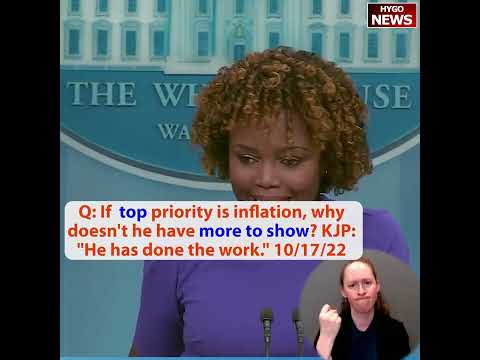
Reporter: If Biden’s Top Priority Is Inflation, “Why Doesn’t He Have More to Show for It?” — KJP: “He Has Done the Work”
On 10/17/2022, a reporter asked White House Press Secretary Karine Jean-Pierre a question the administration had never been able to answer satisfactorily: “If President Biden’s top domestic priority is inflation, why doesn’t he have more to show for it?” KJP responded that Biden “understands that inflation is an issue” and “has done the work” with congressional Democrats on the Inflation Reduction Act — then pivoted to attacking Republicans. She could not point to a single concrete result of Biden’s “number one economic priority” that had actually reduced the prices Americans were paying at the grocery store, gas station, or in their rent.
”Why Doesn’t He Have More to Show?”
The reporter’s question used KJP’s own framing against her. The White House had repeatedly described inflation as Biden’s “top domestic priority” and “number one economic priority.” If that was true — if the president had devoted his primary focus to combating inflation — the results should have been visible. Instead, inflation remained at 8.2% year-over-year, families were paying 13% more for goods and services than when Biden took office, and real wages had declined for 18 consecutive months.
“Following up on something you said earlier: If President Biden’s top domestic priority is inflation, why doesn’t he have more to show for it?” the reporter asked.
The question exposed the gap between rhetoric and results. In Washington, declaring something a “top priority” is often treated as equivalent to addressing it. The White House could point to speeches, statements, executive orders, and legislation. What it could not point to was lower prices at the checkout line.
”He Has Done the Work”
KJP’s response was a study in circular reasoning. “So, the president understands — and we’ve talked about this many times — that inflation is an issue. High — high cost — cost is an issue for the American people,” KJP said, stumbling over her own talking points. “And so, he’s been very clear about making that his number one economic priority.”
“And he has done the work. And he’s done the work with congressional Democrats, when you think about the Inflation Reduction Act,” KJP continued.
The structure of the answer was revealing: Biden understands inflation is a problem, he declared it his priority, and he “did the work.” But the question wasn’t whether Biden understood or worked — it was whether that work produced results. KJP’s answer skipped the results entirely, treating the effort itself as the achievement.
It was the equivalent of a student telling a teacher: “I understand the test is important, I made it my priority, and I did the work” — without mentioning that they failed the exam.
The Inflation Reduction Act Defense
The IRA had become the White House’s all-purpose answer to any inflation question. Whenever reporters asked about high prices, stagnant real wages, or consumer pain, KJP and other administration officials pointed to the Inflation Reduction Act as proof that Biden was “doing something.”
But the IRA’s relationship to actual inflation was tenuous at best. The bill’s primary components were:
- $369 billion in climate and energy spending
- Medicare drug pricing provisions (affecting 10 drugs, starting in 2026)
- ACA subsidy extensions
- A 15% corporate minimum tax
- IRS enforcement funding
Independent analyses consistently found the legislation would have minimal impact on inflation. The CBO’s assessment was that the bill’s effect on inflation would be “negligible.” The Penn Wharton Budget Model found it would have “no meaningful effect on inflation in the near term.” Some economists argued that certain provisions — particularly the additional spending — could actually increase inflationary pressure in the short run.
The name “Inflation Reduction Act” was itself a political creation. Senator Joe Manchin, whose vote was essential, reportedly demanded the name change from “Build Back Better” as a condition of his support, calculating that “inflation reduction” was better branding even if the bill’s actual inflation impact was minimal. Biden himself had acknowledged this at previous events, noting the bill “used to be called Build Back Better.”
The Pivot to Republicans
Unable to cite concrete results, KJP did what she always did — pivoted to attacking Republicans. “Which is how Republicans are actually going to make things worse and Democrats want to do the opposite and make things a little easier,” KJP said.
The pivot served two purposes: it changed the subject from Biden’s results to a hypothetical Republican alternative, and it lowered the bar from “reducing inflation” to “making things a little easier.” The shift from “top domestic priority” to “a little easier” was significant — it tacitly acknowledged that dramatic improvement was not forthcoming while attempting to frame any marginal difference as meaningful.
The argument that Republicans would “make things worse” required accepting that the current state of affairs — 8.2% inflation, 13% cumulative price increases, declining real wages — was Biden’s version of things going relatively well. It was a messaging strategy that conceded the present was bad while arguing the alternative would be worse.
What “Doing the Work” Actually Looked Like
If inflation was truly Biden’s “number one economic priority,” what had the administration actually done beyond the IRA?
Biden had released oil from the Strategic Petroleum Reserve at unprecedented rates — a temporary measure that brought down gas prices from their June peak but depleted the nation’s emergency stockpile to its lowest level in decades without addressing underlying supply constraints.
He had called on oil companies to increase production — the same companies his administration had vilified, investigated, and threatened with windfall profit taxes.
He had urged the Federal Reserve to act on inflation — while simultaneously signing spending bills that increased aggregate demand and complicated the Fed’s tightening efforts.
He had invoked the Defense Production Act for baby formula — months after the shortage began and after the White House admitted it was slow to recognize the crisis.
None of these actions constituted a systematic anti-inflation strategy. They were reactive, ad hoc responses to individual price spikes that failed to address the root causes of broad-based inflation: excess fiscal stimulus, supply chain disruptions exacerbated by extended COVID restrictions, and energy policies that constrained domestic production.
The Federal Reserve Connection
The most significant anti-inflation action in 2022 was being taken not by Biden but by the Federal Reserve, which had raised interest rates six times and was signaling more increases ahead. The Fed’s aggressive tightening — which the administration supported in public while privately worrying about its political impact — was the primary tool being deployed against inflation.
But Fed policy came with costs: mortgage rates above 7%, a stock market down roughly 25%, and growing recession risk. The White House wanted the benefits of Fed tightening (lower inflation) without the costs (economic slowdown) — an impossibility that no amount of “doing the work” could resolve.
The Voter Verdict
Polling consistently showed that voters did not credit Biden with addressing inflation. An October 2022 AP-NORC poll found that 73% of Americans described the economy as poor, and voters trusted Republicans over Democrats on the economy by double digits. The “he has done the work” argument was not persuading anyone outside the White House briefing room.
Key Takeaways
- A reporter asked why Biden had nothing to show for his “top domestic priority” of fighting inflation; KJP said “he has done the work” without citing any concrete results.
- She pointed to the Inflation Reduction Act, which independent analysts said would have “negligible” or “no meaningful effect” on inflation.
- KJP pivoted from claiming Biden would “reduce inflation” to saying Democrats wanted to “make things a little easier” — a significant downgrade in ambition.
- The most significant anti-inflation action was the Federal Reserve’s rate hikes, not any Biden policy.
- Polling showed 73% of Americans rated the economy as poor, and voters trusted Republicans more on the economy by double digits.
Transcript Highlights
The following is transcribed from the video audio (unverified — AI-generated from audio).
- If President Biden’s top domestic priority is inflation, why doesn’t he have more to show for it?
- The president understands that inflation is an issue. High cost is an issue for the American people.
- He’s been very clear about making that his number one economic priority.
- He has done the work with congressional Democrats when you think about the Inflation Reduction Act.
- Republicans are actually going to make things worse and Democrats want to do the opposite.
- Democrats want to make things a little easier.
Full transcript: 107 words transcribed via Whisper AI.