 HYGO News
 If no "masterminds/ringleaders" still battle for the soul of the nation?
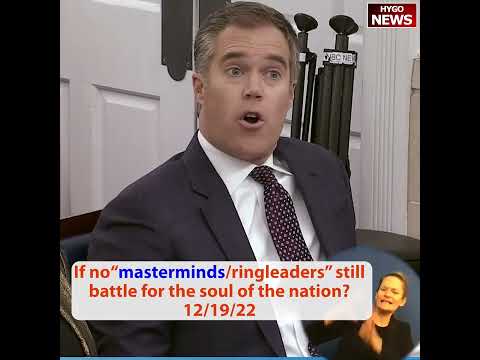
Reporter to KJP: If No “Masterminds/Ringleaders” Are Charged for Jan 6, Is the Battle for the Soul of the Nation Still Ongoing?
On 12/22/2022, a reporter asked White House Press Secretary Karine Jean-Pierre a pointed question connecting Biden’s “battle for the soul of the nation” framing to the January 6 Committee’s findings. “For the president running for office was, as he described, at this battle for the soul of the nation. About 964 people, as I have counted so far, I think, as the latest number, have been charged for their role as rioters. But we heard from Jamie Raskin today, ours is not a system of government where foot soldiers go to jail and masterminds and ringleaders get a free pass,” the reporter said. “If no, quote, masterminds or ringleaders are charged, how does the president sort of view the status of this battle for the soul of the nation?” KJP deflected: “I’m certainly not going to get ahead of any legal outcome that may come out of him. Look, with the president, I said this just moments ago. He believes that our democracy is still under attack.”
The “Battle for the Soul of the Nation” Framing
Biden had used “battle for the soul of the nation” as a consistent political framing:
2020 campaign slogan — Central theme.
Post-inauguration messaging — Continued use.
2022 midterm elections — Key phrase.
Anti-extremism framing — Against MAGA movement.
Democracy defense — Core narrative.
The framing had been particularly prominent in:
September 2022 Philadelphia speech — Red-tinted lighting, Marine background.
Pre-midterm messaging — Anti-MAGA warnings.
January 6 anniversary speeches — Ongoing reference.
Various campaign events — Consistent theme.
The “battle for the soul” framing positioned Biden as defending democratic values against a specific enemy. The enemy was initially Trump personally, then expanded to “MAGA Republicans” generally, and included January 6 participants.
The January 6 Context
The reporter’s question came in context of:
January 6 Committee final hearing — December 19, 2022.
Criminal referrals — From committee to DOJ.
Executive summary released — Detailing findings.
964 charged rioters — Per reporter’s count.
Special counsel investigation — Jack Smith appointed.
Ongoing prosecutions — Federal and state levels.
The January 6 Committee had recommended criminal referrals including Trump himself. Whether DOJ would act on those referrals was uncertain. The question was whether foot soldiers would be prosecuted while senior figures escaped consequences.
Jamie Raskin’s Quote
The reporter cited Representative Jamie Raskin’s words. “Ours is not a system of government where foot soldiers go to jail and masterminds and ringleaders get a free pass,” Raskin had said.
Raskin was:
Congressman from Maryland — Democrat.
January 6 Committee member — Active participant.
Constitutional law professor — Pre-Congress.
Vocal on accountability — Throughout investigations.
Final report advocate — For criminal referrals.
Raskin’s framing captured a fundamental accountability question. If the U.S. justice system prosecuted only those who physically entered the Capitol while ignoring those who organized, funded, and led the effort, the system would fail basic accountability principles.
The Rioter Numbers
The reporter cited specific numbers. “About 964 people, as I have counted so far, I think, as the latest number, have been charged for their role as rioters,” the reporter said.
By December 2022:
900+ criminal charges — Against rioters.
Hundreds convicted — Through pleas and trials.
Various sentences — From probation to years.
Continuing investigations — Ongoing FBI work.
Specific groups prosecuted — Oath Keepers, Proud Boys.
Sedition convictions — Some significant charges.
These prosecutions represented substantial law enforcement effort. Individual rioters had faced significant legal consequences. The question was whether those responsible at higher levels would face similar consequences.
The “Masterminds/Ringleaders” Question
The reporter asked about leadership accountability. “If no, quote, masterminds or ringleaders are charged, how does the president sort of view the status of this battle for the soul of the nation?” the reporter asked.
The question had specific framing:
“Masterminds or ringleaders” — Leaders of the effort.
“No… charged” — Accountability scenarios.
Status of battle — If leaders escape consequences.
“Soul of the nation” — Biden’s own framing.
Quote attribution — From Raskin.
This was a sophisticated political question. If the “battle for the soul” required accountability at all levels, and if leaders weren’t prosecuted, could the battle be said to be continuing or essentially lost? The reporter was using Biden’s own framework to test its current status.
The Political Sensitivity
The question was politically sensitive because:
Trump prosecution decision — Was pending.
Attorney General independence — Was valued.
Political interference concerns — If administration pushed charges.
Democratic base expectations — Of accountability.
Republican warnings — About politicized justice.
Special counsel framework — Was in place.
The Biden administration had to navigate:
Wanting accountability — For January 6.
Avoiding political interference — With DOJ.
Maintaining credibility — On justice system.
Serving Democratic base — Expecting results.
Respecting legal process — Taking time.
KJP couldn’t comment directly on specific prosecutions without appearing to influence them. But she couldn’t ignore the legitimate political question about accountability.
”Not Going to Get Ahead of Legal Outcome”
KJP deflected to DOJ independence. “I’m certainly not going to get ahead of any legal outcome that may come out of him,” KJP said.
The “get ahead” framing:
Respected DOJ independence — Not commenting on cases.
Acknowledged pending decisions — Charges possible.
Deferred substantive answer — To legal process.
Maintained professional distance — From prosecutorial decisions.
Standard White House framing — Across administrations.
This framing was appropriate in principle. White House officials shouldn’t comment on specific prosecutions. But the reporter’s question wasn’t asking for prosecutorial comment — it was asking how Biden viewed the status of his “battle for the soul."
"Still Under Attack”
KJP offered a framing. “With the president, I said this just moments ago. He believes that our democracy is still under attack,” KJP said.
The “still under attack” framing:
Maintained threat narrative — Democracy threatened.
Continued battle — Framework preserved.
Ongoing concern — Without specific enemies.
Flexibility preserved — For various future scenarios.
Political messaging — Consistent with prior framing.
This response partially addressed the question. If democracy was still under attack, the “battle for the soul” was continuing. But it didn’t address whether that battle required specific leader prosecutions or could proceed without them.
The Evolving Threat Framework
Biden’s “battle for the soul” framework evolved over time:
2020 version — Focused on Trump.
2021 post-inauguration — Broadened to extremism.
2022 midterm version — “MAGA Republicans.”
Post-midterm — Various threats.
Ongoing — Adaptable framework.
Each iteration of the framework could accommodate different specific situations. The framework was durable because it was abstract enough to apply to many circumstances. This abstraction allowed the administration to:
Avoid specific commitments — About required outcomes.
Maintain narrative consistency — Across changing circumstances.
Adjust to political reality — Without acknowledging shifts.
Serve partisan purposes — Without being pinned down.
The Raskin Challenge
Raskin’s quote challenged this flexibility. “Foot soldiers go to jail and masterminds and ringleaders get a free pass” was a specific scenario that demanded concrete response. Either:
Leaders would be prosecuted — Confirming the battle was winning.
Leaders would escape — Raising questions about the battle.
Outcome was pending — With uncertainty preserved.
Partial accountability — Some leaders but not all.
KJP’s deflection preserved uncertainty. By not committing to what outcome would satisfy “battle for the soul” accountability, she maintained administration flexibility regardless of what happened with specific prosecutions.
The Subsequent Prosecutions
After this December 2022 briefing, various January 6-related prosecutions continued:
June 2023 — Trump indicted in documents case.
August 2023 — Trump indicted in 2020 election case.
August 2023 — Trump indicted in Georgia state case.
Various Trump allies prosecuted — In different contexts.
January 6 Committee referrals — Partially acted upon.
By the time of these later prosecutions, Biden could arguably point to accountability happening. But in December 2022, the outcome was uncertain and the reporter’s question couldn’t be definitively answered.
The “Foot Soldiers/Leaders” Disparity
The specific concern about “foot soldiers” vs. “leaders” prosecution disparity was valid. The pattern:
Hundreds prosecuted — Mostly lower-level participants.
Few leaders charged — At senior organizational levels.
Trump not yet charged — As of December 2022.
Proud Boys/Oath Keepers leaders — Had been charged.
Planners and organizers — Varied accountability.
This disparity raised legitimate questions about whether justice was being served. If only those who physically entered the Capitol were prosecuted while those who organized the effort escaped, the prosecution pattern would be selective and potentially unjust.
The Political Framework Tensions
Biden’s “battle for the soul” framework created tensions:
Required clear enemies — For effective messaging.
Prosecution decisions — Independent of administration.
Political calendar — Affecting public patience.
Justice system timeline — Slow and deliberate.
Campaign needs — For specific messaging.
Institutional independence — Of prosecution.
The administration needed visible accountability for political purposes. But the Department of Justice’s timeline was necessarily slower than political timelines. This gap created awkward moments when reporters asked about what accountability meant if leaders weren’t yet prosecuted.
The Democratic Base Expectations
Democratic base voters had specific expectations:
Accountability for Trump — As primary goal.
Prosecution of organizers — For comprehensive justice.
Reform of process — To prevent recurrence.
Congressional action — Beyond legal.
Electoral consequences — For participants.
When prosecutions moved slowly, base voters became impatient. The administration had to balance:
Base impatience — For faster accountability.
DOJ independence — From political pressure.
Legal requirements — For proper prosecution.
Political calendar — Election timing.
Credibility concerns — If prosecutions seemed political.
KJP’s deflection to DOJ independence was politically awkward but institutionally necessary. It disappointed those seeking confirmation of pending accountability while respecting proper procedures.
The Democracy Defense Framework
KJP’s “democracy still under attack” framing preserved the battle narrative regardless of specific prosecutions. This framework:
Maintained narrative continuity — Across various outcomes.
Emphasized ongoing threat — Preserving urgency.
Avoided specific commitments — About what success meant.
Flexible application — To various situations.
Political usefulness — For messaging purposes.
The framework would continue serving administration messaging regardless of whether specific high-profile prosecutions occurred. Democracy under attack was a status claim about the broader situation rather than a specific accountability requirement.
Key Takeaways
- A reporter asked KJP how Biden viewed the status of his “battle for the soul of the nation” if no January 6 “masterminds or ringleaders” were charged.
- The reporter cited Rep. Jamie Raskin: “Ours is not a system of government where foot soldiers go to jail and masterminds and ringleaders get a free pass.”
- The reporter noted 964 rioters had been charged while senior organizers had not been.
- KJP deflected to DOJ independence: “I’m certainly not going to get ahead of any legal outcome.”
- She offered a framing: “He believes that our democracy is still under attack.”
- The exchange captured tension between Biden’s “battle” framing and the pace/scope of accountability for January 6.
- Subsequent prosecutions would address some of this concern, but in December 2022 the outcome was uncertain.
Transcript Highlights
The following is transcribed from the video audio (unverified — AI-generated from audio).
- For the president running for office was, as he described, at this battle for the soul of the nation.
- About 964 people have been charged for their role as rioters.
- We heard from Jamie Raskin today, ours is not a system of government where foot soldiers go to jail and masterminds and ringleaders get a free pass.
- If no, quote, masterminds or ringleaders are charged, how does the president sort of view the status of this battle for the soul of the nation?
- I’m certainly not going to get ahead of any legal outcome that may come out of him.
- He believes that our democracy is still under attack.
Full transcript: 132 words transcribed via Whisper AI.