 HYGO News
 'I Don't Believe You', Sen. Kennedy questions Biden's judicial nominee Jennifer Sung
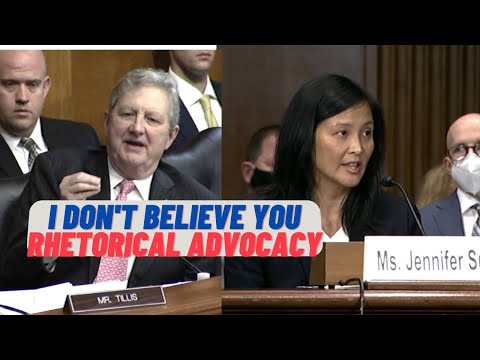
“I Don’t Believe You”: Sen. Kennedy Questions Biden’s Judicial Nominee Jennifer Sung
On September 14, 2021, President Biden’s nominee for the 9th Circuit Court of Appeals, Jennifer Sung, faced a relentless line of questioning from Senator John Kennedy (R-LA) before the Senate Judiciary Committee over a 2018 letter she signed that called Supreme Court Justice Brett Kavanaugh “intellectually and morally bankrupt.” The exchange became a viral moment as Kennedy repeatedly pressed Sung to answer a simple yes-or-no question — whether she believed Kavanaugh was morally bankrupt — and Sung repeatedly refused to give a direct answer, claiming her statement was “rhetorical advocacy.” Kennedy’s frustration boiled over: “See, I don’t believe you.”
The Letter That Started It All
At the center of the confrontation was a letter Sung had signed in 2018 as a Yale Law School alumna during Kavanaugh’s Supreme Court confirmation process. The letter declared that Kavanaugh was “intellectually and morally bankrupt” and suggested that his confirmation would cause people to die.
When Kennedy raised the letter, Sung attempted to distance herself from its contents. She explained that she had signed it “as an alum addressing my law school alma mater” and claimed she did not understand that it would be used as a public advocacy piece. She said she “believed it was only addressed to my law school administration.”
Kennedy was visibly unimpressed by the explanation. He began with a direct question: “Counselor, did you really say that Justice Kavanaugh was a morally bankrupt person?”
Sung confirmed she had signed the letter but said she had “read it quickly” before adding her name. Kennedy pressed: “Did you really say that Justice Kavanaugh, if he would, was confirmed, would cause people to die?”
Sung acknowledged signing the letter but characterized the language as “overheated rhetoric.”
Kennedy’s Repeated Question and Sung’s Refusal to Answer
What followed was an extended back-and-forth that became the hearing’s defining moment. Kennedy asked a direct question — “Do you believe that Brett Kavanaugh is a morally bankrupt person?” — and Sung refused to answer directly, citing her role as a judicial nominee.
“Senator, sitting here as a judicial nominee, it is not appropriate for me to comment personally on any of this,” Sung said.
Kennedy pushed harder: “This is really simple. You said, Brett Kavanaugh is a morally bankrupt person. It’s as clear as thunder on a summer night. Now, you’re under oath. Do you believe he is or not? How hard is that? You’ll have much harder questions as a federal judge, if you make it that far.”
Sung offered: “I appreciate the question, Senator. As I stated, those statements were rhetorical advocacy.”
Kennedy demanded a definition: “What is rhetorical advocacy? Is it a lie?”
“No, it’s not a lie, Senator,” Sung replied. “I would say that it’s statements that are made in service of an advocacy position.”
Kennedy seized on the admission: “And if you issue an opinion and you get reversed by the Supreme Court, you’re just going to say, oh, don’t worry about injustices. That was just rhetorical advocacy. What is this?”
Sung distinguished between advocacy statements and judicial rulings: “Absolutely not, Senator. If the court issues an opinion as a lower court judge, I would be absolutely bound to follow it. It is not merely rhetorical advocacy. It is the law of the land."
"I Don’t Believe You”
After multiple rounds of the same question and non-answer, Kennedy abandoned any diplomatic pretense. He told Sung directly that he did not accept her explanations.
“See, I don’t believe you. I think you said, I think you allowed your political beliefs to cloud your judgment,” Kennedy said. “And I think you said a few years ago what you said about Brett Kavanaugh, and I think you believe it.”
He then raised the practical implications for anyone who might appear before Sung as a judge: “And I can’t imagine what it’s going to be like to be a litigant in front of you with that demonstration of lack of judicial temperament and judgment. How can a litigant possibly think that you’re not going to act on personal beliefs if he were so intemperate to say something like this?”
Sung attempted one final assurance: “What I want to assure you is that as an advocate, as a litigator, as a neutral adjudicator, and as a judge, if confirmed, I would absolutely respect the authority of every Supreme Court justice and all of its precedents without reservation.”
Kennedy’s response became the most quoted line of the hearing: “You’re the only person in the Milky Way that believes you are impartial.”
The Yale Law School Question
In the final moments of his questioning, Kennedy shifted to an entirely different topic that caught Sung off guard. He asked whether she was proud of the fact that Yale Law School — her alma mater — had a quota system limiting the number of Asian American students.
“Have you ever written a letter about that?” Kennedy asked. “Or does that not, how, what does that fit in your socioeconomic view of the world that you think everybody else should adopt and you will impose if you’re in a position of power?”
Sung said she was not aware of any such policy. Kennedy’s one-line response: “You need to get out more.”
The exchange was notable because it juxtaposed Sung’s willingness to sign a politically charged letter about Kavanaugh’s confirmation with what Kennedy characterized as silence on a civil rights issue affecting Asian Americans at her own law school.
The Broader Confirmation Battle
The hearing highlighted a recurring tension in judicial confirmation proceedings: whether statements made as a private citizen or advocate should be treated as disqualifying when a nominee seeks a position requiring impartiality. Sung argued that advocacy statements and judicial decision-making are fundamentally different activities. Kennedy argued that a person who would sign a letter calling a sitting justice morally bankrupt had already demonstrated a lack of the temperament required for the federal bench.
The committee chair intervened at several points to give Kennedy extra time and to ensure Sung had the opportunity to respond, but the exchange remained one-sided throughout. Sung’s repeated reliance on the phrase “rhetorical advocacy” to explain away her past statements became a flashpoint that Kennedy exploited to maximum effect.
Key Takeaways
- Biden’s 9th Circuit nominee Jennifer Sung signed a 2018 Yale Law School alumni letter calling Justice Kavanaugh “intellectually and morally bankrupt” and suggesting his confirmation would cause people to die, then repeatedly refused under oath to say whether she still held that view.
- Kennedy pressed Sung multiple times to answer whether Kavanaugh was morally bankrupt, with Sung calling her statements “rhetorical advocacy” and Kennedy retorting, “Is it a lie?” before declaring, “I don’t believe you. I think you allowed your political beliefs to cloud your judgment.”
- Kennedy closed by telling Sung she was “the only person in the Milky Way that believes you are impartial” and asking why she had never written a letter about Yale Law School’s treatment of Asian Americans despite signing a politically charged letter about Kavanaugh.