 HYGO News
 KJP's 'Hypo-Theoreticals' and 'Warload' Gaffes Contrast With Her 'Beyond Capable' Self-Assessment
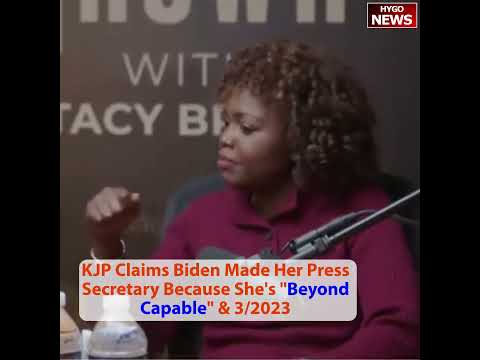
KJP’s “Hypo-Theoreticals” and “Warload” Gaffes Contrast With Her “Beyond Capable” Self-Assessment
This short video compilation highlights two of White House Press Secretary Karine Jean-Pierre’s most notable verbal errors — calling hypotheticals “hypo-theoreticals” and mispronouncing “warlord” as “warload” — and places them alongside her podcast interview in which she described herself as “beyond capable” of serving as the president’s spokesperson. The juxtaposition was sharp and effective: a press secretary who could not pronounce common English words was simultaneously claiming that the Bidens chose her because of her exceptional qualifications.
The two gaffes featured in this clip represented different types of verbal failures, but both pointed to the same underlying issue: Jean-Pierre consistently struggled with vocabulary that her role required her to use fluently and accurately.
The “Hypo-Theoreticals” Gaffe
On August 30, 2023, a reporter asked Jean-Pierre whether President Biden would accept a short-term continuing resolution to fund the government through December. The question was timely and specific, relating to an active congressional debate about government spending.
Jean-Pierre’s response: “That is something — I’m not going to get into hypo-theoreticals. That is something that Congress — Congress should — should kind of decide.”
The word she was attempting to say was “hypotheticals,” one of the most commonly deployed words in the press secretary’s vocabulary. Press secretaries across administrations have used the phrase “I’m not going to get into hypotheticals” as a standard tool for declining to answer speculative questions. It is a word that any press secretary would use multiple times per week, if not per day.
Instead, Jean-Pierre produced “hypo-theoreticals,” a non-word that appeared to be a garbled combination of “hypotheticals” and “theoretical.” The error suggested that Jean-Pierre was not fully processing the word as she spoke it, treating it as a sound pattern to reproduce rather than a word whose meaning and pronunciation she had internalized.
The broader context made the error worse. The reporter’s question was not hypothetical at all. A continuing resolution through December was an option that congressional leaders were actively discussing. Jean-Pierre was using the “hypotheticals” dodge — itself a questionable response to a question about an active legislative proposal — and could not even pronounce the word she was hiding behind.
The “Warload” Gaffe
In a separate briefing, Jean-Pierre was discussing the Wagner Group crisis and the Russian military dynamics surrounding Yevgeny Prigozhin when she mispronounced “warlord” as “warload”: “If we take a step back, if you look back for a second, all of this happened because of dysfunction inside Russia. A Russian warload himself.”
“Warlord” is a straightforward English word with a clear pronunciation and meaning: a military commander, especially one who operates independently of any national government. The word has been used in English for centuries and appears regularly in news coverage of global conflicts.
Jean-Pierre’s substitution of “warload” for “warlord” was notable for several reasons. First, the statement appeared to be prepared or at least based on talking points, meaning Jean-Pierre would have seen the word in written form before speaking it. Second, the topic was serious — the Wagner Group’s armed rebellion against Russian military leadership in June 2023 was one of the most significant geopolitical events of the year. Third, the mispronunciation was not even close to ambiguous; “warload” is a completely different word that does not exist in standard English.
For a White House spokesperson to mispronounce a key term while briefing on a major international crisis undermined the seriousness of the communication and raised questions about her comprehension of the subject matter she was presenting.
Why These Two Gaffes Were Paired
The compilation video paired these two specific gaffes for a reason. Each one alone could be dismissed as a single verbal slip that anyone might make under the pressure of a live briefing. Together, they established a pattern.
“Hypo-theoreticals” was a mispronunciation of a word from Jean-Pierre’s own professional vocabulary — a word she should have used so frequently that its pronunciation was automatic. “Warload” was a mispronunciation of a common English word while discussing a subject of global importance. One was a failure with the tools of her trade; the other was a failure with basic English. Together they painted a picture of someone who was operating at the outer limits of her verbal capacity in a role that demanded verbal precision.
The pattern extended well beyond these two examples. Jean-Pierre’s tenure produced “Noble Prize” (five times for Nobel Prize), “Bi-Carmel” (three times for bicameral), “armtice” (for armistice), “$70 per gallon” (instead of per barrel), and “going out of school” (instead of going off script). Each new example reinforced the impression left by the previous ones.
The “Beyond Capable” Interview
The video placed these gaffes alongside clips from Jean-Pierre’s podcast interview with journalist Stacy Brown, in which she explained why the Bidens chose her as press secretary.
“They decided that they wanted Karine Jean-Pierre, with all of the things, all of the communities that I represent, clearly being a black person, right, being a black woman,” Jean-Pierre told Brown. “They said, we want you to represent us, we want you to represent the White House. We want to meet this moment that we’re in, and we know that you are beyond capable of doing that, right. You are — you are, uh, you are experienced, and you are the voice that we want to have.”
The contrast between calling yourself “beyond capable” and being unable to pronounce “hypotheticals” or “warlord” was the central message of the compilation. Jean-Pierre’s own words framed her selection as being driven primarily by her identity and the communities she represented, with capability mentioned as a secondary consideration. Her performance at the podium then demonstrated that even the secondary consideration was questionable.
Jean-Pierre also told Brown: “Knowing that I am representing the voice of the president, then I have to do that, right? That’s the job.” Her critics argued that mispronouncing basic words, struggling with prepared remarks, and frequently failing to answer reporters’ questions substantively all constituted a failure to do precisely that job.
The Role of the Press Secretary
The White House press secretary is one of the most verbally demanding positions in the federal government. The person who holds the role is expected to speak clearly and precisely, handle rapid-fire questioning from experienced journalists, master a vast range of policy topics, and never create a story through their own verbal errors.
Previous press secretaries of both parties had generally met this standard. They might have been evasive, combative, or misleading, but they rarely made themselves the story through basic pronunciation errors. Jean-Pierre’s tenure broke that pattern by producing a steady stream of viral clips that were not about what she said but about how she failed to say it correctly.
The compilation video underscored that Jean-Pierre’s difficulties were not isolated incidents but a defining characteristic of her time at the podium. The “hypo-theoreticals” and “warload” clips were representative of a much larger body of evidence that accumulated throughout her tenure.
The Broader Debate
The pairing of Jean-Pierre’s gaffes with her “beyond capable” interview fed into a broader national conversation about hiring practices and merit. Jean-Pierre’s own description of her selection emphasized her identity — “clearly being a black person, right, being a black woman” — as a primary factor. Her critics argued that this amounted to an admission that demographic representation had been prioritized over competence.
Supporters countered that Jean-Pierre’s identity was an important form of representation and that press secretaries of previous administrations had also made errors. However, the frequency and nature of Jean-Pierre’s verbal struggles made the comparison difficult to sustain. No previous press secretary had produced such a consistent catalog of basic pronunciation errors during prepared statements.
The debate was never resolved because it touched on questions about affirmative action, meritocracy, and representation that divide Americans along deeply held philosophical lines. What was not debatable was the objective record: Jean-Pierre consistently mispronounced words that her job required her to use accurately, and her own description of why she was hired placed identity ahead of traditional qualifications.
Key Takeaways
- This short video pairs Jean-Pierre’s “hypo-theoreticals” (for hypotheticals) and “warload” (for warlord) mispronunciations with her podcast claim of being “beyond capable.”
- “Hypotheticals” is one of the most commonly used words in the press secretary’s vocabulary, making Jean-Pierre’s mispronunciation of it particularly notable.
- The “warload” error occurred during a briefing on the Wagner Group crisis, one of the most significant geopolitical events of 2023, undermining the seriousness of the communication.
- Jean-Pierre told podcast host Stacy Brown that the Bidens chose her because of the communities she represents, “clearly being a black person, right, being a black woman,” framing identity as a primary selection factor.
- The compilation was part of a larger series documenting the gap between Jean-Pierre’s self-assessment and her documented performance at the White House podium.