 HYGO News
 HYGONews Week's Most Popular Stories 7/4/23, Supreme Court on student loan bailout
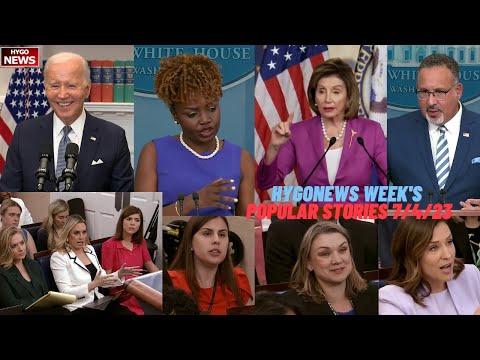
HYGO News Week’s Most Popular Stories — July 4, 2023: Supreme Court Strikes Down Student Loan Bailout
The week of July 4, 2023, was dominated by the Supreme Court’s decision to invalidate President Biden’s $400 billion student loan forgiveness program. The ruling sent shockwaves through the political landscape, prompting angry responses from the President, awkward questions about Nancy Pelosi’s role in the legal reasoning, and heated press briefing exchanges about the fairness of forgiving student loans versus PPP loans. This weekly roundup captures the biggest moments from a week that reshaped the student loan debate.
Supreme Court Invalidates Biden’s Student Loan Program
On June 30, 2023, the Supreme Court put the final nail in the coffin of Biden’s student loan forgiveness plan. The 6-3 ruling in Biden v. Nebraska found that the President exceeded his authority under the HEROES Act in attempting to cancel up to $10,000 in student debt for borrowers earning under $125,000 and up to $20,000 for Pell Grant recipients.
Chief Justice John Roberts delivered the majority opinion, joined by Justices Thomas, Alito, Gorsuch, Kavanaugh, and Barrett. Justice Kagan filed the dissent, joined by Justices Sotomayor and Jackson. In a separate unanimous decision in Department of Education v. Brown, Justice Alito delivered the opinion addressing standing issues.
Biden lashed out at Republicans and rebuked the Supreme Court justices in his response. When a reporter asked, “Did you overstep your authority?” Biden replied as he shuffled away from the lectern: “I think the Court misinterpreted the Constitution.”
Biden Blames Republicans, Calls Ruling “A Mistake”
In a more extended statement, Biden directed his anger squarely at Republicans while dismissing the Court’s legal reasoning.
Biden said: “For Republicans in Congress, this is not about reducing the deficit, it’s not about fairness and forgiving loans, it’s only about forgiving loans they have to pay. Today, the Supreme Court sided with them. I believe the Court’s decision to strike down my student debt relief program was a mistake, was wrong.”
The framing was deliberate. Rather than acknowledging that the Court found his program exceeded executive authority, Biden characterized the ruling as a political act — the Court “siding with” Republicans. This narrative was central to the administration’s strategy of turning the legal defeat into a political weapon against the GOP.
Supreme Court Cites Pelosi Against Biden
In one of the most striking details of the ruling, Chief Justice Roberts and the majority cited former House Speaker Nancy Pelosi’s own words as part of their reasoning for striking down the program.
During a July 2021 press conference, Pelosi had stated unequivocally: “People think that the President of the United States has the power for debt forgiveness. He does not. He can postpone. He can delay. But he does not have that power. That has to be an act of Congress.”
The Court’s inclusion of this quote created a remarkable situation: the most powerful Democrat in Congress had publicly articulated the exact legal position that the conservative majority used to invalidate a Democratic President’s signature education policy. The irony was not lost on observers who noted that borrowers looking for someone to blame could find it within the President’s own party.
”False Hope” Exchange with Reporter
A particularly tense moment came when a reporter directly confronted Biden about whether he had given borrowers false hope by promising relief he lacked the authority to deliver.
The reporter asked: “Mr. President, why did you give millions of borrowers false hope? You’ve dated — doubted your own authority here in the past.”
Biden pushed back firmly: “I didn’t give any false hope. The question was whether or not I would do even more than was requested. What I did, I thought was appropriate and was able to be done and would get done. I didn’t give borrowers false hope. But the Republicans snatched away the hope that it was — they were given. And it’s real — real hope.”
The exchange highlighted the political risk of the administration’s approach. By announcing the program, launching the application website, and pre-approving 16 million borrowers before the legal challenges were resolved, the White House had created concrete expectations that were now dashed. Biden’s insistence that it was not “false hope” but rather hope that was “snatched away” by Republicans was a distinction that may have been lost on the millions of borrowers who received pre-approval notifications for relief they would never receive.
Biden Vows to “Pursue Another” Path
In his closing remarks on the ruling, Biden acknowledged the blow while promising to find alternative routes to relief.
Biden said: “Let me close with this: Our Republican officials say, ‘Student loan relief is a giveaway to the privileged.’ You hear that loud now: ‘the privileged.’ I love the concern for the privileged. But I know who student loan borrowers are in this country. They’re a young — put — putting off buying their first home until they can get out from under their student loans. Hope on the horizon thanks to the relief that I planned last year — today’s Court decision snatched it away from them. I get it. I get it. I hear this. And I’m concerned about it. But today’s decision has closed one path. Now we’re going to pursue another.”
The “another path” Biden referenced would materialize as the SAVE income-driven repayment plan, announced that same day, which restructured payments rather than canceling debt outright.
PPP Loans vs Student Loans Debate
The week also featured the White House’s ongoing defense of comparing student loan forgiveness to the Paycheck Protection Program. A reporter challenged the comparison, noting that PPP loans were designed from the start to be forgiven while student loans were expected to be repaid.
Ramamurti deflected the structural argument and focused on Republican inconsistency: “We never got a single bit of incoming from Republicans saying, ‘Slow down PPP forgiveness.’ In fact, the incoming we got was people saying, ‘Do it faster. Make it easier for people to qualify for forgiveness.’ So, yeah, we think that there is a real tension between that and the idea that if we’re going to try and give $10,000 to a nurse or a firefighter, that that somehow is unacceptable or crosses the line.”
Key Takeaways
- The Supreme Court ruled 6-3 in Biden v. Nebraska to invalidate the $400 billion student loan forgiveness program, with Biden calling it “a mistake” and blaming Republicans rather than acknowledging the Court’s finding that he exceeded executive authority.
- The majority opinion cited Nancy Pelosi’s July 2021 statement that the President “does not” have the power to cancel student debt, using the Democratic Speaker’s own words against her party’s program.
- A reporter directly confronted Biden about giving borrowers “false hope,” with the President insisting Republicans “snatched away” hope rather than acknowledging the legal vulnerability of his approach.
- Biden vowed to “pursue another” path after the ruling, which led to the announcement of the SAVE income-driven repayment plan on the same day.
- The White House continued defending its comparison of student loan forgiveness to PPP loans despite a reporter pointing out the fundamental structural difference that PPP was designed for forgiveness while student loans were expected to be repaid.