 HYGO News
 HUD Sec Turner Terminates Obama-Era AFFH Rule; Jeffries: 'Republicans Are Lying'; Trump Guarantees Entitlements
HUD Sec Turner Terminates Obama-Era AFFH Rule; Jeffries: “Republicans Are Lying”; Trump Guarantees Entitlements
A compilation from late February 2025 captured three distinct political battles playing out simultaneously. HUD Secretary Scott Turner announced the termination of the Obama-era Affirmatively Furthering Fair Housing (AFFH) rule, which he said the Trump administration was ending to “restore power back to our localities and to save our suburbs.” House Minority Leader Hakeem Jeffries accused Republicans of “lying to the American people about Medicaid,” claiming the budget resolution authorized “$880 billion in cuts.” And Trump reiterated his guarantee that Medicare, Medicaid, and Social Security would not be touched — “this will not be ‘read my lips’” — while confirming he would pursue fraud aggressively. UK PM Starmer also praised Trump for creating “the space” that made a Ukraine peace deal possible.
Turner Ends AFFH: “Save Our Suburbs”
HUD Secretary Scott Turner made the announcement that fulfilled one of Trump’s longstanding campaign promises regarding suburban communities.
“This is the Trump administration’s leadership to end Affirmatively Furthering Fair Housing and to restore power back to our localities and to save our suburbs,” Turner said.
The AFFH rule, originally implemented under the Obama administration in 2015, required communities receiving federal housing funds to analyze patterns of segregation and take active steps to promote integration. In practice, critics argued, the rule gave the federal government leverage to force suburban communities to build low-income housing developments, overriding local zoning decisions and community preferences.
Trump had suspended the rule during his first term but had not formally terminated it. Biden had moved to reinstate and strengthen AFFH requirements. Turner’s announcement represented the definitive end of the policy under the current administration.
The political significance of AFFH termination extended beyond housing policy. During the 2020 and 2024 campaigns, Trump had explicitly warned suburban voters that Democratic housing policies would change the character of their neighborhoods by forcing high-density, low-income housing into areas zoned for single-family homes. The argument had resonated particularly with suburban women and homeowners concerned about property values and community safety. Turner’s action delivered on that warning by removing the federal tool that enabled the policy.
The framing — “restore power back to our localities” — positioned the termination as a federalism issue rather than a racial one. Local communities, not Washington bureaucrats, would decide their own zoning and housing policies. The decision about what kind of development to allow in a suburban neighborhood would be made by the people who lived there, not by HUD administrators applying a federal formula.
Jeffries: “$880 Billion in Cuts”
House Minority Leader Hakeem Jeffries launched a forceful counterattack on the Republican budget resolution, accusing the majority of planning to gut Medicaid.
“Republicans are lying to the American people about Medicaid,” Jeffries said. “The Republican budget authorizes up to $880 billion in cuts to Medicaid by directing the Energy and Commerce Committee to find those spending cuts.”
He painted the picture of who would be affected: “That means Medicaid — that will hurt children, hurt families, hurt everyday Americans with disabilities, and hurt seniors.”
Jeffries issued a direct challenge: “I can’t say it any other way. Republicans are lying. Prove me wrong. There’s nothing more that I would like better, that we as House Democrats would like better, than for Republicans to prove us wrong that they are not planning to cut Medicaid.”
The $880 billion figure referred to the spending reduction target that the budget resolution assigned to the House Energy and Commerce Committee, which had jurisdiction over Medicaid. Democrats argued that the only way to achieve cuts of that magnitude within the committee’s jurisdiction was to reduce Medicaid benefits or eligibility. Republicans countered that the savings could come from eliminating fraud, reducing waste, and reforming program administration without cutting benefits for eligible recipients.
The Medicaid debate was one of the most politically sensitive elements of the reconciliation process. Medicaid covered approximately 90 million Americans, including children, pregnant women, elderly nursing home residents, and people with disabilities. Any perception that Republicans intended to cut benefits for these populations could be politically devastating, which was why Trump was simultaneously and repeatedly guaranteeing that entitlements would not be touched.
Trump: “This Will Not Be ‘Read My Lips’”
Trump addressed the entitlement question with the same emphatic guarantee he had been delivering at every opportunity.
“Can you guarantee that Medicare, Medicaid, and Social Security will not be touched?” a reporter asked.
“Yeah, I mean, I have said it so many times. You shouldn’t be asking me that question, okay?” Trump responded. “This will not be ‘read my lips.’ It won’t be ‘read my lips’ anymore. We’re not going to touch it.”
The George H.W. Bush reference — his famous “read my lips, no new taxes” pledge that he subsequently broke — was Trump’s way of saying his guarantee was not the kind of empty promise that politicians routinely made and discarded. He was staking his credibility on the commitment.
Trump then drew the line that distinguished benefit protection from fraud enforcement. “Now, we are going to look for fraud,” he said. “I’m sure you’re okay with that — like people that shouldn’t be on, people that are illegal aliens and others.”
He cited the specific example that had become a recurring DOGE talking point: “You see that immediately when you see people that are 200 years old that are being sent checks for Social Security. Some of them are actually being sent checks.”
Trump pointed to the enforcement mechanism: “So we’re tracing that down, and I have a feeling that Pam is going to do a very good job with that. But you have a lot of fraud.”
He concluded definitively: “But no, I’m not — we’re not doing anything.”
The dual message — absolute protection for legitimate beneficiaries, aggressive pursuit of fraud — was the administration’s answer to both the Jeffries critique and the media’s persistent questioning. Benefits would be maintained. Fraud would be eliminated. The two were not in conflict; they were complementary.
Starmer on Ukraine: “The Space You Created”
PM Starmer offered another endorsement of Trump’s Ukraine peace efforts, this time with more specific language about the UK’s role in ensuring any deal lasted.
“The deal, if we get it, is going to be hugely important,” Starmer said. “I don’t think it would have happened if the space hadn’t been created for it by yourself.”
The phrase “the space you created” was diplomatically significant. Starmer was crediting Trump not just with negotiating a deal but with creating the conditions — the diplomatic environment, the leverage, the credibility — that made negotiations possible in the first place. The “space” was what three years of Biden-era policy had failed to create.
Starmer then addressed the critical question of enforcement. “If there’s a deal, we’ve got to make sure it’s a deal that lasts, that is not temporary but lasts,” he said. “And that’s why we need to make sure that it’s secure. And we’ve leaned in and said we’ll play our part.”
He committed the UK to the enforcement framework: “We’ve talked and we will talk about how we work with yourself, Mr. President, to ensure that this deal is something which is not violated. Because it’s very important — if there is a deal, we keep it.”
The UK’s commitment to enforcing a peace deal added a major European military power to the post-war security architecture. Britain’s nuclear deterrent, its intelligence capabilities, and its military deployability made it a credible guarantor of any settlement terms.
Sanctions on the UK?
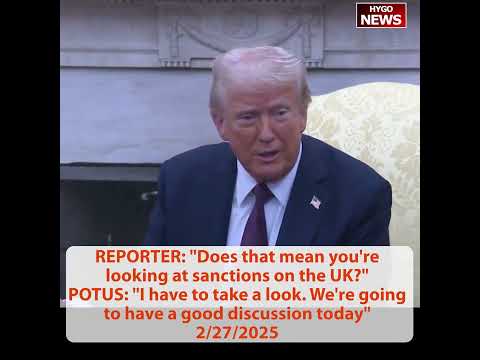
A reporter asked whether Trump was considering sanctions on the United Kingdom. Trump’s response was carefully noncommittal.
“Well, I have to take a look,” Trump said. “I mean, we’re going to have a good discussion today.” He gestured to Secretary Rubio: “And we have some very talented people on the other side. And we have some people that probably aren’t as talented as them, but they’re pretty good. Marco, what do you think? Our people are pretty good.”
The sanctions question may have been related to UK free speech regulations that affected American tech companies, or to other bilateral issues. Trump’s refusal to rule sanctions out maintained leverage while his warm tone toward Starmer suggested the topic would be resolved cooperatively rather than coercively.
Key Takeaways
- HUD Secretary Turner terminated the Obama-era AFFH rule, ending federal requirements that pushed low-income housing into suburbs, saying the move would “restore power back to our localities.”
- Jeffries accused Republicans of “lying about Medicaid,” claiming the budget resolution authorized “$880 billion in cuts” that would “hurt children, families, and seniors.”
- Trump guaranteed entitlements would not be cut — “this will not be ‘read my lips’” — while confirming aggressive fraud enforcement against payments to “people that are 200 years old.”
- Starmer credited Trump with creating “the space” that made a Ukraine peace deal possible and committed the UK to ensuring any agreement “is not violated.”
- Trump declined to rule out sanctions on the UK but signaled the issue would be resolved through “good discussion” rather than confrontation.